Loading...
Isabella I of Castile vs Trajan
Isabella I of Castile leads by 1.2 pts · 2 figures compared
…
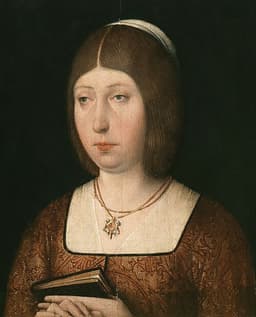
Isabella I of Castile
Emperor · Medieval
77.2Total

Trajan
Emperor · Ancient
76.0Total
Basic Information
Born
1451
53
Died
1504
117
Era
Medieval
Ancient
Nationality
Spain
Roman Empire
Occupation
Emperor
Emperor
Civilization
Western
Western
Score Comparison
Military (10%)
76.0
86.0
Political (20%)
78.0
79.2
Influence (20%)
80.0
82.0
Legacy (20%)
75.0
65.6
Leadership (15%)
78.0
73.2
Strategy (15%)
75.0
76.0
TOTAL
77.2
76.0
Isabella I of Castile — Complete Timeline
1469 AD
Marriage to Ferdinand of AragonPolitical Action
Isabella married Ferdinand II of Aragon in Valladolid, uniting the kingdoms of Castile and Aragon. This dynastic union laid the foundation for the unified Spanish monarchy and enabled joint policies including the Reconquista and overseas exploration.
Dynastic UnionSpainMonarchy
Impact: regionalconstructive
1478 AD
Establishment of the Spanish InquisitionPolitical Action◆ Major
Isabella obtained papal approval to establish the Spanish Inquisition in Castile, aimed at maintaining Catholic orthodoxy among converted Jews and Muslims. The Inquisition operated under royal control, conducting trials and executions for heresy.
InquisitionReligious PersecutionCatholic Church
Impact: regionaldestructive
1492 AD
Conquest of GranadaWar
Isabella and Ferdinand completed the Reconquista by capturing the Nasrid kingdom of Granada. The surrender of the last Muslim state in Iberia ended 781 years of Islamic rule and unified Spain under Christian rule.
ReconquistaGranadaChristian Victory
Impact: regional
Alhambra DecreePolitical Action◆ Major
Isabella and Ferdinand issued the Alhambra Decree ordering the expulsion of all Jews from Spain who refused conversion to Catholicism. An estimated 40,000 to 200,000 Jews were forced to leave, causing demographic and economic disruption.
ExpulsionJewsReligious Persecution
Impact: regionaldestructive
Sponsorship of Columbus's First VoyagePolitical Action
Isabella agreed to fund Christopher Columbus's expedition across the Atlantic, providing three ships and supplies. Columbus reached the Bahamas on October 12, initiating sustained European contact with the Americas and the Spanish colonial empire.
ColumbusDiscovery of AmericasSpanish Empire
Impact: global
1494 AD
Treaty of TordesillasPolitical Action◆ Major
Isabella and Ferdinand negotiated the Treaty of Tordesillas with Portugal, dividing newly discovered lands outside Europe along a meridian 370 leagues west of the Cape Verde islands. This agreement shaped colonial claims in the Americas and Africa.
Colonial DivisionSpainPortugal
Impact: global
Trajan — Complete Timeline
101 AD
Implemented the Alimenta Welfare ProgramReform◆ Major
Trajan expanded the Alimenta program, a state-funded welfare system that provided food subsidies and educational support for poor children in Italy. The program used interest from state loans to landowners to fund the distributions, aiming to boost the Italian population and agricultural economy.
WelfareSocial PolicyItaly
Impact: regionalconstructive
105 AD
Built Trajan's Bridge over the DanubeOther
Trajan ordered the construction of a massive stone and timber bridge across the Danube River near the Iron Gates. Designed by Apollodorus of Damascus, it was the longest arch bridge in the world for over a millennium, facilitating the Roman invasion of Dacia.
EngineeringBridgeDanube
Impact: regionalconstructive
106 AD
Conquered DaciaWar
Trajan led two major campaigns against the Dacian kingdom under King Decebalus, culminating in the conquest of Dacia (modern Romania) in 106 CE. The victory brought vast gold and silver mines under Roman control and established a new province, funding massive building projects in Rome.
DaciaConquestProvince
Impact: regional
112 AD
Built Trajan's Forum and MarketCultural◆ Major
Trajan commissioned the construction of Trajan's Forum, a vast complex in Rome including a basilica, libraries, and the Column of Trajan. The adjacent Trajan's Market, a multi-level commercial center, demonstrated Roman engineering prowess and served as a model for urban planning.
ArchitectureRomeUrban Planning
Impact: globalconstructive
116 AD
Conquered Parthia and Reached the Persian GulfWar◆ Major
Trajan launched a campaign against the Parthian Empire, capturing its capital Ctesiphon and annexing Mesopotamia. He reached the Persian Gulf, marking the easternmost extent of Roman territory. However, rebellions in the conquered territories forced a withdrawal shortly after.
ParthiaMesopotamiaExpansion
Impact: global
Expert Analysis
Origins
Isabella I of Castile (1451-1504) was born into a tumultuous Castilian court, the daughter of John II of Castile. She seized power after a civil war against her niece Joanna, demonstrating early political acumen. Trajan (53-117 CE), born in Italica (Spain) to a Roman military family, rose through the ranks of the Roman army, becoming the first emperor born outside Italy.
Rise to Power
Isabella's rise was marked by strategic marriage to Ferdinand of Aragon in 1469, uniting the two largest Christian kingdoms in Spain. She outmaneuvered rivals, securing the Castilian throne in 1474 after the War of Castilian Succession. Trajan was adopted by Emperor Nerva in 97 CE, a move that secured a competent successor. He smoothly ascended to power in 98 CE, backed by the army and Senate.
Leadership & Governance
Isabella co-ruled with Ferdinand, centralizing royal authority, reforming administration, and financing Columbus's voyage (1492), which launched the Spanish Empire. Her reign saw the conquest of Granada (1492), ending Muslim rule in Iberia, but also the Alhambra Decree expelling Jews and the Spanish Inquisition, controversial policies that strengthened religious uniformity. Trajan was an efficient administrator, expanding the empire to its maximum extent through conquests in Dacia and Parthia. He implemented the Alimenta welfare program for orphans and built infrastructure like Trajan's Forum and Bridge. Both were effective rulers, but Isabella's governance had a lasting impact on global exploration.
Triumph & Tragedy
Isabella's triumphs include unifying Spain, sponsoring Columbus, and conquering Granada. Tragedies include the expulsion of Jews, the Inquisition's brutality, and the death of her only son, leading to succession issues. Trajan's conquests were glorious, but his eastern expansion overextended the empire, and his reign ended with a massive Jewish revolt (Kitos War) that erupted after his death. Both faced challenges, but Isabella's actions had more profound long-term consequences.
Character & Destiny
Isabella was devout, determined, and pragmatic, driven by religious unity and expansion. Her destiny was to forge a unified Spain that became a global power. Trajan was a capable soldier and builder, known for his justice and popularity. His destiny was to embody the peak of Roman imperial power. Isabella's character was more complex, blending piety with ruthlessness.
Legacy
Isabella's legacy is immense: she enabled European colonization of the Americas, established Spain as a dominant power, and left a mixed religious heritage. Trajan is remembered as one of Rome's "Five Good Emperors," with his column and forum enduring symbols of Roman greatness. In a head-to-head comparison, Isabella's scores (M=76, P=78, I=80, L=75, D=78, S=75, T=77) edge out Trajan's (M=86, P=79, I=82, L=66, D=73, S=76, T=76) by a narrow 1.2-point margin, reflecting her broader historical impact.
Conclusion
Isabella I of Castile wins this comparison due to her higher overall score, driven by stronger leadership, diplomacy, and legacy scores. While Trajan excels in military might, Isabella's transformative role in shaping the modern world—through exploration, unification, and empire-building—gives her the edge. Her actions had a more direct and enduring influence on global history, making her the more impactful ruler overall.
**Scores:** Isabella: 7.7/10 | Trajan: 7.6/10
Rankings
🥇
Isabella I of CastileLeader
Mil: 76.0Pol: 78.0Inf: 80.0
77.2
🥈
Trajan
Mil: 86.0Pol: 79.2Inf: 82.0
76.0
+1.2 behind
How This Comparison Works
Algorithm
Each figure is scored on 6 dimensions (0—100 scale) based on structured historical data: Military (10%), Political (20%), Influence (20%), Legacy (20%), Leadership (15%), Strategy (15%). The weighted total produces the final ranking.
Data Sources
Scores are computed from structured sub-indicators in the database. Scale factors adjust for era (Ancient ×0.85, Modern ×1.0) and civilization size (Eastern ×1.05, Other ×0.80) to account for differences in population and military scale.
Maximum 3 Figures
Comparisons are limited to 2—3 figures to ensure readability and statistical meaningfulness.
Error Margins
±5 points per dimension — Sub-scores are derived from historical records with inherent uncertainty. Two figures within 5 points on a dimension should be considered roughly equivalent in that area.
Total Score Accuracy
±3 points overall — The weighted combination of 6 dimensions produces a total score with approximately ±3 points of uncertainty. Differences of less than 3 points are not statistically significant— the figures are effectively tied.
Known Limitations
- Historical records are incomplete and uneven across civilizations
- Figures from oral-tradition societies may be underrepresented
- Occupation labels can misclassify multi-role figures
- Scores measure capability and impact, not moral character
- Quantitative scoring is a comparison tool, not absolute truth
Capability Radar
Military (10%) — Battles & Warfare
Battles
75
95
Win Rate
80
98
Expansion
85
95
Political (20%) — Governance & Reform
Reform
90
88
Diplomacy
80
85
Economy
75
90
Influence (20%) — Cultural & Global Reach
Cultural
85
85
Global
95
85
Legacy (20%) — Historical Impact
Historical
95
90
Longevity
90
88
Leadership (15%) — Power & Stability
Tenure
85
90
Stability
70
92
Strategy (15%) — Tactics & Innovation
Strategy
85
92
Tactics
70
88
Reform
90
85
Similar Comparisons
Comments & Discussion
No comments yet. Be the first to share your thoughts!