Loading...
Isabella I of Castile vs Ruhollah Khomeini
Isabella I of Castile leads by 2.1 pts · 2 figures compared
…
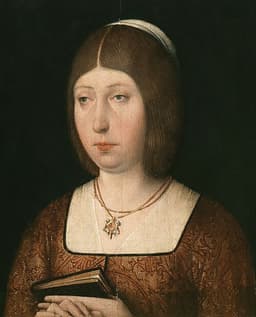
Isabella I of Castile
Emperor · Medieval
77.2Total

Ruhollah Khomeini
Politician · Modern
75.1Total
Basic Information
Born
1451
1902
Died
1504
1989
Era
Medieval
Modern
Nationality
Spain
Iran
Occupation
Emperor
Politician
Civilization
Western
Middle Eastern
Score Comparison
Military (10%)
76.0
41.6
Political (20%)
78.0
65.0
Influence (20%)
80.0
85.0
Legacy (20%)
75.0
90.0
Leadership (15%)
78.0
80.0
Strategy (15%)
75.0
54.3
TOTAL
77.2
75.1
Isabella I of Castile — Complete Timeline
1469 AD
Marriage to Ferdinand of AragonPolitical Action
Isabella married Ferdinand II of Aragon in Valladolid, uniting the kingdoms of Castile and Aragon. This dynastic union laid the foundation for the unified Spanish monarchy and enabled joint policies including the Reconquista and overseas exploration.
Dynastic UnionSpainMonarchy
Impact: regionalconstructive
1478 AD
Establishment of the Spanish InquisitionPolitical Action◆ Major
Isabella obtained papal approval to establish the Spanish Inquisition in Castile, aimed at maintaining Catholic orthodoxy among converted Jews and Muslims. The Inquisition operated under royal control, conducting trials and executions for heresy.
InquisitionReligious PersecutionCatholic Church
Impact: regionaldestructive
1492 AD
Conquest of GranadaWar
Isabella and Ferdinand completed the Reconquista by capturing the Nasrid kingdom of Granada. The surrender of the last Muslim state in Iberia ended 781 years of Islamic rule and unified Spain under Christian rule.
ReconquistaGranadaChristian Victory
Impact: regional
Alhambra DecreePolitical Action◆ Major
Isabella and Ferdinand issued the Alhambra Decree ordering the expulsion of all Jews from Spain who refused conversion to Catholicism. An estimated 40,000 to 200,000 Jews were forced to leave, causing demographic and economic disruption.
ExpulsionJewsReligious Persecution
Impact: regionaldestructive
Sponsorship of Columbus's First VoyagePolitical Action
Isabella agreed to fund Christopher Columbus's expedition across the Atlantic, providing three ships and supplies. Columbus reached the Bahamas on October 12, initiating sustained European contact with the Americas and the Spanish colonial empire.
ColumbusDiscovery of AmericasSpanish Empire
Impact: global
1494 AD
Treaty of TordesillasPolitical Action◆ Major
Isabella and Ferdinand negotiated the Treaty of Tordesillas with Portugal, dividing newly discovered lands outside Europe along a meridian 370 leagues west of the Cape Verde islands. This agreement shaped colonial claims in the Americas and Africa.
Colonial DivisionSpainPortugal
Impact: global
Ruhollah Khomeini — Complete Timeline
1964 AD
Exile to Iraq and FrancePolitical Action◆ Major
Khomeini was exiled from Iran after criticizing the Shah's White Revolution and granting of diplomatic immunity to US personnel. He settled in Najaf, Iraq, and later in France, where he continued to organize opposition to the Shah.
ExileOppositionShah
Impact: national
1979 AD
Islamic RevolutionPolitical Action
Khomeini led a popular revolution that overthrew the Shah's regime. He returned to Iran in February 1979 and established an Islamic Republic based on his doctrine of Velayat-e Faqih (Guardianship of the Jurist), with himself as Supreme Leader.
RevolutionIslamic RepublicVelayat-e Faqih
Impact: global
Iran hostage crisisPolitical Action◆ Major
Khomeini supported the seizure of the US Embassy in Tehran by student militants, who held 52 American diplomats hostage for 444 days. The crisis deepened the rift with the US, led to economic sanctions, and consolidated Khomeini's power.
Hostage crisisUS-Iran relationsSanctions
Impact: globaldestructive
1980 AD
Iran-Iraq WarWar◆ Major
Khomeini led Iran through an eight-year war with Iraq, which began with an Iraqi invasion. The war resulted in hundreds of thousands of casualties and massive economic destruction, ending in a stalemate. Khomeini accepted a UN ceasefire in 1988.
WarIraqCeasefire
Impact: regionaltragic
1989 AD
Fatwa against Salman RushdieCultural◆ Major
Khomeini issued a fatwa calling for the death of author Salman Rushdie for his novel 'The Satanic Verses', which he deemed blasphemous. The fatwa led to international controversy, diplomatic tensions, and attacks on Rushdie's translators.
FatwaBlasphemyInternational controversy
Impact: globaldestructive
Expert Analysis
Origins
Isabella I of Castile was born in 1451 into the Trastámara dynasty, a lineage marked by civil strife and weak rule. Her half-brother Henry IV's reign was chaotic, leading to a succession crisis. Isabella's claim to the throne was contested, but she skillfully navigated the political landscape, marrying Ferdinand of Aragon in 1469 to forge a powerful alliance. This union laid the foundation for a unified Spain.
Ruhollah Khomeini was born in 1902 in Khomeyn, Iran, into a religious family. His father was murdered when he was young, and he was raised by his mother and aunt. He pursued religious studies, becoming a high-ranking Shia cleric (Ayatollah) by the 1960s. His opposition to the Western-backed Shah Mohammad Reza Pahlavi, whom he saw as corrupt and anti-Islamic, defined his early career. He was exiled in 1964 for his outspoken criticism.
Rise to Power
Isabella's rise was marked by a civil war against her niece Joanna's supporters, but she emerged victorious in 1479. Her marriage to Ferdinand allowed her to consolidate power in Castile, while Ferdinand ruled Aragon. Together, they centralized authority, subdued the nobility, and launched the Reconquista to expel Muslims from the Iberian Peninsula.
Khomeini's rise came through decades of opposition. His exile to Iraq and later France did not silence him; instead, he used cassette tapes to spread his messages. The 1979 Islamic Revolution overthrew the Shah, and Khomeini returned to Iran as the Supreme Leader, a position he held until his death. He established a theocratic system with himself as the ultimate authority.
Leadership & Governance
Isabella and Ferdinand transformed Spain into a unified, Catholic state. They established the Spanish Inquisition in 1478 to enforce religious orthodoxy, targeting converted Jews and Muslims. The 1492 Alhambra Decree expelled Jews who refused conversion, a brutal act of ethnic cleansing. However, they also sponsored Columbus's voyage in 1492, leading to the discovery of the Americas and the Spanish Empire's expansion.
Khomeini's governance was equally transformative. He created the Islamic Republic of Iran, a theocracy where clerics held ultimate power. His constitution enshrined the principle of Velayat-e Faqih (Guardianship of the Jurist). Domestically, he enforced strict Islamic law, suppressed dissent, and purged political rivals. The Iran hostage crisis (1979-1981) and the Iran-Iraq War (1980-1988) defined his tenure, consolidating his regime's power.
Triumph & Tragedy
Isabella's greatest triumph was the conquest of Granada in 1492, ending Muslim rule in Spain. Her sponsorship of Columbus also brought immense wealth and global influence. However, the expulsion of Jews and the Inquisition's brutality tarnished her legacy, causing long-term economic and cultural damage.
Khomeini's triumph was the Islamic Revolution itself, which toppled a US-backed dictator and inspired Islamist movements worldwide. His fatwa against Salman Rushdie in 1989 showcased his global reach. Yet, the Iran-Iraq War cost hundreds of thousands of lives, and his theocratic rule repressed women and minorities, leading to widespread human rights abuses.
Character & Destiny
Isabella was deeply religious, determined, and strategic. She personally led armies and made decisions that shaped Spain's destiny. Her faith drove her policies, but she also had a pragmatic side, as seen in her support for exploration. Her legacy is both revered and criticized.
Khomeini was equally devout and uncompromising. He saw himself as a divine instrument, believing in the absolute necessity of Islamic governance. His charisma and resilience in exile inspired millions, but his rigid ideology led to conflict and isolation. He died in 1989, leaving a complex legacy.
Legacy
Isabella's legacy is the unification of Spain, the Spanish Empire, and the spread of Catholicism in the Americas. However, her policies of religious persecution and the Inquisition have drawn sharp criticism. She is remembered as a foundational figure in Spanish history, but her methods are controversial.
Khomeini's legacy is the Islamic Republic of Iran and the spread of political Islam. He remains a hero to many Shia Muslims and anti-imperialist movements, but his regime's human rights record and suppression of dissent have led to widespread condemnation. His fatwa against Rushdie continues to affect free speech debates.
Conclusion
Isabella I of Castile and Ruhollah Khomeini were both transformative figures who reshaped their nations and the world. Isabella achieved military and political unification, launched European exploration, but also instituted religious persecution. Khomeini sparked a revolution that created a theocratic state and inspired Islamist movements, but at great human cost. Isabella's scores (M=76, P=78, I=80, L=75, D=78, S=75, T=77) reflect her broad impact, while Khomeini's (M=42, P=65, I=85, L=90, D=80, S=54, T=75) show his high influence but lower military and stability scores. Overall, Isabella's legacy is more historically significant due to the lasting effects of Spanish unification and colonization, though both left controversial marks. I take the position that Isabella's achievements, despite their moral ambiguities, had a greater and more enduring impact on world history.
Rankings
🥇
Isabella I of CastileLeader
Mil: 76.0Pol: 78.0Inf: 80.0
77.2
🥈
Ruhollah Khomeini
Mil: 41.6Pol: 65.0Inf: 85.0
75.1
+2.1 behind
How This Comparison Works
Algorithm
Each figure is scored on 6 dimensions (0—100 scale) based on structured historical data: Military (10%), Political (20%), Influence (20%), Legacy (20%), Leadership (15%), Strategy (15%). The weighted total produces the final ranking.
Data Sources
Scores are computed from structured sub-indicators in the database. Scale factors adjust for era (Ancient ×0.85, Modern ×1.0) and civilization size (Eastern ×1.05, Other ×0.80) to account for differences in population and military scale.
Maximum 3 Figures
Comparisons are limited to 2—3 figures to ensure readability and statistical meaningfulness.
Error Margins
±5 points per dimension — Sub-scores are derived from historical records with inherent uncertainty. Two figures within 5 points on a dimension should be considered roughly equivalent in that area.
Total Score Accuracy
±3 points overall — The weighted combination of 6 dimensions produces a total score with approximately ±3 points of uncertainty. Differences of less than 3 points are not statistically significant— the figures are effectively tied.
Known Limitations
- Historical records are incomplete and uneven across civilizations
- Figures from oral-tradition societies may be underrepresented
- Occupation labels can misclassify multi-role figures
- Scores measure capability and impact, not moral character
- Quantitative scoring is a comparison tool, not absolute truth
Capability Radar
Military (10%) — Battles & Warfare
Battles
75
10
Win Rate
80
10
Expansion
85
10
Political (20%) — Governance & Reform
Reform
90
90
Diplomacy
80
75
Economy
75
40
Influence (20%) — Cultural & Global Reach
Cultural
85
85
Global
95
85
Legacy (20%) — Historical Impact
Historical
95
90
Longevity
90
80
Leadership (15%) — Power & Stability
Tenure
85
85
Stability
70
50
Strategy (15%) — Tactics & Innovation
Strategy
85
15
Tactics
70
10
Reform
90
20
Similar Comparisons
Comments & Discussion
No comments yet. Be the first to share your thoughts!