Loading...
Isaac II Angelos vs Richard the Lionheart
Richard the Lionheart leads by 16.4 pts · 2 figures compared
…
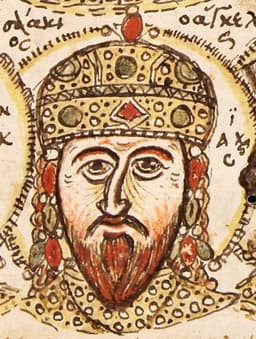
Isaac II Angelos
Emperor · Medieval
35.4Total

Richard the Lionheart
Emperor · Medieval
51.8Total
Basic Information
Born
1156
1157
Died
1204
1199
Era
Medieval
Medieval
Nationality
Byzantine Empire
England
Occupation
Emperor
Emperor
Civilization
Western
Western
Score Comparison
Military (10%)
10.2
70.0
Political (20%)
32.1
32.2
Influence (20%)
45.5
56.7
Legacy (20%)
38.3
52.0
Leadership (15%)
31.2
51.9
Strategy (15%)
39.6
50.0
TOTAL
35.4
51.8
Isaac II Angelos — Complete Timeline
1185 AD
Accession as emperor after overthrowing Andronikos IPolitical Action◆ Major
Isaac II Angelos led a popular revolt that overthrew Andronikos I Komnenos, and was proclaimed emperor. His accession ended the Komnenian dynasty's rule and began the Angelid dynasty, but the empire was weakened by internal strife and external threats.
RevoltDynastic ChangePopular Uprising
Impact: national
1190 AD
Defeat at the Battle of TryavnaWar◆ Major
Isaac II led a campaign against the Bulgarian rebels under Ivan Asen I and Peter IV. The Byzantine army was ambushed and defeated at Tryavna, with Isaac barely escaping. The defeat solidified the Second Bulgarian Empire's independence from Byzantine rule.
Byzantine-Bulgarian WarsMilitary DefeatRebellion
Impact: regionaldestructive
1195 AD
Blinding and deposition by Alexios III AngelosPolitical Action◆ Major
Isaac II was overthrown and blinded by his brother Alexios III Angelos in a palace coup. Isaac was imprisoned, and Alexios III seized the throne. The blinding was a traditional Byzantine punishment for usurpers, but it left Isaac incapacitated and the empire divided.
CoupDynastic ConflictBlinding
Impact: nationaltragic
1203 AD
Restoration and flight during the Fourth CrusadePolitical Action◆ Major
Isaac II was restored to the throne by the Fourth Crusade, alongside his son Alexios IV Angelos, after the crusaders besieged Constantinople. However, the restored regime failed to pay the promised rewards to the crusaders, leading to renewed conflict and Isaac's death in prison in 1204.
Fourth CrusadeRestorationSiege of Constantinople
Impact: regionaltragic
Richard the Lionheart — Complete Timeline
1191 AD
Siege of AcreWar◆ Major
Richard I led English forces in the siege of Acre during the Third Crusade. After the city surrendered, Richard ordered the execution of 2,700 Muslim prisoners when Saladin failed to meet ransom terms. The victory secured a key port for the crusaders.
Third CrusadeSiegeExecution
Impact: regionaldestructive
Battle of ArsufWar◆ Major
Richard I defeated Saladin's forces at Arsuf in Palestine. Richard's disciplined infantry and cavalry repelled repeated Muslim attacks. The victory allowed the crusaders to secure the coast and march toward Jerusalem without further major engagements.
Third CrusadeBattleSaladin
Impact: regional
1192 AD
Treaty of JaffaPolitical Action◆ Major
Richard I and Saladin signed a three-year truce at Jaffa. The treaty granted crusader control of the coastal strip from Tyre to Jaffa and guaranteed safe passage for Christian pilgrims to Jerusalem. Richard then departed for Europe.
Third CrusadeTreatyTruce
Impact: regionalconstructive
Capture and Imprisonment in AustriaPolitical Action◆ Major
Richard I was captured near Vienna by Duke Leopold V of Austria, whom he had insulted during the crusade. Leopold handed Richard to Emperor Henry VI. Richard was imprisoned until 1194, when England paid a ransom of 150,000 marks.
ImprisonmentRansomAustria
Impact: regionaltragic
Expert Analysis
Origins
Isaac II Angelos was born around 1156 into the Angelos family, a minor Byzantine aristocratic clan. His early life was marked by the decline of the Komnenian dynasty under Andronikos I. Isaac's family background provided him with connections but not the rigorous military training typical of Komnenian emperors. He rose to prominence not through military prowess but through a popular revolt in 1185 after Andronikos I's oppressive rule sparked widespread discontent.
Richard the Lionheart was born on September 8, 1157, at Beaumont Palace, Oxford, the third son of King Henry II of England and Eleanor of Aquitaine. From childhood, Richard was groomed for leadership, inheriting Aquitaine from his mother and gaining military experience in his father's campaigns against rebellious barons. His upbringing instilled a chivalric ethos and a focus on martial excellence.
Rise to Power
Isaac II's rise was sudden and chaotic. In September 1185, a mob in Constantinople proclaimed Isaac emperor after he killed Stephen Hagiochristophorites, a hated official. Isaac then led a revolt that overthrew Andronikos I, who was brutally killed. Isaac was crowned on September 12, 1185. His accession ended the Komnenian dynasty but left him with a depleted treasury and a fractured empire.
Richard's path to power was more deliberate. He rebelled against his father Henry II in 1173-1174, and later allied with King Philip II of France against Henry. After Henry's death in 1189, Richard became king of England, Duke of Normandy, and Count of Anjou. He immediately began preparations for the Third Crusade, selling offices and lands to raise funds. His coronation on September 3, 1189, was marred by anti-Jewish riots, which Richard swiftly punished.
Leadership & Governance
Isaac II's governance was marked by incompetence and corruption. He failed to maintain the administrative reforms of the Komnenoi, allowing provincial governors to become virtually independent. His military leadership was poor: at the Battle of Tryavna in 1190, he led a campaign against Bulgarian rebels under Ivan Asen I and Peter IV. The Byzantine army was ambushed and defeated, with Isaac barely escaping. His reign saw the loss of Cyprus to Isaac Komnenos and the rise of Bulgarian and Serbian independence.
Richard, on the other hand, was a capable military commander but an absentee ruler. He spent only six months of his ten-year reign in England, leaving governance to regents. His taxation policies, including the 'Saladin tithe,' funded the crusade but caused resentment. Richard's leadership style was autocratic and focused on warfare. He scored 51.9 in leadership, reflecting his ability to command armies, but his political score of 32.2 indicates his neglect of domestic affairs.
Triumph & Tragedy
Isaac II's greatest triumph was overthrowing Andronikos I, ending a tyranny. However, his reign was a cascade of failures: the loss of Cyprus, the Bulgarian rebellion, and his own deposition. In 1195, his brother Alexios III overthrew and blinded him, imprisoning him for eight years. His restoration in 1203 by the Fourth Crusade was a tragedy: the crusaders, ostensibly restoring Isaac and his son Alexios IV, instead sacked Constantinople in 1204, ending the Byzantine Empire's central authority.
Richard's triumphs include the capture of Acre in 1191 and the victory at Arsuf on September 7, 1191, where his disciplined infantry and cavalry repelled Saladin's attacks. He also negotiated the Treaty of Jaffa in 1192, securing a three-year truce and crusader control of the coast. However, his failure to recapture Jerusalem and his capture near Vienna in 1192 by Duke Leopold V (whom he had insulted) were major setbacks. Richard was imprisoned for over a year and ransomed for 150,000 marks.
Character & Destiny
Isaac II was indecisive and easily influenced, surrounded by corrupt officials. His character led to a weak central authority, inviting external threats. He scored 39.6 in strategy, reflecting poor planning, and 10.2 in military, the lowest of any Byzantine emperor. His destiny was sealed by his inability to control the empire's decline.
Richard was courageous but arrogant, earning enemies like Leopold and Philip II. His chivalric ideals drove him to crusade but also led to reckless decisions, such as insulting Leopold. He scored 70.0 in military, among the highest of his era, but his political score of 32.2 shows his neglect of domestic stability. His character ensured his legacy as a warrior king but also limited his long-term impact.
Legacy
Isaac II's legacy is largely negative: his reign accelerated the Byzantine Empire's collapse. The Fourth Crusade's sack of Constantinople in 1204, which occurred partly due to his restoration, fragmented the empire into successor states. He is remembered as a symbol of Byzantine decline. His total score of 35.4 reflects this.
Richard's legacy is more complex. He is celebrated as a military hero, especially in England and France, but his reign left England financially drained. His military achievements influenced medieval warfare, and his participation in the Third Crusade shaped Christian-Muslim relations. Richard scored 52.0 in legacy, higher than Isaac's 38.3. However, his failure to secure Jerusalem and his short reign limit his overall impact.
Conclusion
Richard the Lionheart had greater impact than Isaac II Angelos. Richard's military score of 70.0 versus Isaac's 10.2, and his overall score of 51.8 versus 35.4, demonstrate his superior effectiveness. Richard's actions, though flawed, shaped the course of the Crusades and left a lasting cultural legacy. Isaac's reign, marked by incompetence, directly contributed to the collapse of the Byzantine Empire, a negative impact of great magnitude. While Richard failed to achieve his ultimate goals, his influence on medieval history is more significant than Isaac's catastrophic rule. The data supports Richard as the more impactful figure.
Rankings
🥇
Richard the LionheartLeader
Mil: 70.0Pol: 32.2Inf: 56.7
51.8
🥈
Isaac II Angelos
Mil: 10.2Pol: 32.1Inf: 45.5
35.4
+16.4 behind
How This Comparison Works
Algorithm
Each figure is scored on 6 dimensions (0—100 scale) based on structured historical data: Military (10%), Political (20%), Influence (20%), Legacy (20%), Leadership (15%), Strategy (15%). The weighted total produces the final ranking.
Data Sources
Scores are computed from structured sub-indicators in the database. Scale factors adjust for era (Ancient ×0.85, Modern ×1.0) and civilization size (Eastern ×1.05, Other ×0.80) to account for differences in population and military scale.
Maximum 3 Figures
Comparisons are limited to 2—3 figures to ensure readability and statistical meaningfulness.
Error Margins
±5 points per dimension — Sub-scores are derived from historical records with inherent uncertainty. Two figures within 5 points on a dimension should be considered roughly equivalent in that area.
Total Score Accuracy
±3 points overall — The weighted combination of 6 dimensions produces a total score with approximately ±3 points of uncertainty. Differences of less than 3 points are not statistically significant— the figures are effectively tied.
Known Limitations
- Historical records are incomplete and uneven across civilizations
- Figures from oral-tradition societies may be underrepresented
- Occupation labels can misclassify multi-role figures
- Scores measure capability and impact, not moral character
- Quantitative scoring is a comparison tool, not absolute truth
Capability Radar
Military (10%) — Battles & Warfare
Battles
10
75
Win Rate
10
70
Expansion
5
30
Political (20%) — Governance & Reform
Reform
10
15
Diplomacy
10
45
Economy
10
20
Influence (20%) — Cultural & Global Reach
Cultural
5
60
Global
5
55
Legacy (20%) — Historical Impact
Historical
20
70
Longevity
10
65
Leadership (15%) — Power & Stability
Tenure
30
40
Stability
5
25
Strategy (15%) — Tactics & Innovation
Strategy
10
65
Tactics
10
85
Reform
5
20
Similar Comparisons
Comments & Discussion
No comments yet. Be the first to share your thoughts!