Loading...
Imelda Marcos vs Max Petitpierre
Max Petitpierre leads by 11.7 pts · 2 figures compared
…
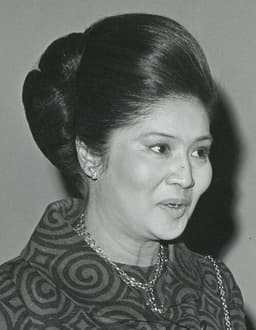
Imelda Marcos
Politician · Modern
45.0Total
Max Petitpierre
Politician · Modern
56.7Total
Basic Information
Born
1929
1899
Died
—
1994
Era
Modern
Modern
Nationality
Philippines
Switzerland
Occupation
Politician
Politician
Civilization
Eastern
Western
Score Comparison
Military (10%)
17.0
48.4
Political (20%)
29.3
72.0
Influence (20%)
56.4
53.3
Legacy (20%)
45.0
45.8
Leadership (15%)
67.0
80.0
Strategy (15%)
35.2
43.3
TOTAL
45.0
56.7
Imelda Marcos — Complete Timeline
1969 AD
Led the construction of the Cultural Center of the PhilippinesCultural
Imelda Marcos spearheaded the construction of the CCP complex, including the main theater and the Folk Arts Theater. The project was part of her 'edifice complex' and aimed to promote Filipino arts and culture. It was criticized for its cost during a period of poverty.
CultureArchitectureArts
Impact: nationalconstructive
1975 AD
Appointed Governor of Metro ManilaPolitical Action◆ Major
President Ferdinand Marcos appointed Imelda Marcos as Governor of Metro Manila. She oversaw the construction of cultural centers, hospitals, and infrastructure projects. However, her tenure was also marked by allegations of corruption and extravagance.
GovernorMetro ManilaMarcos
Impact: regional
1986 AD
Fled to Hawaii after the People Power RevolutionPolitical Action◆ Major
After the fall of the Marcos regime, Imelda fled with her husband to Hawaii on a US Air Force plane. She was later charged with corruption and human rights abuses. The Marcoses left behind an estimated $10 billion in stolen wealth.
ExilePeople PowerCorruption
Impact: nationaltragic
Acquired a collection of over 3,000 pairs of shoesOther
After the Marcoses fled, the public discovered Imelda's massive shoe collection in the Malaca
ScandalLuxuryCorruption
Impact: globaldestructive
Max Petitpierre — Complete Timeline
1944 AD
Election to the Swiss Federal CouncilPolitical Action◆ Major
Petitpierre was elected to the Swiss Federal Council, representing the Free Democratic Party. He took over the Political Department (foreign affairs) during the final years of World War II.
Federal CouncilGovernmentForeign Affairs
Impact: nationalconstructive
1950 AD
Presidency of the Swiss ConfederationPolitical Action◆ Major
Petitpierre served his first term as President of the Swiss Confederation. He held the office four times (1950, 1955, 1960, 1965), overseeing post-war reconstruction and economic growth.
PresidencyLeadershipPost-War
Impact: nationalconstructive
Switzerland's Policy of 'Good Offices'Political Action◆ Major
Petitpierre developed Switzerland's role as a provider of 'good offices' in international diplomacy, offering mediation and hosting international conferences. This enhanced Switzerland's neutral status during the Cold War.
DiplomacyNeutralityCold War
Impact: globalconstructive
1960 AD
Switzerland's Joining of the European Free Trade AssociationPolitical Action◆ Major
Petitpierre oversaw Switzerland's accession to the European Free Trade Association (EFTA), a trade bloc of non-EEC European countries. This maintained Swiss economic integration without political integration.
EFTATradeIntegration
Impact: regionalconstructive
Expert Analysis
Origins
Imelda Romualdez Marcos was born on July 2, 1929, in Manila, Philippines, into a wealthy but politically connected family. Her father, Vicente Orestes Romualdez, was a lawyer and her mother, Remedios Trinidad, was a teacher. After her mother's death, Imelda grew up in Tacloban, Leyte, raised by her father's sister. She studied at St. Paul's College and later at the University of the Philippines, but did not graduate. Her beauty and singing talent helped her win the title of 'Rose of Tacloban' in 1949, which launched her into Manila's social scene.
Max Petitpierre was born on February 26, 1899, in Neuchâtel, Switzerland, into a Protestant family. His father was a professor of French literature. Petitpierre studied law at the University of Neuchâtel and later at the University of Zurich, earning a doctorate. He worked as a lawyer and became a professor of civil law at the University of Neuchâtel. His academic background shaped his methodical approach to politics.
Rise to Power
Imelda Marcos rose to prominence through her marriage to Ferdinand Marcos in 1954. Ferdinand was a rising politician who became President of the Philippines in 1965. Imelda leveraged her charisma and social skills to support his campaigns. In 1975, Ferdinand appointed her as Governor of Metro Manila, a position with significant administrative power. She also served as Minister of Human Settlements and as a member of the Executive Committee, effectively making her the second most powerful person in the regime. Her control over cultural projects and infrastructure gave her a platform for influence.
Max Petitpierre entered politics in the 1930s, serving in the Swiss Parliament. In 1944, he was elected to the Swiss Federal Council, representing the Free Democratic Party. He took over the Political Department (foreign affairs) in 1945. He served as President of the Swiss Confederation four times: 1950, 1955, 1960, and 1965. His rise was steady, based on his expertise in law and diplomacy, rather than personal charisma.
Leadership & Governance
Imelda Marcos governed through a combination of patronage, propaganda, and authoritarian control. She oversaw the construction of grandiose projects like the Cultural Center of the Philippines (1969), the Folk Arts Theater (1974), and the Manila Film Center (1982). These projects, part of her 'edifice complex,' were meant to project an image of progress, but they often came at enormous cost and with allegations of corruption. She also managed social programs, but her leadership style was autocratic, suppressing dissent. During the martial law years (1972-1981), she supported her husband's crackdown on opponents, including the arrest of Senator Benigno Aquino Jr.
Max Petitpierre led with a focus on neutrality and diplomacy. He developed Switzerland's policy of 'good offices,' offering mediation and hosting international conferences. He oversaw Switzerland's accession to the European Free Trade Association (EFTA) in 1960, maintaining economic ties without joining the European Economic Community. His governance was consensus-driven, reflecting Swiss federalism. His leadership style was cautious and pragmatic, prioritizing stability.
Triumph & Tragedy
Imelda's greatest triumph was her role in building cultural institutions that remain landmarks, such as the Cultural Center of the Philippines. She also initiated the 'Kilusan ng Kabataan' youth program and the 'Green Revolution' for food production. However, her greatest tragedy was the collapse of the Marcos regime in 1986. The People Power Revolution forced her and Ferdinand to flee to Hawaii. The discovery of her collection of over 3,000 pairs of shoes in Malacañang Palace became a symbol of the regime's extravagance and corruption. She faced numerous corruption charges, though she was acquitted in many cases and later returned to the Philippines as a congresswoman.
Max Petitpierre's triumph was establishing Switzerland as a hub for international diplomacy. He hosted the 1954 Geneva Conference on Indochina and the 1955 Summit of the Four Powers. His tragedy was limited: Switzerland's policy of neutrality sometimes meant inaction during crises, such as the Hungarian Revolution of 1956, where Switzerland provided only humanitarian aid. His legacy is seen as positive but cautious.
Character & Destiny
Imelda Marcos was characterized by her ambition, vanity, and resilience. She projected an image of glamour and power, but her decisions were often driven by personal aggrandizement. Her character led to the downfall of the Marcos dynasty, as the public turned against the regime's excesses. Historical assessments view her as a symbol of corruption and authoritarianism, though she maintained a loyal following.
Max Petitpierre was methodical, reserved, and principled. He believed in neutrality as a moral stance, not just a political tool. His character shaped Switzerland's post-war identity as a neutral mediator. He is remembered as a competent statesman who guided Switzerland through the Cold War without controversy.
Legacy
Imelda Marcos's legacy is mixed. She scored 45.0 overall, with a Military score of 17.0, Political 29.3, Influence 56.4, Legacy 45.0, Leadership 67.0, and Strategy 35.2. Her influence on Philippine culture is tangible through buildings, but her political legacy is tainted by corruption. The term 'Imeldific' describes excessive ostentation. Her shoe collection remains a cautionary tale.
Max Petitpierre's legacy is more positive but less flashy. He scored 56.7 overall, with Military 48.4, Political 72.0, Influence 53.3, Legacy 45.8, Leadership 80.0, and Strategy 43.3. His 'good offices' policy set a precedent for Swiss diplomacy. Switzerland's membership in EFTA and its role in international mediation owe much to his efforts.
Conclusion
Max Petitpierre had greater impact, as reflected in his higher total score of 56.7 compared to Imelda Marcos's 45.0. Petitpierre's contributions to Swiss neutrality and international diplomacy were constructive and enduring, while Imelda's legacy is largely negative, defined by corruption and authoritarianism. Petitpierre's leadership score of 80.0 and political score of 72.0 demonstrate effective governance, whereas Imelda's leadership score of 67.0 is undermined by her low political and strategy scores. In terms of lasting positive influence, Petitpierre's work facilitated international cooperation, while Imelda's projects, though physically enduring, symbolize a failed regime. Therefore, Petitpierre's impact on global diplomacy surpasses Imelda's impact on Philippine culture.
Rankings
🥇
Max PetitpierreLeader
Mil: 48.4Pol: 72.0Inf: 53.3
56.7
🥈
Imelda Marcos
Mil: 17.0Pol: 29.3Inf: 56.4
45.0
+11.7 behind
How This Comparison Works
Algorithm
Each figure is scored on 6 dimensions (0—100 scale) based on structured historical data: Military (10%), Political (20%), Influence (20%), Legacy (20%), Leadership (15%), Strategy (15%). The weighted total produces the final ranking.
Data Sources
Scores are computed from structured sub-indicators in the database. Scale factors adjust for era (Ancient ×0.85, Modern ×1.0) and civilization size (Eastern ×1.05, Other ×0.80) to account for differences in population and military scale.
Maximum 3 Figures
Comparisons are limited to 2—3 figures to ensure readability and statistical meaningfulness.
Error Margins
±5 points per dimension — Sub-scores are derived from historical records with inherent uncertainty. Two figures within 5 points on a dimension should be considered roughly equivalent in that area.
Total Score Accuracy
±3 points overall — The weighted combination of 6 dimensions produces a total score with approximately ±3 points of uncertainty. Differences of less than 3 points are not statistically significant— the figures are effectively tied.
Known Limitations
- Historical records are incomplete and uneven across civilizations
- Figures from oral-tradition societies may be underrepresented
- Occupation labels can misclassify multi-role figures
- Scores measure capability and impact, not moral character
- Quantitative scoring is a comparison tool, not absolute truth
Capability Radar
Military (10%) — Battles & Warfare
Battles
13
28
Win Rate
17
35
Expansion
18
35
Political (20%) — Governance & Reform
Reform
10
55
Diplomacy
30
70
Economy
15
65
Influence (20%) — Cultural & Global Reach
Cultural
45
30
Global
35
30
Legacy (20%) — Historical Impact
Historical
40
40
Longevity
30
35
Leadership (15%) — Power & Stability
Tenure
60
60
Stability
10
75
Strategy (15%) — Tactics & Innovation
Strategy
24
40
Tactics
27
39
Reform
28
46
Similar Comparisons
Comments & Discussion
No comments yet. Be the first to share your thoughts!