Loading...
Igrish-Halam vs Julius Caesar
Julius Caesar leads by 46.1 pts · 2 figures compared
…
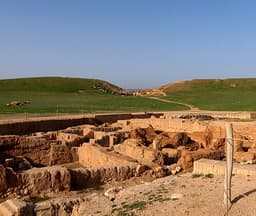
Igrish-Halam
Emperor · Ancient
36.7Total

Julius Caesar
General · Ancient
82.8Total
Basic Information
Born
-2400
-100
Died
-2380
-44
Era
Ancient
Ancient
Nationality
Ebla
Roman Republic
Occupation
Emperor
General
Civilization
Middle Eastern
Western
Score Comparison
Military (10%)
50.0
88.0
Political (20%)
26.4
78.0
Influence (20%)
43.2
85.0
Legacy (20%)
34.2
82.0
Leadership (15%)
31.2
80.0
Strategy (15%)
36.8
85.0
TOTAL
36.7
82.8
Julius Caesar — Complete Timeline
58 BC
Gallic WarsWar◆ Major
Caesar, as proconsul of Gaul, launched a series of campaigns that conquered all of Gaul (modern France, Belgium, and parts of Switzerland). He fought numerous battles, including against the Helvetii, the Belgae, and the Gallic chieftain Vercingetorix. The wars brought immense wealth and a loyal army to Caesar.
Gallic WarsConquestRoman Expansion
Impact: regional
49 BC
Crossing the RubiconPolitical Action◆ Major
Caesar led Legio XIII across the Rubicon River into Italy, defying the Roman Senate's order to disband his army. This act triggered a civil war against Pompey and the Optimates, ultimately leading to Caesar's dictatorship and the end of the Roman Republic.
Roman Civil WarEnd of RepublicPower Struggle
Impact: global
48 BC
Battle of PharsalusWar◆ Major
Caesar's outnumbered army defeated the larger forces of Pompey the Great at Pharsalus in Greece. Caesar's tactical use of a reserve line to counter Pompey's cavalry charge proved decisive. Pompey fled to Egypt, where he was assassinated, leaving Caesar as the undisputed master of the Roman world.
Roman Civil WarBattleDecisive Victory
Impact: regional
44 BC
Appointment as Dictator for LifePolitical Action◆ Major
The Roman Senate appointed Caesar dictator perpetuo (dictator for life), granting him unprecedented personal power. This move concentrated military, legislative, and judicial authority in one person, effectively ending the Roman Republic's traditional system of checks and balances and alarming many senators.
DictatorshipEnd of RepublicPower Consolidation
Impact: regionaldestructive
Assassination on the Ides of MarchPolitical Action◆ Major
A group of Roman senators, led by Marcus Junius Brutus and Gaius Cassius Longinus, stabbed Caesar to death at a meeting of the Senate in the Theatre of Pompey. The assassination was intended to restore the Republic, but instead triggered another civil war that led to the rise of the Roman Empire.
AssassinationRoman PoliticsEnd of Republic
Impact: globaldestructive
Expert Analysis
igrish-halam-vs-julius-caesar
# The Ides of Ebla: What a Forgotten King and a Legendary General Reveal About Power
On a March morning in 44 BCE, Julius Caesar walked into the Senate chamber and into history's most famous assassination. Twenty-three dagger strokes ended the life of a man who had conquered Gaul, defeated his rivals in civil war, and transformed the Roman Republic into something unrecognizable. Twenty-three centuries earlier, in a mud-brick palace in what is now northern Syria, another ruler met a far quieter end. Igrish-Halam, king of Ebla, simply vanished from the record. No dramatic betrayal, no immortalized last words, no Shakespearean tragedy. His kingdom would be burned to ash within a generation. The contrast between these two men—one whose name echoes through millennia, the other so obscure that even his exact fate remains unknown—raises a haunting question: What separates a figure who reshapes the world from one who is swallowed by it?
Origins
Julius Caesar was born into the twilight of the Roman Republic, a world of senatorial intrigue, slave armies, and relentless expansion. His family, the Julii, claimed descent from the goddess Venus, but they were politically marginal. Caesar grew up in a Rome where power belonged to men with gold and legions, and he learned early that reputation was a weapon. His father died when he was sixteen, thrusting him into a world where he had to forge his own path through debt, exile, and military service.
Igrish-Halam ruled Ebla at the dawn of written history, around 2400 BCE. His world was one of city-states, clay tablets, and trade routes stretching from the Mediterranean to Mesopotamia. Ebla was wealthy—its archives reveal a sophisticated bureaucracy that tracked everything from sheep shipments to diplomatic marriages. But it was also vulnerable, surrounded by rising powers like Akkad and Mari. Igrish-Halam inherited a throne, not a struggle. There is no record of his education, his ambitions, or his fears. He was a king in an age when kings were expected to maintain, not transform.
Rise to Power
Caesar’s ascent was a masterpiece of calculated risk. He borrowed fortunes to fund political campaigns, seduced allies and enemies alike, and spent years in Gaul building a loyal army that would later make him unstoppable. The crossing of the Rubicon in 49 BCE was not a spontaneous act of ambition but the culmination of decades of maneuvering. He understood that in a republic collapsing under its own contradictions, the man who moved first and fastest would win everything.
Igrish-Halam’s rise is a blank page. He appears in the Ebla archives as a king, but how he got there—whether through inheritance, election, or conquest—is unknown. The tablets mention him in passing, as a name in lists of tribute or treaties. His power was real but constrained. He ruled not as a dictator but as a primus inter pares among Ebla’s merchant elites, his authority checked by assemblies and rival families. He did not climb; he simply occupied.
Leadership & Governance
Caesar governed as a revolutionary. As dictator, he reformed the calendar, extended citizenship to provincials, initiated public works, and centralized authority in ways that made the old Republic obsolete. His military genius was inseparable from his political vision: every campaign, from Gaul to Egypt, was designed to generate glory, wealth, and loyalty. He knew that in Rome, popularity was power, and he courted the masses with games, land reforms, and bread. Yet his governance was also ruthless—he crushed opposition without mercy, and his clemency toward former enemies was a calculated tactic, not kindness.
Igrish-Halam governed as a manager. The Ebla archives show a kingdom run on accountants and scribes, where grain distributions and textile production were tracked with obsessive precision. His military was likely defensive, designed to protect trade routes rather than conquer neighbors. There is no evidence of grand reforms or visionary projects. He maintained what his predecessors built. In a world without standing armies or mass media, that was enough to keep Ebla prosperous—but not enough to save it.
Triumph & Tragedy
Caesar’s greatest triumph was the conquest of Gaul—a nine-year campaign that added a vast territory to Roman control, made him fabulously wealthy, and gave him an army that worshipped him. His most devastating failure was not a military defeat but a political miscalculation: he believed that by concentrating power in himself, he could save Rome from its own decay. Instead, he provoked the very violence he sought to end. The Ides of March was the tragedy of a man who saw the problem clearly but could not see that his solution was the problem.
Igrish-Halam’s triumph, if he had one, is lost. His tragedy is the silence of history. Ebla was sacked around 2300 BCE by Sargon of Akkad, and the king who followed Igrish-Halam—Isar-Damu—faced the destruction that his predecessor could not prevent. The archives were buried, forgotten for four thousand years, and when they were unearthed in the 1970s, Igrish-Halam was just a name on a clay tablet. His tragedy is not that he failed, but that no one remembers whether he succeeded.
Character & Destiny
Caesar was audacious, calculating, and supremely confident. He gambled constantly—on his life, his fortune, his legacy—and he won until he didn’t. His personality shaped his destiny: his refusal to disband his army, his contempt for senatorial tradition, his belief that he alone could fix Rome. That same personality made his assassination inevitable. He was a man who could not stop, even when stopping might have saved him.
Igrish-Halam was cautious, perhaps, or simply typical. His personality is invisible to us, erased by time and the limits of clay. His destiny was to be a placeholder between eras, a king who kept the wheels turning until a greater force arrived. He did not shape history; history shaped him, and then discarded him.
Legacy
Caesar’s legacy is the Roman Empire, and through it, Western civilization. His name became a title—Kaiser, Tsar—and his reforms laid the groundwork for two thousand years of governance. He is studied, debated, dramatized, and mythologized. Even his death became a symbol: the Ides of March, a warning against ambition.
Igrish-Halam’s legacy is the Ebla archives—a treasure trove of information about early urban life, but one in which he is a footnote. He is remembered not for what he did, but for where he was. His legacy is the silence of a king who did not write his own story.
Conclusion
Standing at the edge of these two lives, one cannot help but feel the weight of contingency. Caesar’s world—of writing, of memory, of deliberate self-mythology—allowed him to shape how he would be remembered. Igrish-Halam’s world—of oral tradition, of fragile clay, of kingdoms that rose and fell in a generation—did not. But there is another lesson here, more unsettling. Caesar’s ambition brought him glory, but also the knife. Igrish-Halam’s caution brought him obscurity, but perhaps a peaceful reign. Which is the greater tragedy: to be forgotten, or to be remembered for your destruction? The Ides of March and the silent tablets of Ebla offer no easy answer. They only remind us that history is not a record of the best or the wisest, but of the loudest—and that most of us, like Igrish-Halam, will never get to speak.
Rankings
🥇
Julius CaesarLeader
Mil: 88.0Pol: 78.0Inf: 85.0
82.8
🥈
Igrish-Halam
Mil: 50.0Pol: 26.4Inf: 43.2
36.7
+46.1 behind
How This Comparison Works
Algorithm
Each figure is scored on 6 dimensions (0—100 scale) based on structured historical data: Military (10%), Political (20%), Influence (20%), Legacy (20%), Leadership (15%), Strategy (15%). The weighted total produces the final ranking.
Data Sources
Scores are computed from structured sub-indicators in the database. Scale factors adjust for era (Ancient ×0.85, Modern ×1.0) and civilization size (Eastern ×1.05, Other ×0.80) to account for differences in population and military scale.
Maximum 3 Figures
Comparisons are limited to 2—3 figures to ensure readability and statistical meaningfulness.
Error Margins
±5 points per dimension — Sub-scores are derived from historical records with inherent uncertainty. Two figures within 5 points on a dimension should be considered roughly equivalent in that area.
Total Score Accuracy
±3 points overall — The weighted combination of 6 dimensions produces a total score with approximately ±3 points of uncertainty. Differences of less than 3 points are not statistically significant— the figures are effectively tied.
Known Limitations
- Historical records are incomplete and uneven across civilizations
- Figures from oral-tradition societies may be underrepresented
- Occupation labels can misclassify multi-role figures
- Scores measure capability and impact, not moral character
- Quantitative scoring is a comparison tool, not absolute truth
Capability Radar
Military (10%) — Battles & Warfare
Battles
10
95
Win Rate
10
92
Expansion
15
97
Political (20%) — Governance & Reform
Reform
15
90
Diplomacy
20
85
Economy
15
82
Influence (20%) — Cultural & Global Reach
Cultural
10
88
Global
5
94
Legacy (20%) — Historical Impact
Historical
15
95
Longevity
10
96
Leadership (15%) — Power & Stability
Tenure
20
75
Stability
15
60
Strategy (15%) — Tactics & Innovation
Strategy
10
94
Tactics
10
96
Reform
10
88
Similar Comparisons
Comments & Discussion
No comments yet. Be the first to share your thoughts!