Loading...
Idriss Deby vs Ivan Konev
Idriss Deby leads by 0.0 pts · 2 figures compared
…
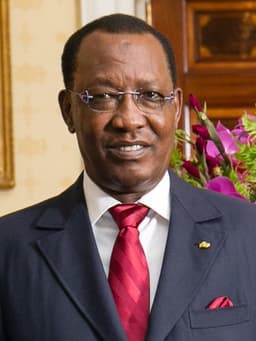
Idriss Deby
General · Modern
58.9Total

Ivan Konev
General · Modern
58.9Total
Basic Information
Born
1952
1897
Died
—
1973
Era
Modern
Modern
Nationality
Chad
USSR
Occupation
General
General
Civilization
Other
Western
Score Comparison
Military (10%)
67.5
72.0
Political (20%)
68.0
43.7
Influence (20%)
55.7
55.0
Legacy (20%)
49.2
56.0
Leadership (15%)
68.0
71.0
Strategy (15%)
55.0
67.2
TOTAL
58.9
58.9
Idriss Deby — Complete Timeline
1990 AD
Seized Power in CoupPolitical Action
Idriss Deby, a former military commander, led a rebellion that overthrew President Hiss
Coup d'étatChadRebellion
Impact: national
1996 AD
Won First Multi-Party ElectionPolitical Action◆ Major
Deby won the 1996 presidential election, the first multi-party election in Chad's history. The election was criticized for irregularities but was seen as a step towards democratic transition.
ElectionDemocracyChad
Impact: national
2003 AD
Chad-Cameroon Pipeline CompletionOther◆ Major
The Chad-Cameroon Petroleum Development and Pipeline Project became operational, allowing Chad to export oil. The project brought significant revenue but also raised concerns about corruption and environmental impact.
Oil PipelineEconomyChad
Impact: national
2013 AD
Military Intervention in Northern MaliWar◆ Major
Chadian troops under Deby's command played a key role in the French-led intervention in Mali, fighting against Islamist insurgents. The intervention helped push back militants but resulted in Chadian casualties.
Military InterventionMaliCounterterrorism
Impact: regional
2021 AD
Killed on the Front LinesWar
President Idriss Deby was killed while visiting troops fighting rebels from the Front for Change and Concord in Chad (FACT) in northern Chad. His death on the battlefield was confirmed by the military.
DeathChadConflict
Impact: nationaltragic
Ivan Konev — Complete Timeline
1943 AD
Commanded Steppe Front at the Battle of KurskWar◆ Major
Konev commanded the Steppe Front during the Battle of Kursk. His forces were held in reserve and committed to the counteroffensive after the German offensive stalled. He led the liberation of Belgorod and Kharkov, pushing German forces back across Ukraine.
World War IIBattle of KurskEastern Front
Impact: regionalconstructive
1944 AD
Commanded 1st Ukrainian Front in the Lvov-Sandomierz OffensiveWar◆ Major
Konev commanded the 1st Ukrainian Front in the Lvov-Sandomierz Offensive, which destroyed German Army Group North Ukraine. His forces captured Lvov and established a bridgehead across the Vistula River. This operation paved the way for the advance into Germany.
World War IIEastern FrontLvov-Sandomierz
Impact: regionalconstructive
1945 AD
Liberated PragueWar◆ Major
Konev's 1st Ukrainian Front launched the Prague Offensive in May 1945, the last major Soviet operation of World War II. His forces captured Prague on May 9, 1945, after German forces surrendered. The liberation of Prague marked the end of the war in Europe.
World War IIPrague OffensiveLiberation
Impact: regionalconstructive
Commanded the Capture of BerlinWar
Konev's 1st Ukrainian Front participated in the Battle of Berlin alongside Zhukov's 1st Belorussian Front. His forces advanced from the south, encircling the city and linking up with American forces on the Elbe. The capture of Berlin ended the war in Europe.
World War IIBattle of BerlinVictory
Impact: globalconstructive
Expert Analysis
Origins
Idriss Deby (born 1952) was a member of the Zaghawa ethnic group in Chad. He received military training in France and served under President Hissène Habré. Ivan Konev (born 1897) was a peasant from Russia who joined the Red Army in 1918. He rose through the ranks during the Russian Civil War and later attended the Frunze Military Academy.
Rise to Power
Deby seized power in a coup in December 1990, overthrowing Habré. He led a rebellion from Sudan and captured N'Djamena on December 2, 1990. Konev rose through the Soviet military hierarchy, commanding the Steppe Front at the Battle of Kursk in 1943. He later commanded the 1st Ukrainian Front, leading successful offensives such as the Lvov-Sandomierz Offensive in 1944.
Leadership & Governance
Deby ruled Chad for 30 years, winning multi-party elections in 1996 and 2001, though these were criticized for irregularities. He focused on oil revenues from the Chad-Cameroon pipeline (operational 2003) but faced repeated rebellions. Konev was a strict disciplinarian, known for his aggressive tactics. He served as a deputy minister of defense and commanded Warsaw Pact forces. His governance style was Soviet authoritarian, with no democratic processes.
Triumph & Tragedy
Deby's triumph was bringing stability to Chad and playing a key role in the intervention in Mali (2013), where Chadian troops fought Islamist insurgents. His tragedy was his death on the front lines in April 2021, killed by rebels, which destabilized Chad. Konev's triumph was capturing Berlin and liberating Prague in 1945. His tragedy was his involvement in the suppression of the Hungarian Revolution in 1956, which tarnished his legacy. Konev scored 72.0 in military, while Deby scored 67.5.
Character & Destiny
Deby was seen as a pragmatic leader who used military force to maintain power. He was known for his personal bravery, dying while visiting troops. Konev was ambitious and competitive, often clashing with Zhukov. He was a skilled strategist but ruthless in carrying out orders.
Legacy
Deby's legacy is mixed: he modernized Chad's economy but left a weak democratic system. Konev is remembered as a key Soviet commander of WWII, but his involvement in Hungary casts a shadow. Deby's influence score is 55.7, Konev's 55.0. Legacy: Deby 49.2, Konev 56.0.
Conclusion
While both had significant impact in their spheres, Ivan Konev's role in World War II and the liberation of Europe gives him a greater historical impact. His military score (72.0) and leadership score (71.0) are higher than Deby's (67.5 and 68.0). Konev's decisions affected millions, whereas Deby's influence was largely regional. Thus, Konev is the more impactful figure.
Rankings
🥇
Idriss DebyLeader
Mil: 67.5Pol: 68.0Inf: 55.7
58.9
🥈
Ivan Konev
Mil: 72.0Pol: 43.7Inf: 55.0
58.9
How This Comparison Works
Algorithm
Each figure is scored on 6 dimensions (0—100 scale) based on structured historical data: Military (10%), Political (20%), Influence (20%), Legacy (20%), Leadership (15%), Strategy (15%). The weighted total produces the final ranking.
Data Sources
Scores are computed from structured sub-indicators in the database. Scale factors adjust for era (Ancient ×0.85, Modern ×1.0) and civilization size (Eastern ×1.05, Other ×0.80) to account for differences in population and military scale.
Maximum 3 Figures
Comparisons are limited to 2—3 figures to ensure readability and statistical meaningfulness.
Error Margins
±5 points per dimension — Sub-scores are derived from historical records with inherent uncertainty. Two figures within 5 points on a dimension should be considered roughly equivalent in that area.
Total Score Accuracy
±3 points overall — The weighted combination of 6 dimensions produces a total score with approximately ±3 points of uncertainty. Differences of less than 3 points are not statistically significant— the figures are effectively tied.
Known Limitations
- Historical records are incomplete and uneven across civilizations
- Figures from oral-tradition societies may be underrepresented
- Occupation labels can misclassify multi-role figures
- Scores measure capability and impact, not moral character
- Quantitative scoring is a comparison tool, not absolute truth
Capability Radar
Military (10%) — Battles & Warfare
Battles
65
85
Win Rate
60
80
Expansion
55
75
Political (20%) — Governance & Reform
Reform
40
30
Diplomacy
55
40
Economy
35
20
Influence (20%) — Cultural & Global Reach
Cultural
30
50
Global
35
55
Legacy (20%) — Historical Impact
Historical
45
65
Longevity
40
45
Leadership (15%) — Power & Stability
Tenure
75
55
Stability
30
35
Strategy (15%) — Tactics & Innovation
Strategy
60
82
Tactics
55
78
Reform
70
60
Similar Comparisons
Comments & Discussion
No comments yet. Be the first to share your thoughts!