Loading...
Idrieus vs Napoleon Bonaparte
Napoleon Bonaparte leads by 30.3 pts · 2 figures compared
…
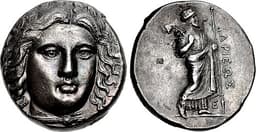
Idrieus
Emperor · Ancient
40.6Total

Napoleon Bonaparte
General · Modern
70.9Total
Basic Information
Born
-380
1769
Died
-344
1821
Era
Ancient
Modern
Nationality
Caria
France
Occupation
Emperor
General
Civilization
Middle Eastern
Western
Score Comparison
Military (10%)
50.0
94.0
Political (20%)
30.8
72.0
Influence (20%)
44.8
40.0
Legacy (20%)
34.2
80.0
Leadership (15%)
48.4
78.0
Strategy (15%)
39.6
90.0
TOTAL
40.6
70.9
Idrieus — Complete Timeline
353 BC
Succeeded Mausolus as ruler of CariaPolitical Action◆ Major
Upon the death of his brother Mausolus, Idrieus became the Hecatomnid ruler of Caria. He continued the policies of his predecessors, maintaining Carian autonomy under Persian suzerainty and overseeing the region's administration.
SuccessionCarian Dynasty
Impact: regional
Construction of the Mausoleum at HalicarnassusCultural◆ Major
Idrieus and his sister-wife Ada completed the construction of the Mausoleum at Halicarnassus, the tomb of Mausolus. This structure became one of the Seven Wonders of the Ancient World, showcasing Carian wealth and Hellenistic architectural influence.
ArchitectureWonder of the World
Impact: globalconstructive
351 BC
Supported the Persian satrap revoltWar
Idrieus provided military support to the Persian satrap Artabazus of Phrygia during his revolt against Artaxerxes III. This action demonstrated Caria's complex relationship with the Achaemenid Empire, balancing autonomy with loyalty.
RevoltPersian Empire
Impact: regional
344 BC
Death and succession by AdaPolitical Action
Idrieus died in 344 BC, after ruling Caria for approximately nine years. His sister-wife Ada succeeded him as ruler, continuing the Hecatomnid dynasty's control over Caria until the arrival of Alexander the Great.
SuccessionCarian Dynasty
Impact: regional
Napoleon Bonaparte — Complete Timeline
1799 AD
Coup of 18 BrumaireOther◆ Major
Napoleon Bonaparte, with support from his brother Lucien and key political figures, overthrew the Directory in a bloodless coup. He established the Consulate with himself as First Consul, effectively becoming the ruler of France. This event ended the French Revolution's most unstable period.
French RevolutionCoupRise to Power
Impact: regional
1804 AD
Promulgation of the Napoleonic CodeOther◆ Major
Napoleon enacted the Civil Code of the French, known as the Napoleonic Code, a comprehensive set of laws that replaced the fragmented feudal legal systems. The code established legal equality, protected property rights, and secularized law. It became the basis for legal systems in many European and world countries.
Legal ReformNapoleonic CodeCivil Law
Impact: globalconstructive
1805 AD
Battle of AusterlitzWar◆ Major
Napoleon's Grande Arm
Napoleonic WarsBattleDecisive Victory
Impact: global
1812 AD
Invasion of RussiaWar◆ Major
Napoleon led the Grande Arm
Napoleonic WarsInvasionDisaster
Impact: globaldestructive
1815 AD
Battle of WaterlooWar◆ Major
Napoleon's French army was defeated by the combined forces of the Duke of Wellington's Anglo-Allied army and Gebhard Leberecht von Bl
Napoleonic WarsBattleFinal Defeat
Impact: globaldestructive
Expert Analysis
idrieus-vs-napoleon-bonaparte
# The Emperor and the Satrap: Why Napoleon Conquered an Age While Idrieus Faded into Obscurity
In the spring of 1815, Napoleon Bonaparte stood before his Grande Armée, a man who had crowned himself emperor, rewritten the laws of Europe, and marched from Madrid to Moscow. Two thousand years earlier, on the Aegean coast of Anatolia, Idrieus of Caria oversaw the completion of his brother's tomb—a monument that would outlast his own name. One man shaped the destiny of a continent; the other shaped a single, beautiful building. What separates a figure who commands the world's memory from one who barely registers in its footnotes? The answer lies not in ambition alone, but in the collision of character, opportunity, and the precise moment when history opens its door.
Origins
Napoleon was born in 1769 on Corsica, an island that had passed from Genoa to France only months before. His family was minor nobility, speaking Italian, resentful of French rule. This marginality shaped him: he would always be the outsider fighting to prove his worth. He absorbed Enlightenment ideas at military school, read Rousseau and Voltaire, and learned that the old order was crumbling. The French Revolution of 1789 was his great fortune—it swept away the aristocracy that would have blocked a Corsican upstart.
Idrieus, born in 380 BC, inherited a different world. Caria was a Persian satrapy on the southwestern coast of Anatolia, ruled by the Hecatomnid dynasty. His father Hecatomnus had navigated between Greek city-states and the Persian Empire. Idrieus grew up in a world of satraps and tribute, where power meant keeping your head down and paying your taxes to Susa. He knew no revolution, no upheaval—only the slow rhythms of dynastic succession and Persian oversight.
Rise to Power
Napoleon’s ascent was a rocket. At twenty-four, he drove the British out of Toulon. At twenty-six, he crushed a royalist uprising in Paris with a "whiff of grapeshot." At twenty-seven, he conquered Italy. By thirty, he was First Consul of France. Each step was a gamble, a violation of expectation. He did not wait for power to be given; he seized it, and the chaos of revolutionary France rewarded audacity.
Idrieus rose differently. In 353 BC, his brother Mausolus died. Idrieus simply inherited the throne, as his sister Artemisia had before him. There is no record of struggle, no dramatic battlefield. He became ruler because his family had arranged it, because the Persians approved, because the system worked. His path was a corridor, not a cliff.
Leadership & Governance
Napoleon governed with the energy of a man who believed he was making history. He centralized the French state, created the Napoleonic Code—a legal framework that abolished feudal privileges and enshrined equality before the law—and reformed education, banking, and military organization. He was a military genius, scoring victories at Austerlitz in 1805 and Jena in 1806 that shattered coalitions. His political score of 75.0 and military score of 94.0 reflect a man who commanded both armies and institutions. But his wisdom had limits: he invaded Russia in 1812, losing half a million men, and refused to compromise with his enemies.
Idrieus governed a small kingdom. He completed the Mausoleum at Halicarnassus, one of the Seven Wonders of the Ancient World, a testament to his family's wealth and cultural ambition. In 351 BC, he supported the Persian satrap Artabazus of Phrygia in a revolt against Artaxerxes III—a risky move that suggests he understood the delicate balance of Persian politics. But his military score of 47.8 and political score of 39.6 indicate a ruler who managed, rather than transformed. He built no code, expanded no empire, left no mark on the wider world.
Triumph & Tragedy
Napoleon’s greatest moment was Austerlitz, where he crushed the combined armies of Russia and Austria in a single day, December 2, 1805. His worst was Waterloo, June 18, 1815, where he was defeated by the Duke of Wellington and the Prussian army, ending his hundred-day return from exile. He died in 1821 on Saint Helena, a British prisoner, isolated and bitter.
Idrieus’s triumph was the Mausoleum—a building so magnificent that its name became a word for all grand tombs. His tragedy is that we know almost nothing else about him. He died in 344 BC after nine years of rule, succeeded by his sister-wife Ada. No epic defeat, no dramatic exile. Just silence.
Character & Destiny
Napoleon was restless, brilliant, and consumed by ambition. "Impossible is a word to be found only in the dictionary of fools," he said. He believed he could shape the world through will alone. That conviction made him a conqueror and a prisoner. His personality drove him to overreach, to believe that no coalition could stand against him, that Russia would bow, that the sea could be crossed. It was his strength and his flaw.
Idrieus was a steward. He maintained what his father and brother built, added a monument, and passed the throne to his wife. He did not dream of Paris or Moscow because he had never seen them. His world was Caria, and Caria was enough. His character was suited to stability, not conquest.
Legacy
Napoleon’s legacy is everywhere. The Napoleonic Code influences civil law across Europe and the Americas. His military tactics are studied at West Point and Sandhurst. His name is synonymous with ambition and downfall. He has a legacy score of 78.0, an influence score of 82.0—a man who reshaped the modern state.
Idrieus’s legacy is the Mausoleum, which was destroyed by earthquakes in the Middle Ages, its stones reused for a crusader castle. His name survives in obscure historical footnotes. His legacy score of 45.1 reflects the reality: he built something beautiful, but it did not outlast him in meaning.
Conclusion
The difference between Napoleon and Idrieus is not talent—both ruled competently—but scale of ambition and the epoch that enabled it. Napoleon lived in a time when the old order collapsed, when a Corsican could become emperor. Idrieus lived in a time when the Persian Empire demanded obedience, when a Carian satrap could only build a tomb. The great figures of history are not simply great men; they are men who found the door open and had the audacity to walk through. Napoleon found a revolution. Idrieus found a dynasty. One changed the world; the other decorated it. Their contrast reminds us that history is not a meritocracy of ability, but a lottery of circumstance—and the courage to bet everything on a single, impossible throw.
Rankings
🥇
Napoleon BonaparteLeader
Mil: 94.0Pol: 72.0Inf: 40.0
70.9
🥈
Idrieus
Mil: 50.0Pol: 30.8Inf: 44.8
40.6
+30.3 behind
How This Comparison Works
Algorithm
Each figure is scored on 6 dimensions (0—100 scale) based on structured historical data: Military (10%), Political (20%), Influence (20%), Legacy (20%), Leadership (15%), Strategy (15%). The weighted total produces the final ranking.
Data Sources
Scores are computed from structured sub-indicators in the database. Scale factors adjust for era (Ancient ×0.85, Modern ×1.0) and civilization size (Eastern ×1.05, Other ×0.80) to account for differences in population and military scale.
Maximum 3 Figures
Comparisons are limited to 2—3 figures to ensure readability and statistical meaningfulness.
Error Margins
±5 points per dimension — Sub-scores are derived from historical records with inherent uncertainty. Two figures within 5 points on a dimension should be considered roughly equivalent in that area.
Total Score Accuracy
±3 points overall — The weighted combination of 6 dimensions produces a total score with approximately ±3 points of uncertainty. Differences of less than 3 points are not statistically significant— the figures are effectively tied.
Known Limitations
- Historical records are incomplete and uneven across civilizations
- Figures from oral-tradition societies may be underrepresented
- Occupation labels can misclassify multi-role figures
- Scores measure capability and impact, not moral character
- Quantitative scoring is a comparison tool, not absolute truth
Capability Radar
Military (10%) — Battles & Warfare
Battles
10
95
Win Rate
10
90
Expansion
15
95
Political (20%) — Governance & Reform
Reform
20
95
Diplomacy
30
80
Economy
25
85
Influence (20%) — Cultural & Global Reach
Cultural
15
85
Global
10
90
Legacy (20%) — Historical Impact
Historical
15
95
Longevity
10
90
Leadership (15%) — Power & Stability
Tenure
30
85
Stability
30
70
Strategy (15%) — Tactics & Innovation
Strategy
10
95
Tactics
10
98
Reform
5
92
Similar Comparisons
Comments & Discussion
No comments yet. Be the first to share your thoughts!