Loading...
Ibrahim Lodi vs Napoleon Bonaparte
Napoleon Bonaparte leads by 30.3 pts · 2 figures compared
…
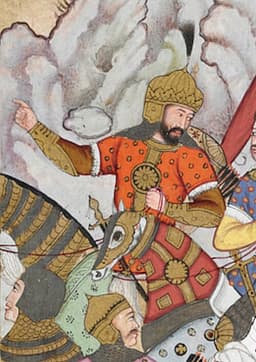
Ibrahim Lodi
Emperor · Medieval
40.6Total

Napoleon Bonaparte
General · Modern
70.9Total
Basic Information
Born
1480
1769
Died
1526
1821
Era
Medieval
Modern
Nationality
India
France
Occupation
Emperor
General
Civilization
Indian
Western
Score Comparison
Military (10%)
50.0
94.0
Political (20%)
29.3
72.0
Influence (20%)
47.1
40.0
Legacy (20%)
36.7
80.0
Leadership (15%)
48.4
78.0
Strategy (15%)
30.3
90.0
TOTAL
40.6
70.9
Ibrahim Lodi — Complete Timeline
1520 AD
Alienation of the Afghan NobilityPolitical Action◆ Major
Ibrahim Lodi alienated the Afghan nobles by replacing them with low-born officials and treating them harshly. This led to widespread disaffection and rebellions, including the defection of Daulat Khan Lodi to Babur. It fatally weakened his rule.
NobilityPolitical MistakeRebellion
Impact: nationaldestructive
1524 AD
Suppression of the Rebellion of Rana SangaWar
Ibrahim Lodi led a campaign against the Rajput ruler Rana Sanga of Mewar, who had invaded Lodi territory. He forced Sanga to retreat but failed to decisively defeat him. This conflict diverted resources from the growing Mughal threat.
Rajput WarMewarMilitary Campaign
Impact: regional
1526 AD
Battle of PanipatWar
Ibrahim Lodi's army was defeated by Babur's Mughal forces at the First Battle of Panipat. Babur used gunpowder weapons and cavalry tactics to overwhelm the larger Lodi army. Ibrahim Lodi was killed in battle, ending the Lodi dynasty.
BattleMughal ConquestEnd of Dynasty
Impact: globaltragic
Napoleon Bonaparte — Complete Timeline
1799 AD
Coup of 18 BrumaireOther◆ Major
Napoleon Bonaparte, with support from his brother Lucien and key political figures, overthrew the Directory in a bloodless coup. He established the Consulate with himself as First Consul, effectively becoming the ruler of France. This event ended the French Revolution's most unstable period.
French RevolutionCoupRise to Power
Impact: regional
1804 AD
Promulgation of the Napoleonic CodeOther◆ Major
Napoleon enacted the Civil Code of the French, known as the Napoleonic Code, a comprehensive set of laws that replaced the fragmented feudal legal systems. The code established legal equality, protected property rights, and secularized law. It became the basis for legal systems in many European and world countries.
Legal ReformNapoleonic CodeCivil Law
Impact: globalconstructive
1805 AD
Battle of AusterlitzWar◆ Major
Napoleon's Grande Arm
Napoleonic WarsBattleDecisive Victory
Impact: global
1812 AD
Invasion of RussiaWar◆ Major
Napoleon led the Grande Arm
Napoleonic WarsInvasionDisaster
Impact: globaldestructive
1815 AD
Battle of WaterlooWar◆ Major
Napoleon's French army was defeated by the combined forces of the Duke of Wellington's Anglo-Allied army and Gebhard Leberecht von Bl
Napoleonic WarsBattleFinal Defeat
Impact: globaldestructive
Expert Analysis
ibrahim-lodi-vs-napoleon-bonaparte
# The Conqueror and the Collapsed Throne
In the spring of 1526, on a dusty plain north of Delhi, two armies faced each other under a merciless sun. On one side stood Ibrahim Lodi, the last sultan of the Lodi dynasty, surrounded by tens of thousands of men and a hundred war elephants—the traditional instruments of Indian power. On the other side stood Babur, a Central Asian prince with a fraction of the men but something far more deadly: cannons. By day’s end, the old world had ended. Ibrahim Lodi lay dead on the battlefield, his army shattered, and the Delhi Sultanate—which had ruled northern India for over three centuries—had collapsed into dust. Just a decade earlier, on the other side of the world, a young Corsican artillery officer named Napoleon Bonaparte was beginning a rise that would shake Europe to its foundations. These two men, separated by continents and centuries, both faced moments of supreme military test. One became the architect of a new age. The other became its victim. Why?
Origins
Napoleon Bonaparte was born in 1769 on the island of Corsica, a land only recently annexed by France. His family was minor nobility, poor and resentful of French rule. As a boy, he spoke Italian-accented French and was mocked by his classmates at military school. That sting of humiliation never left him. He devoured history and military theory, particularly the works of Alexander the Great and Julius Caesar. His era was one of revolutionary upheaval—the French Revolution had smashed the old order, creating a vacuum where talent, not birth, could ascend. Napoleon was a child of chaos, and chaos was his element.
Ibrahim Lodi was born in 1480 into the ruling family of the Lodi dynasty, an Afghan clan that had seized the Delhi Sultanate a generation earlier. He was raised in the palace, surrounded by the rituals of kingship, but also by the poisonous politics of a court where noble families wielded power equal to the throne. His father, Sikandar Lodi, had kept the Afghan nobility in check through a mix of patronage and fear. But the world Ibrahim inherited was brittle. The Delhi Sultanate was a patchwork of rival chieftains, Rajput kingdoms, and religious tensions. Unlike Napoleon, who came of age in an era of revolutionary possibility, Ibrahim was born into a system already fraying at the seams.
Rise to Power
Napoleon’s rise was meteoric and improbable. In 1793, at just 24, he commanded the artillery that recaptured the port of Toulon from British forces. The feat made him a brigadier general overnight. By 1796, he was leading the Army of Italy, a ragged force that he turned into a conquering machine. His victories in Italy—at Lodi, Arcole, Rivoli—were not just military triumphs; they were political theater. He sent captured enemy flags back to Paris, wrote his own dispatches glorifying his deeds, and cultivated an image of invincibility. In 1799, he staged a coup and made himself First Consul. By 1804, he crowned himself Emperor of the French. He was 35.
Ibrahim Lodi’s path was far narrower. He inherited the throne in 1517 upon his father’s death. But he lacked his father’s political cunning. Almost immediately, he began alienating the Afghan nobility—the very men whose loyalty held the sultanate together. In 1520, he replaced high-born nobles with low-born officials and treated the old aristocracy with contempt. This was not a calculated strategy; it was a fatal error born of pride and insecurity. The nobles began conspiring against him. One of them, Daulat Khan Lodi, even invited Babur—a foreign invader from Ferghana—to invade India. Ibrahim’s rise was not a climb; it was an inheritance he squandered.
Leadership & Governance
Napoleon was a revolutionary reformer. He centralized the French state, created the Bank of France, and established the Napoleonic Code—a legal framework that enshrined equality before the law, property rights, and secular governance. His code influenced legal systems across Europe and beyond. As a military commander, he was unmatched in his era: he used speed, deception, and overwhelming force at decisive points. His strategy was to divide his enemies, destroy their armies in detail, and impose peace on his terms. He governed conquered territories with a mix of French administration and local collaboration. He was ruthless when necessary, but also pragmatic.
Ibrahim Lodi’s governance was the opposite. He ruled through fear and favoritism, rewarding sycophants and punishing dissent. He failed to secure the loyalty of his Afghan nobles, who were the backbone of his military. He also failed to pacify the Rajput kingdoms; in 1524, he led a campaign against Rana Sanga of Mewar but could only force a temporary withdrawal, not a lasting peace. His administration was feudal and fragmented. There was no unifying legal code, no central bank, no vision beyond preserving his own power. When Babur invaded, many Afghan nobles simply refused to fight for Ibrahim—or actively sided with the enemy.
Triumph & Tragedy
Napoleon’s greatest triumph was the Battle of Austerlitz in 1805, where he crushed the combined armies of Russia and Austria. He called it his masterpiece. At its peak, his empire stretched from Spain to Poland. His tragedy came in 1812, when he invaded Russia. The vast distances, the brutal winter, and the Russian scorched-earth tactics destroyed his Grand Army. He lost over 400,000 men. Exiled to Elba in 1814, he escaped and returned for a final campaign—only to meet his definitive defeat at Waterloo in 1815. He died in exile on Saint Helena in 1821, a prisoner of the British.
Ibrahim Lodi’s triumph was almost nonexistent. His only notable military success was forcing back Rana Sanga in 1524, but it was a hollow victory that solved nothing. His tragedy was the First Battle of Panipat on April 21, 1526. Babur’s army was smaller, but he had cannons and matchlock muskets—gunpowder weapons that the Lodi forces had never faced. The war elephants, terrified by the noise and smoke, trampled their own men. Ibrahim Lodi fought bravely, refusing to flee, and was killed on the battlefield. His body was found among the dead. The Delhi Sultanate ended that day.
Character & Destiny
Napoleon was driven by an insatiable ambition and a belief in his own destiny. He was intelligent, energetic, and charismatic—but also arrogant, paranoid, and incapable of sharing power. His personality shaped his decisions: he trusted no one fully, micromanaged campaigns, and refused to delegate. This ultimately led to his downfall, as he overextended his empire and alienated his allies. Yet his character also fueled his rise. He had the vision to see that the old world of kings and aristocracies was dying, and he rode the wave of revolutionary change.
Ibrahim Lodi was the opposite: a man of limited vision and fatal pride. He could not see that his kingdom was a house of cards. He treated the Afghan nobility—the pillars of his state—as enemies. He failed to adapt to new military technology or strategy. His character—stubborn, suspicious, and petty—made him incapable of the flexibility that survival required. He was not a villain; he was a man trapped in a system he did not understand and could not change. Destiny gave him a throne he was unable to hold.
Legacy
Napoleon’s legacy is immense. The Napoleonic Code shaped modern law in much of Europe and Latin America. He reorganized the German states, paving the way for German unification. He sold the Louisiana Territory to the United States, doubling its size. He is remembered as both a military genius and a tyrant, a liberator and a conqueror. His score of 82.4 reflects a figure who fundamentally changed the world.
Ibrahim Lodi’s legacy is smaller but significant. He is remembered as the last sultan of the Delhi Sultanate, the man whose defeat opened the door for the Mughal Empire—a dynasty that would rule India for over three centuries. His score of 44.4 reflects a figure who failed in his own time but whose failure made way for something greater. He is a cautionary tale about the cost of poor leadership and the danger of ignoring the forces of change.
Conclusion
Napoleon and Ibrahim Lodi stood at the same crossroads of history: the moment when gunpowder and centralized power were overturning the old feudal order. Napoleon embraced the new world; Ibrahim Lodi clung to the old one. One became the architect of a new Europe; the other became the foundation stone of a new India. Their stories remind us that history is not kind to those who cannot adapt. The difference between triumph and tragedy is often not talent or luck, but the willingness to see the world as it is—and to change before it changes you.
Rankings
🥇
Napoleon BonaparteLeader
Mil: 94.0Pol: 72.0Inf: 40.0
70.9
🥈
Ibrahim Lodi
Mil: 50.0Pol: 29.3Inf: 47.1
40.6
+30.3 behind
How This Comparison Works
Algorithm
Each figure is scored on 6 dimensions (0—100 scale) based on structured historical data: Military (10%), Political (20%), Influence (20%), Legacy (20%), Leadership (15%), Strategy (15%). The weighted total produces the final ranking.
Data Sources
Scores are computed from structured sub-indicators in the database. Scale factors adjust for era (Ancient ×0.85, Modern ×1.0) and civilization size (Eastern ×1.05, Other ×0.80) to account for differences in population and military scale.
Maximum 3 Figures
Comparisons are limited to 2—3 figures to ensure readability and statistical meaningfulness.
Error Margins
±5 points per dimension — Sub-scores are derived from historical records with inherent uncertainty. Two figures within 5 points on a dimension should be considered roughly equivalent in that area.
Total Score Accuracy
±3 points overall — The weighted combination of 6 dimensions produces a total score with approximately ±3 points of uncertainty. Differences of less than 3 points are not statistically significant— the figures are effectively tied.
Known Limitations
- Historical records are incomplete and uneven across civilizations
- Figures from oral-tradition societies may be underrepresented
- Occupation labels can misclassify multi-role figures
- Scores measure capability and impact, not moral character
- Quantitative scoring is a comparison tool, not absolute truth
Capability Radar
Military (10%) — Battles & Warfare
Battles
20
95
Win Rate
10
90
Expansion
15
95
Political (20%) — Governance & Reform
Reform
15
95
Diplomacy
10
80
Economy
15
85
Influence (20%) — Cultural & Global Reach
Cultural
10
85
Global
10
90
Legacy (20%) — Historical Impact
Historical
20
95
Longevity
10
90
Leadership (15%) — Power & Stability
Tenure
30
85
Stability
10
70
Strategy (15%) — Tactics & Innovation
Strategy
15
95
Tactics
15
98
Reform
10
92
Similar Comparisons
Comments & Discussion
CannonFodderCritic6/17/2026
Comparing a 16th-century sultan who couldn't adapt to gunpowder tactics to Napoleon, the artillery genius who conquered Europe with cannon, is like comparing a horse cart to a locomotive. Ibrahim had 100 elephants and still lost to Babur's 20 cannons. Napoleon would've demolished that same elephant army with mobile field artillery, raining case shot from 500 yards while infantry squares held the line. Ibrahim's static, medieval mindset was already obsolete when he died. Napoleon built modern war
战象退役官6/17/2026
拿破仑要是面对易卜拉欣·洛迪那一百头战象,估计会笑出声来。法国皇帝的军事天才在于他懂得利用地形、炮兵和机动性。洛迪在帕尼帕特战役中让战象冲在最前面,结果被巴布尔的大炮吓得乱跑,踩死自己人。拿破仑在奥斯特里茨用炮兵迂回分割敌军,那才叫战术。洛迪的失败不是意外,是封建体制的必然崩溃。两个时代的人,差距不是一星半点。
EmperorAnalyst6/17/2026
The critical difference here is institutional adaptability. Napoleon inherited a meritocratic officer corps from the French Revolution, where talent could rise from the ranks. Ibrahim ruled a Delhi Sultanate decaying from within, where loyalty to his Afghan aristocracy mattered more than competence. When Babur's cannons thundered, Ibrahim's nobles switched sides mid-battle. Napoleon faced similar betrayals but had created a system—the Grande Armée—that operated on standardized drill and logistic
破碎王冠观察者6/17/2026
拿破仑的崛起靠的是大革命后的法国民族主义,士兵为他而死是为国家荣誉。洛迪呢?他的臣子都恨他,说他傲慢残暴,连自己人都想除掉他。帕尼帕特战场上,巴布尔不过几千人,洛迪有几万大军,结果贵族们在新世纪第一轮炮声中就撤了。拿破仑在滑铁卢虽然输了,但他的军队直到最后都在拼命。洛迪连忠诚都没赢过,怎么能赢战争?领袖的失败,早在开战前就注定了。