Loading...
Ibrahim Lodi vs Julius Caesar
Julius Caesar leads by 42.2 pts · 2 figures compared
…
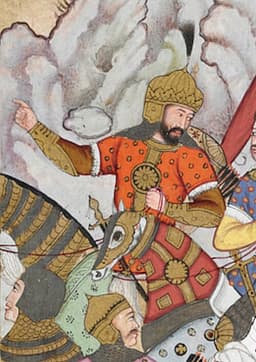
Ibrahim Lodi
Emperor · Medieval
40.6Total

Julius Caesar
General · Ancient
82.8Total
Basic Information
Born
1480
-100
Died
1526
-44
Era
Medieval
Ancient
Nationality
India
Roman Republic
Occupation
Emperor
General
Civilization
Indian
Western
Score Comparison
Military (10%)
50.0
88.0
Political (20%)
29.3
78.0
Influence (20%)
47.1
85.0
Legacy (20%)
36.7
82.0
Leadership (15%)
48.4
80.0
Strategy (15%)
30.3
85.0
TOTAL
40.6
82.8
Ibrahim Lodi — Complete Timeline
1520 AD
Alienation of the Afghan NobilityPolitical Action◆ Major
Ibrahim Lodi alienated the Afghan nobles by replacing them with low-born officials and treating them harshly. This led to widespread disaffection and rebellions, including the defection of Daulat Khan Lodi to Babur. It fatally weakened his rule.
NobilityPolitical MistakeRebellion
Impact: nationaldestructive
1524 AD
Suppression of the Rebellion of Rana SangaWar
Ibrahim Lodi led a campaign against the Rajput ruler Rana Sanga of Mewar, who had invaded Lodi territory. He forced Sanga to retreat but failed to decisively defeat him. This conflict diverted resources from the growing Mughal threat.
Rajput WarMewarMilitary Campaign
Impact: regional
1526 AD
Battle of PanipatWar
Ibrahim Lodi's army was defeated by Babur's Mughal forces at the First Battle of Panipat. Babur used gunpowder weapons and cavalry tactics to overwhelm the larger Lodi army. Ibrahim Lodi was killed in battle, ending the Lodi dynasty.
BattleMughal ConquestEnd of Dynasty
Impact: globaltragic
Julius Caesar — Complete Timeline
58 BC
Gallic WarsWar◆ Major
Caesar, as proconsul of Gaul, launched a series of campaigns that conquered all of Gaul (modern France, Belgium, and parts of Switzerland). He fought numerous battles, including against the Helvetii, the Belgae, and the Gallic chieftain Vercingetorix. The wars brought immense wealth and a loyal army to Caesar.
Gallic WarsConquestRoman Expansion
Impact: regional
49 BC
Crossing the RubiconPolitical Action◆ Major
Caesar led Legio XIII across the Rubicon River into Italy, defying the Roman Senate's order to disband his army. This act triggered a civil war against Pompey and the Optimates, ultimately leading to Caesar's dictatorship and the end of the Roman Republic.
Roman Civil WarEnd of RepublicPower Struggle
Impact: global
48 BC
Battle of PharsalusWar◆ Major
Caesar's outnumbered army defeated the larger forces of Pompey the Great at Pharsalus in Greece. Caesar's tactical use of a reserve line to counter Pompey's cavalry charge proved decisive. Pompey fled to Egypt, where he was assassinated, leaving Caesar as the undisputed master of the Roman world.
Roman Civil WarBattleDecisive Victory
Impact: regional
44 BC
Appointment as Dictator for LifePolitical Action◆ Major
The Roman Senate appointed Caesar dictator perpetuo (dictator for life), granting him unprecedented personal power. This move concentrated military, legislative, and judicial authority in one person, effectively ending the Roman Republic's traditional system of checks and balances and alarming many senators.
DictatorshipEnd of RepublicPower Consolidation
Impact: regionaldestructive
Assassination on the Ides of MarchPolitical Action◆ Major
A group of Roman senators, led by Marcus Junius Brutus and Gaius Cassius Longinus, stabbed Caesar to death at a meeting of the Senate in the Theatre of Pompey. The assassination was intended to restore the Republic, but instead triggered another civil war that led to the rise of the Roman Empire.
AssassinationRoman PoliticsEnd of Republic
Impact: globaldestructive
Expert Analysis
ibrahim-lodi-vs-julius-caesar
# The Crossing and the Collapse
On a January morning in 49 BCE, a fifty-year-old Roman general stood at the bank of the Rubicon River, a small stream that marked the boundary between his province and Rome itself. To cross with an army was treason. Julius Caesar paused, then uttered a gambler’s words: “The die is cast.” He crossed, and the Republic bled.
Fourteen hundred miles east and seventeen centuries later, another ruler faced his own Rubicon. In April 1526, near the town of Panipat, Sultan Ibrahim Lodi of Delhi mounted his war elephant and surveyed an army of perhaps fifty thousand men. Before him stood Babur, a Central Asian prince with far fewer soldiers—but with cannons and matchlock muskets. The sultan did not pause. He charged. By sunset, his head was on a pike, his dynasty extinguished.
Two men, both heirs to thrones, both fighting to hold power. One became the father of an empire; the other became a footnote. The difference was not merely in their victories, but in everything that came before.
Origins
Gaius Julius Caesar was born into a patrician family that had fallen on hard times—politically, if not financially. His Rome was a republic in decay, a city of marble and blood, where ambitious men clawed for power through military glory and popular favor. Caesar’s aunt had married Gaius Marius, the great populist general; his own wife was the daughter of Cinna, Marius’s ally. From boyhood, Caesar breathed the air of civil war and faction. He learned early that in Rome, survival meant alliance, and greatness meant risk.
Ibrahim Lodi was born into a different world. The Delhi Sultanate had ruled northern India for over three centuries, a patchwork of Turkic, Afghan, and Indian nobles held together by sword and faith. His grandfather Bahlul Lodi had founded the dynasty; his father Sikandar Lodi had consolidated it. Ibrahim inherited a throne at age thirty-seven, but he inherited also a nobility that saw the sultan as first among equals, not an absolute monarch. Where Caesar had to climb, Ibrahim had only to hold. And holding proved harder.
Rise to Power
Caesar’s path was a long, brilliant climb through the ranks of Roman politics. He was captured by pirates as a young man, laughed at their ransom demand, and later crucified them. He served as quaestor in Spain, aedile in Rome, and pontifex maximus—chief priest—by his late thirties. His military career began in earnest with the conquest of Gaul, a nine-year campaign that made him fabulously rich, gave him a loyal army, and terrified his enemies in the Senate. By the time he crossed the Rubicon, he had already spent a decade proving himself in the field and in the forum.
Ibrahim Lodi’s rise was simpler: his father died, and he became sultan. He had no campaigns to his name, no legend, no bond with the men who were supposed to serve him. Worse, he seems to have believed that the title alone was enough. Within a few years of his accession, he had managed to alienate nearly every powerful family in his kingdom.
Leadership & Governance
Caesar governed as he fought—with speed, calculation, and a willingness to forgive. After defeating his rival Pompey, Caesar pardoned many of his enemies and appointed them to high office. He reformed the calendar, extended citizenship to provincials, and launched massive building projects. His rule was autocratic, but it was also competent and generous. He understood that power required not just force, but legitimacy.
Ibrahim Lodi governed as he fought—with arrogance and rigidity. According to the chroniclers, he replaced Afghan nobles with low-born officials, insulted his commanders, and refused to share authority. By 1520, the Afghan nobility was in open revolt. His own governor of Punjab, Daulat Khan Lodi, invited Babur to invade. The sultan had no allies because he had made no friends. He had no strategy because he had never needed one.
The contrast is stark. Caesar’s political score of 78 reflects a man who, whatever his flaws, knew how to manage men. Ibrahim’s political score of 44 reflects a ruler who could not even manage his own court.
Triumph & Tragedy
Caesar’s greatest moment was perhaps his victory at the Battle of Alesia (52 BCE), where he besieged the Gallic chieftain Vercingetorix while simultaneously fighting off a massive relief army. It was a masterpiece of military engineering and nerve. His tragedy came on the Ides of March, 44 BCE, when sixty senators stabbed him to death in the Senate house. He died, according to tradition, covering his face with his toga—a man who had conquered Gaul but could not conquer the hatred of his peers.
Ibrahim Lodi’s tragedy was the Battle of Panipat. He had the numbers, the elephants, the home ground. Babur had the guns. The Mughal cannons terrified the Lodi war elephants, which turned and trampled their own infantry. The battle was over in hours. Ibrahim fought bravely, sources say, and died on the field. But bravery without strategy is just suicide.
Character & Destiny
Caesar was a man of immense charm, intellectual curiosity, and ruthless ambition. He wrote his own commentaries, seduced his enemies’ wives, and wept at the sight of Alexander the Great’s statue because he felt he had achieved nothing by the same age. His character drove him to take risks that would have destroyed lesser men—and it drove him to ignore warnings that he would be killed. He believed his luck would hold. It did not.
Ibrahim Lodi was, by most accounts, proud, suspicious, and isolated. He trusted no one, and so no one trusted him. He was not stupid—he fought his rebellion against Rana Sanga in 1524 with some skill—but he lacked the political imagination to see that a throne is not a fortress. It is a relationship.
Legacy
Caesar’s legacy is everywhere. His name became a title—Kaiser, Tsar. His calendar, with small adjustments, is the one we use. His conquests created the Roman Empire, and that empire shaped the West. He is remembered as a genius, a tyrant, and a turning point in history.
Ibrahim Lodi’s legacy is a cautionary tale. He is remembered as the last sultan of the Delhi Sultanate, the man whose incompetence opened the door for the Mughals. His scores—military 11.8, leadership 40.7—reflect a ruler who failed in almost every dimension. Yet he is not entirely to blame. The Lodi dynasty was fragile, the nobility fractious, and the gunpowder revolution was about to sweep across India. He was the wrong man at the wrong time.
Conclusion
Caesar and Ibrahim Lodi never met, never could have met. But their stories speak to the same truth: power is not given, it is built. Caesar built for decades, brick by brick, battle by battle, alliance by alliance. Ibrahim Lodi inherited a house already cracking and did nothing to shore it up. One crossed a river and remade the world. The other charged across a field and vanished from it.
The die is cast every day, in small decisions and large. For Caesar, it fell his way—until it did not. For Ibrahim Lodi, it never really rolled at all.
Rankings
🥇
Julius CaesarLeader
Mil: 88.0Pol: 78.0Inf: 85.0
82.8
🥈
Ibrahim Lodi
Mil: 50.0Pol: 29.3Inf: 47.1
40.6
+42.2 behind
How This Comparison Works
Algorithm
Each figure is scored on 6 dimensions (0—100 scale) based on structured historical data: Military (10%), Political (20%), Influence (20%), Legacy (20%), Leadership (15%), Strategy (15%). The weighted total produces the final ranking.
Data Sources
Scores are computed from structured sub-indicators in the database. Scale factors adjust for era (Ancient ×0.85, Modern ×1.0) and civilization size (Eastern ×1.05, Other ×0.80) to account for differences in population and military scale.
Maximum 3 Figures
Comparisons are limited to 2—3 figures to ensure readability and statistical meaningfulness.
Error Margins
±5 points per dimension — Sub-scores are derived from historical records with inherent uncertainty. Two figures within 5 points on a dimension should be considered roughly equivalent in that area.
Total Score Accuracy
±3 points overall — The weighted combination of 6 dimensions produces a total score with approximately ±3 points of uncertainty. Differences of less than 3 points are not statistically significant— the figures are effectively tied.
Known Limitations
- Historical records are incomplete and uneven across civilizations
- Figures from oral-tradition societies may be underrepresented
- Occupation labels can misclassify multi-role figures
- Scores measure capability and impact, not moral character
- Quantitative scoring is a comparison tool, not absolute truth
Capability Radar
Military (10%) — Battles & Warfare
Battles
20
95
Win Rate
10
92
Expansion
15
97
Political (20%) — Governance & Reform
Reform
15
90
Diplomacy
10
85
Economy
15
82
Influence (20%) — Cultural & Global Reach
Cultural
10
88
Global
10
94
Legacy (20%) — Historical Impact
Historical
20
95
Longevity
10
96
Leadership (15%) — Power & Stability
Tenure
30
75
Stability
10
60
Strategy (15%) — Tactics & Innovation
Strategy
15
94
Tactics
15
96
Reform
10
88
Similar Comparisons
Comments & Discussion
No comments yet. Be the first to share your thoughts!