Loading...
Hongwu Emperor vs Napoleon Bonaparte
Hongwu Emperor leads by 1.1 pts · 2 figures compared
…
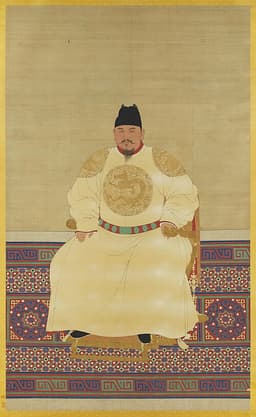
Hongwu Emperor
Emperor · Medieval
72.0Total

Napoleon Bonaparte
General · Modern
70.9Total
Basic Information
Born
1328
1769
Died
1398
1821
Era
Medieval
Modern
Nationality
China
France
Occupation
Emperor
General
Civilization
Eastern
Western
Score Comparison
Military (10%)
85.0
94.0
Political (20%)
78.0
72.0
Influence (20%)
68.0
40.0
Legacy (20%)
65.0
80.0
Leadership (15%)
78.0
78.0
Strategy (15%)
68.0
90.0
TOTAL
72.0
70.9
Hongwu Emperor — Complete Timeline
1368 AD
Capture of Dadu (Beijing)War◆ Major
Ming forces under Xu Da captured the Yuan capital of Dadu (modern Beijing). The last Yuan emperor fled to the steppes. This conquest ended Mongol rule in China proper and solidified Ming control over the northern heartland.
Yuan Dynasty FallBeijingMilitary Campaign
Impact: national
Agrarian Reforms and Land RedistributionReform◆ Major
Hongwu implemented land surveys and redistributed land from large estates to peasant farmers. He reduced taxes, promoted irrigation projects, and encouraged cultivation of wasteland. These policies revived agriculture after decades of war and famine.
Land ReformAgriculturePeasant Welfare
Impact: nationalprogressive
Founding of the Ming DynastyPolitical Action
Zhu Yuanzhang proclaimed himself the Hongwu Emperor in Nanjing, founding the Ming dynasty. He led rebel forces to expel the Mongol Yuan dynasty from China, restoring Han Chinese rule after nearly a century of foreign domination.
Dynasty FoundingHan RestorationMing Dynasty
Impact: globalconstructive
1380 AD
Execution of Hu Weiyong and Purge of OfficialsPolitical Action◆ Major
Hongwu accused Chancellor Hu Weiyong of treason and had him executed. This triggered a massive purge that killed tens of thousands of officials and their families. The emperor then abolished the position of chancellor, centralizing all power in his own hands.
PurgeCentralizationPolitical Violence
Impact: nationaldestructive
1382 AD
Establishment of the Jinyiwei (Imperial Guard)Political Action◆ Major
Hongwu created the Jinyiwei, a secret police force under his direct control. They spied on officials, investigated corruption, and suppressed dissent. This institution became a tool of political repression, executing thousands during purges.
Secret PoliceRepressionPolitical Control
Impact: nationaldestructive
Napoleon Bonaparte — Complete Timeline
1799 AD
Coup of 18 BrumaireOther◆ Major
Napoleon Bonaparte, with support from his brother Lucien and key political figures, overthrew the Directory in a bloodless coup. He established the Consulate with himself as First Consul, effectively becoming the ruler of France. This event ended the French Revolution's most unstable period.
French RevolutionCoupRise to Power
Impact: regional
1804 AD
Promulgation of the Napoleonic CodeOther◆ Major
Napoleon enacted the Civil Code of the French, known as the Napoleonic Code, a comprehensive set of laws that replaced the fragmented feudal legal systems. The code established legal equality, protected property rights, and secularized law. It became the basis for legal systems in many European and world countries.
Legal ReformNapoleonic CodeCivil Law
Impact: globalconstructive
1805 AD
Battle of AusterlitzWar◆ Major
Napoleon's Grande Arm
Napoleonic WarsBattleDecisive Victory
Impact: global
1812 AD
Invasion of RussiaWar◆ Major
Napoleon led the Grande Arm
Napoleonic WarsInvasionDisaster
Impact: globaldestructive
1815 AD
Battle of WaterlooWar◆ Major
Napoleon's French army was defeated by the combined forces of the Duke of Wellington's Anglo-Allied army and Gebhard Leberecht von Bl
Napoleonic WarsBattleFinal Defeat
Impact: globaldestructive
Expert Analysis
hongwu-emperor-vs-napoleon-bonaparte
# The Emperor and the Eagle: Two Paths to Power
On a frozen December morning in 1805, Napoleon Bonaparte watched his Grand Army crush the combined forces of Austria and Russia at Austerlitz. He was thirty-six years old, already master of Europe. Four centuries earlier and half a world away, a Chinese peasant named Zhu Yuanzhang watched from the walls of Nanjing as his rebel army drove the Mongol Yuan dynasty from the capital. Both men rose from nothing to rule empires. But the stories of Napoleon and the Hongwu Emperor reveal how the same ambition, shaped by radically different worlds, can lead to triumph—and to very different kinds of ruin.
Origins
Napoleon was born in 1769 on Corsica, a Mediterranean island that France had purchased from Genoa just a year before. His family was minor nobility, poor but proud. At nine, he entered a French military school, where his classmates mocked his accent and his small stature. He read voraciously—Caesar, Alexander, the Enlightenment philosophers—and he burned with the desire to prove himself. The French Revolution, which erupted when he was twenty, shattered the old order and opened doors that birth alone had once closed. For a brilliant young artillery officer, it was the perfect storm.
Zhu Yuanzhang’s origins were far grimmer. Born in 1328 to a family of tenant farmers in what is now Anhui province, he watched plague, famine, and flood wipe out his entire family when he was sixteen. Orphaned and starving, he entered a Buddhist monastery as a beggar monk. When the monastery ran out of food, he wandered for years, begging. The Mongol Yuan dynasty, weakened by corruption and rebellion, was collapsing. Zhu joined a rebel band, not out of ideology but survival. He had nothing to lose.
Rise to Power
Napoleon’s ascent was meteoric. In 1793, at twenty-four, he recaptured the port of Toulon from British forces with a brilliant artillery plan. By 1795, he saved the revolutionary government from a royalist uprising. In 1796, he was given command of the French army in Italy—and in a series of lightning campaigns, he defeated the Austrians and carved out a reputation as the greatest general of his age. He understood that in the chaos of revolution, a man with victories could write his own rules. By 1799, he staged a coup and made himself First Consul. By 1804, he crowned himself Emperor.
Zhu’s rise was slower, more brutal, and more collective. He joined the Red Turban rebels, a millenarian sect that believed in the coming of the Buddha Maitreya. He married the daughter of a rebel leader, earned a reputation for discipline and ruthlessness, and gradually built his own army. Unlike Napoleon, who fought for France, Zhu fought for a people—the Han Chinese, who had suffered a century under Mongol rule. His genius was political as much as military: he recruited Confucian scholars, established a civil administration, and presented himself as a restorer of Chinese civilization. In 1368, after fifteen years of war, he proclaimed the Ming dynasty in Nanjing. His army captured the Yuan capital, Dadu (modern Beijing), and the last Mongol emperor fled.
Leadership & Governance
Napoleon governed as a conqueror. He centralized the French state, created the Napoleonic Code—a legal system that enshrined equality before the law, property rights, and secular governance—and reformed education, finance, and the church. He was a military genius of the first order, with a Strategy score of 93, but his political wisdom was more fragile. He trusted his own brilliance above all, and he never built institutions that could survive without him. His empire was a pyramid balanced on his own head.
Hongwu governed as a peasant emperor who never forgot where he came from—or how easily power could be lost. His Political score of 80 reflects a ruler who understood that legitimacy required more than conquest. He redistributed land from large estates to peasant farmers, reduced taxes, and promoted agriculture. He rebuilt the irrigation systems, restored the examination system for civil servants, and established schools in every county. But his rule had a dark side. In 1380, he executed his own chancellor, Hu Weiyong, on charges of treason, then purged tens of thousands of officials in a paranoid bloodbath. In 1382, he created the Jinyiwei, a secret police force that spied on everyone. Napoleon conquered Europe; Hongwu conquered his own government.
Triumph & Tragedy
Napoleon’s greatest moment was Austerlitz, where he destroyed a larger allied army through deception and speed. His most devastating failure was the invasion of Russia in 1812. He marched 600,000 men into the vastness of the Russian winter; fewer than 100,000 came back. He was exiled to Elba in 1814, returned for a hundred days, and met his final defeat at Waterloo in 1815. He died in 1821 on the remote island of Saint Helena, a prisoner of the British.
Hongwu’s greatest moment was the founding of the Ming dynasty itself—the reunification of China under Han rule after nearly a century of foreign domination. His tragedy was the system he built. His purges decimated the educated class he needed to run the empire. His paranoia created a court of fear. When he died in 1398, he left a stable but brittle state, one that would struggle with corruption and factionalism for the next two centuries.
Character & Destiny
Napoleon was driven by ambition without limit. “The world suffers a lot,” he once said, “not because of the violence of bad people, but because of the silence of good people.” But he was not silent—he was relentless. He believed that a man could shape history through will alone. And for a time, he did. But his personality—arrogant, impatient, unable to delegate—also sealed his fate. He could not stop conquering, even when conquest no longer served him.
Hongwu was driven by fear as much as ambition. He had seen the world collapse, had starved, had begged. He knew that power was fragile and that betrayal was always waiting. So he built walls—around his empire, around his court, around his own mind. His personality created a state that was strong but paranoid, stable but cruel. He died knowing he had saved China, but also knowing he had drowned it in blood.
Legacy
Napoleon left behind the Napoleonic Code, the model for modern civil law across Europe and the world. He left behind the myth of the self-made man, the idea that genius can rewrite history. His Influence score of 82 reflects a figure who, even in defeat, reshaped the modern world. But his legacy is ambiguous: liberator or tyrant, reformer or conqueror? He is remembered as a force of nature, a man who changed the rules.
Hongwu left behind the Ming dynasty, which ruled China for nearly three centuries. He left behind a restored Confucian order, a revitalized agriculture, and a bureaucracy that, for all its flaws, served as the backbone of Chinese governance. His Legacy score of 75.1 is lower than Napoleon’s, but his impact was deeper in its own way. He is remembered as a peasant who became emperor, a man who saved China from foreign rule and then ruled it with an iron hand.
Conclusion
Napoleon and Hongwu both rose from nothing, both built empires, both shaped history. But one conquered Europe and fell, while the other conquered China and endured. The difference was not talent—Napoleon was the greater military mind. It was not ambition—both had it in abundance. It was the worlds they inhabited. Napoleon lived in a Europe of competing states, where a single genius could redraw borders in a single campaign. Hongwu lived in a China of deep civilizational memory, where legitimacy came from restoring order, not from breaking it. Napoleon’s story is about the power of the individual; Hongwu’s is about the power of the system. Both are true. And both, in their own ways, are warnings.
Rankings
🥇
Hongwu EmperorLeader
Mil: 85.0Pol: 78.0Inf: 68.0
72.0
🥈
Napoleon Bonaparte
Mil: 94.0Pol: 72.0Inf: 40.0
70.9
+1.1 behind
How This Comparison Works
Algorithm
Each figure is scored on 6 dimensions (0—100 scale) based on structured historical data: Military (10%), Political (20%), Influence (20%), Legacy (20%), Leadership (15%), Strategy (15%). The weighted total produces the final ranking.
Data Sources
Scores are computed from structured sub-indicators in the database. Scale factors adjust for era (Ancient ×0.85, Modern ×1.0) and civilization size (Eastern ×1.05, Other ×0.80) to account for differences in population and military scale.
Maximum 3 Figures
Comparisons are limited to 2—3 figures to ensure readability and statistical meaningfulness.
Error Margins
±5 points per dimension — Sub-scores are derived from historical records with inherent uncertainty. Two figures within 5 points on a dimension should be considered roughly equivalent in that area.
Total Score Accuracy
±3 points overall — The weighted combination of 6 dimensions produces a total score with approximately ±3 points of uncertainty. Differences of less than 3 points are not statistically significant— the figures are effectively tied.
Known Limitations
- Historical records are incomplete and uneven across civilizations
- Figures from oral-tradition societies may be underrepresented
- Occupation labels can misclassify multi-role figures
- Scores measure capability and impact, not moral character
- Quantitative scoring is a comparison tool, not absolute truth
Capability Radar
Military (10%) — Battles & Warfare
Battles
85
95
Win Rate
90
90
Expansion
80
95
Political (20%) — Governance & Reform
Reform
90
95
Diplomacy
70
80
Economy
85
85
Influence (20%) — Cultural & Global Reach
Cultural
75
85
Global
70
90
Legacy (20%) — Historical Impact
Historical
85
95
Longevity
80
90
Leadership (15%) — Power & Stability
Tenure
85
85
Stability
80
70
Strategy (15%) — Tactics & Innovation
Strategy
85
95
Tactics
80
98
Reform
75
92
Similar Comparisons
Comments & Discussion
No comments yet. Be the first to share your thoughts!