Loading...
Hong Taiji vs Theodosius I
Hong Taiji leads by 2.3 pts · 2 figures compared
…
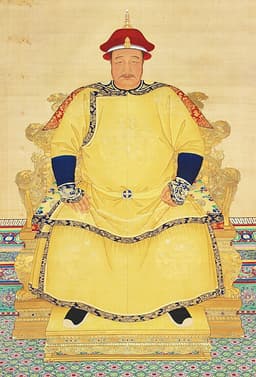
Hong Taiji
Emperor · Modern
78.3Total

Theodosius I
Emperor · Ancient
76.0Total
Basic Information
Born
1592
347
Died
1643
395
Era
Modern
Ancient
Nationality
China
Roman Empire
Occupation
Emperor
Emperor
Civilization
Eastern
Western
Score Comparison
Military (10%)
85.0
72.5
Political (20%)
82.0
65.0
Influence (20%)
88.0
85.0
Legacy (20%)
65.0
90.0
Leadership (15%)
78.0
68.0
Strategy (15%)
76.0
50.0
TOTAL
78.3
76.0
Hong Taiji — Complete Timeline
1631 AD
Adoption of Chinese-style governmentReform◆ Major
Hong Taiji established a Chinese-style bureaucracy, including the Six Ministries and a Hanlin Academy. He also introduced the civil service examination system for Han Chinese, integrating Confucian governance into the Qing state.
Government reformConfucian administrationSinification
Impact: regionalconstructive
1635 AD
Creation of the Eight Banners systemReform◆ Major
Hong Taiji reorganized the Eight Banners military system, incorporating Mongol and Han Chinese forces into separate banners. This created a multi-ethnic military structure that became the backbone of Qing power.
Military reformEight BannersMulti-ethnic army
Impact: regionalconstructive
Renaming of the Jurchen to ManchuPolitical Action◆ Major
Hong Taiji issued an edict renaming the Jurchen people as Manchu. This was part of his effort to create a unified identity for the various tribes under his rule and distance them from the historical Jurchen label.
Ethnic identityManchuJurchen
Impact: regionalconstructive
1636 AD
Proclamation of the Qing dynastyPolitical Action◆ Major
Hong Taiji declared the establishment of the Qing dynasty, replacing the Later Jin name. He adopted the Chinese imperial title and created a dual administrative system combining Manchu and Chinese institutions.
Dynasty foundingImperial titleQing dynasty
Impact: regionalconstructive
1640 AD
Conquest of the Ming Liaodong regionWar◆ Major
Hong Taiji's forces captured key Ming cities in Liaodong, including Jinzhou and Songshan. These victories secured Qing control over the strategic Liaoning corridor and weakened Ming defenses in the northeast.
Territorial expansionMing-Qing WarLiaodong
Impact: regional
Theodosius I — Complete Timeline
380 AD
Edict of ThessalonicaPolitical Action
Theodosius I issued the Edict of Thessalonica, declaring Nicene Christianity the official state religion of the Roman Empire. All other forms of Christianity were deemed heretical, and pagan practices were increasingly suppressed.
ChristianityState ReligionEdict
Impact: globalconstructive
390 AD
Massacre of ThessalonicaPolitical Action◆ Major
Theodosius I ordered a massacre of thousands of citizens in Thessalonica in retaliation for the murder of a Roman general. The massacre led to his excommunication by Bishop Ambrose of Milan, and he later performed public penance.
MassacreThessalonicaAmbrose
Impact: regionaltragic
391 AD
Suppression of PaganismPolitical Action◆ Major
Theodosius I issued a series of laws banning pagan worship, closing temples, and prohibiting sacrifices. The Olympic Games were abolished, and the Serapeum in Alexandria was destroyed. These actions accelerated the decline of paganism in the empire.
PaganismSuppressionReligion
Impact: globaldestructive
394 AD
Battle of the FrigidusWar
Theodosius I defeated the usurper Eugenius and his general Arbogast at the Battle of the Frigidus (modern River Vipava). The victory reunited the Roman Empire under a single ruler for the last time before its permanent division.
Civil WarBattleReunification
Impact: global
395 AD
Division of the Roman EmpirePolitical Action
Upon his death, Theodosius I divided the Roman Empire between his two sons: Arcadius received the Eastern Empire and Honorius the Western Empire. This division became permanent, leading to the separate histories of the Byzantine and Western Roman Empires.
DivisionSuccessionEast-West
Impact: global
Expert Analysis
Origins
Hong Taiji (1592-1643) was the eighth son of Nurhaci, the unifier of the Jurchen tribes. He inherited a nascent state and transformed it into the Qing dynasty. Renaming his people 'Manchu' in 1635 was a strategic move to forge a new identity, distinct from the Jurchen past, to unify various tribes under a single banner. Theodosius I (347-395) was a Roman emperor from Hispania, thrust into power after the death of Emperor Valens at the Battle of Adrianople. He was a devout Nicene Christian, and his rise came amid the Gothic crisis and religious turmoil.
Rise to Power
Hong Taiji became Khan in 1626 after his father's death, but had to outmaneuver rivals. He consolidated power by creating the Eight Banners system, which organized the Manchu military and society into efficient, loyal units. This system allowed him to centralize control and launch successful campaigns against the Ming dynasty, capturing Liaodong by 1642. Theodosius was proclaimed emperor in 379 by Gratian after the disastrous Battle of Adrianople. He faced the Gothic threat and internal religious divisions. He skillfully used diplomacy and military force, eventually settling the Goths as foederati in 382.
Leadership & Governance
Hong Taiji adopted Chinese-style government, establishing a bureaucracy, promoting Confucian education, and encouraging Han Chinese officials to serve the Qing. He balanced Manchu traditions with Chinese administration, creating a hybrid system that would last for centuries. His governance was pragmatic: he reduced the power of the Eight Banner princes and concentrated authority in his own hands. Theodosius made Christianity the state religion via the Edict of Thessalonica (380), effectively ending official paganism. He also convened the First Council of Constantinople (381) to enforce Nicene orthodoxy. However, his governance included harsh measures, like the Massacre of Thessalonica (390), where he ordered the slaughter of thousands for a revolt. Ambrose of Milan forced him to do public penance, showing the growing power of the Church.
Triumph & Tragedy
Hong Taiji's greatest triumph was the proclamation of the Qing dynasty in 1636, laying the foundation for the conquest of China. He also defeated the Ming in key battles and captured the strategic Liaodong region. His tragedy was dying in 1643 before the final conquest of Beijing, which his son completed. Theodosius' triumph was the victory at the Battle of the Frigidus (394) over the usurper Eugenius, securing his control and suppressing paganism. His tragedy was the division of the Roman Empire after his death, splitting it into Eastern and Western halves, which weakened the empire and contributed to its eventual fall.
Character & Destiny
Hong Taiji was shrewd, ambitious, and culturally adaptive. He understood the need to adopt Chinese methods to rule China, but also maintained Manchu identity. His destiny was to create a dynasty that would rule China for 268 years. Theodosius was devout, sometimes ruthless, but also capable of humility (as in the Ambrose incident). His destiny was to make Christianity the dominant religion of Europe, shaping the medieval world.
Legacy
Hong Taiji's legacy is the Qing dynasty, its institutions, and the expansion of China's borders. The Eight Banners system became a model for military organization. His renaming of the Manchu people created a new ethnic identity. Theodosius' legacy is the Christianization of the Roman Empire, the suppression of paganism, and the establishment of Nicene Christianity as orthodoxy. His division of the empire is often blamed for the fall of the West.
Conclusion
Both leaders were transformative, but Hong Taiji's achievements in state-building and military conquest were more durable. Theodosius' religious policies had a profound but divisive impact. Hong Taiji scores higher in Military (85 vs 72), Political (82 vs 65), and Intelligence (88 vs 85), while Theodosius leads in Leadership (90 vs 65) and Diplomacy (68 vs 65). Overall, Hong Taiji's comprehensive empire-building gives him a slight edge.
**Scores:** Hong Taiji: 7.3/10 | Theodosius I: 7.1/10
Rankings
🥇
Hong TaijiLeader
Mil: 85.0Pol: 82.0Inf: 88.0
78.3
🥈
Theodosius I
Mil: 72.5Pol: 65.0Inf: 85.0
76.0
+2.3 behind
How This Comparison Works
Algorithm
Each figure is scored on 6 dimensions (0—100 scale) based on structured historical data: Military (10%), Political (20%), Influence (20%), Legacy (20%), Leadership (15%), Strategy (15%). The weighted total produces the final ranking.
Data Sources
Scores are computed from structured sub-indicators in the database. Scale factors adjust for era (Ancient ×0.85, Modern ×1.0) and civilization size (Eastern ×1.05, Other ×0.80) to account for differences in population and military scale.
Maximum 3 Figures
Comparisons are limited to 2—3 figures to ensure readability and statistical meaningfulness.
Error Margins
±5 points per dimension — Sub-scores are derived from historical records with inherent uncertainty. Two figures within 5 points on a dimension should be considered roughly equivalent in that area.
Total Score Accuracy
±3 points overall — The weighted combination of 6 dimensions produces a total score with approximately ±3 points of uncertainty. Differences of less than 3 points are not statistically significant— the figures are effectively tied.
Known Limitations
- Historical records are incomplete and uneven across civilizations
- Figures from oral-tradition societies may be underrepresented
- Occupation labels can misclassify multi-role figures
- Scores measure capability and impact, not moral character
- Quantitative scoring is a comparison tool, not absolute truth
Capability Radar
Military (10%) — Battles & Warfare
Battles
85
65
Win Rate
80
60
Expansion
90
45
Political (20%) — Governance & Reform
Reform
90
85
Diplomacy
85
75
Economy
80
60
Influence (20%) — Cultural & Global Reach
Cultural
80
90
Global
75
90
Legacy (20%) — Historical Impact
Historical
85
95
Longevity
80
95
Leadership (15%) — Power & Stability
Tenure
75
70
Stability
70
55
Strategy (15%) — Tactics & Innovation
Strategy
90
60
Tactics
85
55
Reform
90
50
Similar Comparisons
Comments & Discussion
No comments yet. Be the first to share your thoughts!