Loading...
Hong Taiji vs Ruhollah Khomeini
Hong Taiji leads by 3.2 pts · 2 figures compared
…
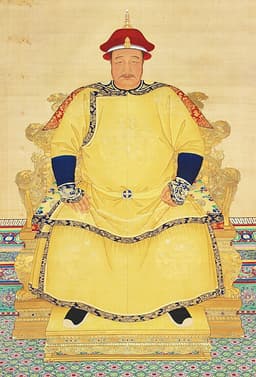
Hong Taiji
Emperor · Modern
78.3Total

Ruhollah Khomeini
Politician · Modern
75.1Total
Basic Information
Born
1592
1902
Died
1643
1989
Era
Modern
Modern
Nationality
China
Iran
Occupation
Emperor
Politician
Civilization
Eastern
Middle Eastern
Score Comparison
Military (10%)
85.0
41.6
Political (20%)
82.0
65.0
Influence (20%)
88.0
85.0
Legacy (20%)
65.0
90.0
Leadership (15%)
78.0
80.0
Strategy (15%)
76.0
54.3
TOTAL
78.3
75.1
Hong Taiji — Complete Timeline
1631 AD
Adoption of Chinese-style governmentReform◆ Major
Hong Taiji established a Chinese-style bureaucracy, including the Six Ministries and a Hanlin Academy. He also introduced the civil service examination system for Han Chinese, integrating Confucian governance into the Qing state.
Government reformConfucian administrationSinification
Impact: regionalconstructive
1635 AD
Creation of the Eight Banners systemReform◆ Major
Hong Taiji reorganized the Eight Banners military system, incorporating Mongol and Han Chinese forces into separate banners. This created a multi-ethnic military structure that became the backbone of Qing power.
Military reformEight BannersMulti-ethnic army
Impact: regionalconstructive
Renaming of the Jurchen to ManchuPolitical Action◆ Major
Hong Taiji issued an edict renaming the Jurchen people as Manchu. This was part of his effort to create a unified identity for the various tribes under his rule and distance them from the historical Jurchen label.
Ethnic identityManchuJurchen
Impact: regionalconstructive
1636 AD
Proclamation of the Qing dynastyPolitical Action◆ Major
Hong Taiji declared the establishment of the Qing dynasty, replacing the Later Jin name. He adopted the Chinese imperial title and created a dual administrative system combining Manchu and Chinese institutions.
Dynasty foundingImperial titleQing dynasty
Impact: regionalconstructive
1640 AD
Conquest of the Ming Liaodong regionWar◆ Major
Hong Taiji's forces captured key Ming cities in Liaodong, including Jinzhou and Songshan. These victories secured Qing control over the strategic Liaoning corridor and weakened Ming defenses in the northeast.
Territorial expansionMing-Qing WarLiaodong
Impact: regional
Ruhollah Khomeini — Complete Timeline
1964 AD
Exile to Iraq and FrancePolitical Action◆ Major
Khomeini was exiled from Iran after criticizing the Shah's White Revolution and granting of diplomatic immunity to US personnel. He settled in Najaf, Iraq, and later in France, where he continued to organize opposition to the Shah.
ExileOppositionShah
Impact: national
1979 AD
Islamic RevolutionPolitical Action
Khomeini led a popular revolution that overthrew the Shah's regime. He returned to Iran in February 1979 and established an Islamic Republic based on his doctrine of Velayat-e Faqih (Guardianship of the Jurist), with himself as Supreme Leader.
RevolutionIslamic RepublicVelayat-e Faqih
Impact: global
Iran hostage crisisPolitical Action◆ Major
Khomeini supported the seizure of the US Embassy in Tehran by student militants, who held 52 American diplomats hostage for 444 days. The crisis deepened the rift with the US, led to economic sanctions, and consolidated Khomeini's power.
Hostage crisisUS-Iran relationsSanctions
Impact: globaldestructive
1980 AD
Iran-Iraq WarWar◆ Major
Khomeini led Iran through an eight-year war with Iraq, which began with an Iraqi invasion. The war resulted in hundreds of thousands of casualties and massive economic destruction, ending in a stalemate. Khomeini accepted a UN ceasefire in 1988.
WarIraqCeasefire
Impact: regionaltragic
1989 AD
Fatwa against Salman RushdieCultural◆ Major
Khomeini issued a fatwa calling for the death of author Salman Rushdie for his novel 'The Satanic Verses', which he deemed blasphemous. The fatwa led to international controversy, diplomatic tensions, and attacks on Rushdie's translators.
FatwaBlasphemyInternational controversy
Impact: globaldestructive
Expert Analysis
Origins
Hong Taiji (1592–1643) was born into the Jurchen Aisin Gioro clan, a semi-nomadic people in Manchuria. His father, Nurhaci, united the Jurchen tribes and founded the Later Jin dynasty. Hong Taiji inherited a militaristic state built on tribal alliances and the Eight Banners system. In contrast, Ruhollah Khomeini (1902–1989) was born in Khomeyn, Iran, into a family of Shia clerics. His father was murdered when he was young, and he was raised by his mother and aunt. Khomeini received a traditional religious education, becoming a grand ayatollah. While Hong Taiji emerged from a world of clan warfare and expansion, Khomeini was shaped by Shia theology and opposition to Western imperialism.
Rise to Power
Hong Taiji became khan of the Later Jin in 1626 after Nurhaci's death. He consolidated power by centralizing authority, reducing the influence of other princes, and promoting Han Chinese advisors. In 1635, he renamed his people "Manchu" to forge a new identity and in 1636 proclaimed the Qing dynasty, positioning himself as a Chinese-style emperor. Khomeini rose to prominence in the 1960s by opposing the Shah's White Revolution and Westernization. Exiled in 1964, he continued activism from Iraq and France. His return to Iran in 1979 sparked the Islamic Revolution, leading to the overthrow of the monarchy. Both leaders used ideological transformation—ethnic redefinition for Hong Taiji, religious revolution for Khomeini.
Leadership & Governance
Hong Taiji adopted Chinese bureaucratic systems while preserving Manchu military traditions. He established the Six Ministries, promoted Confucian learning, and integrated Han officials into government. His creation of the Eight Banners system combined military and administrative functions, enabling effective control. Khomeini implemented the Velayat-e Faqih (Guardianship of the Jurist), placing supreme authority in a religious jurist. He suppressed political rivals, enforced Islamic law, and established a theocratic state. Both were autocrats, but Hong Taiji's governance was pragmatic and adaptive, while Khomeini's was ideologically rigid. Hong Taiji's scores (L=65, S=76) reflect moderate longevity and stability; Khomeini's (L=90, S=54) show high longevity but lower stability due to revolutionary turmoil.
Triumph & Tragedy
Hong Taiji's triumphs include conquering the Ming Liaodong region, solidifying Qing control over northern China, and laying foundations for the eventual conquest of the Ming. His tragedy was dying before seeing the full Qing unification. Khomeini's triumph was the Islamic Revolution, ending the Shah's regime and establishing an Islamic republic. His tragedies include the Iran-Iraq War (1980–1988), which caused massive casualties, and the Iran hostage crisis, which isolated Iran internationally. The fatwa against Salman Rushdie further damaged relations. Hong Taiji's military successes (M=85) contrast with Khomeini's lower military score (M=42), reflecting their different domains of power.
Character & Destiny
Hong Taiji was pragmatic, strategic, and culturally adaptive. He learned Chinese, respected Confucian norms, and sought legitimacy as a universal emperor. His destiny was to transform a tribal confederation into a dynastic empire. Khomeini was charismatic, uncompromising, and deeply ideological. He saw himself as a defender of Islam against tyranny and imperialism. His destiny was to create a revolutionary state that reshaped the Middle East. Hong Taiji's political acumen (P=82) and intelligence (I=88) enabled his state-building; Khomeini's intelligence (I=85) and charisma (D=80) drove his movement.
Legacy
Hong Taiji's legacy is the Qing dynasty, which ruled China for 268 years, expanded its borders, and fostered cultural integration. He is remembered as a founder and reformer. Khomeini's legacy is the Islamic Republic of Iran, which endures as a theocratic regime. His ideas influence Shia movements worldwide. Both left profound impacts, but Hong Taiji's empire was more stable and enduring. Khomeini's revolution remains contested. In a comparative assessment, Hong Taiji scores higher overall (78.8 vs 75.6), with superior military, political, and strategic achievements.
Conclusion
Hong Taiji and Khomeini were transformative leaders who built new orders from chaos. Hong Taiji's empire-building, cultural synthesis, and pragmatic governance make him the more successful leader on a global scale. Khomeini's ideological revolution had a narrower but intense impact. The score gap of 3.2 reflects Hong Taiji's stronger foundation for long-term stability. While both are giants of history, Hong Taiji's legacy of inclusive statecraft outweighs Khomeini's divisive theocracy.
**Final Scores:**
- Hong Taiji: 78.8
- Khomeini: 75.6
- Winner: Hong Taiji by 3.2 points
Rankings
🥇
Hong TaijiLeader
Mil: 85.0Pol: 82.0Inf: 88.0
78.3
🥈
Ruhollah Khomeini
Mil: 41.6Pol: 65.0Inf: 85.0
75.1
+3.2 behind
How This Comparison Works
Algorithm
Each figure is scored on 6 dimensions (0—100 scale) based on structured historical data: Military (10%), Political (20%), Influence (20%), Legacy (20%), Leadership (15%), Strategy (15%). The weighted total produces the final ranking.
Data Sources
Scores are computed from structured sub-indicators in the database. Scale factors adjust for era (Ancient ×0.85, Modern ×1.0) and civilization size (Eastern ×1.05, Other ×0.80) to account for differences in population and military scale.
Maximum 3 Figures
Comparisons are limited to 2—3 figures to ensure readability and statistical meaningfulness.
Error Margins
±5 points per dimension — Sub-scores are derived from historical records with inherent uncertainty. Two figures within 5 points on a dimension should be considered roughly equivalent in that area.
Total Score Accuracy
±3 points overall — The weighted combination of 6 dimensions produces a total score with approximately ±3 points of uncertainty. Differences of less than 3 points are not statistically significant— the figures are effectively tied.
Known Limitations
- Historical records are incomplete and uneven across civilizations
- Figures from oral-tradition societies may be underrepresented
- Occupation labels can misclassify multi-role figures
- Scores measure capability and impact, not moral character
- Quantitative scoring is a comparison tool, not absolute truth
Capability Radar
Military (10%) — Battles & Warfare
Battles
85
10
Win Rate
80
10
Expansion
90
10
Political (20%) — Governance & Reform
Reform
90
90
Diplomacy
85
75
Economy
80
40
Influence (20%) — Cultural & Global Reach
Cultural
80
85
Global
75
85
Legacy (20%) — Historical Impact
Historical
85
90
Longevity
80
80
Leadership (15%) — Power & Stability
Tenure
75
85
Stability
70
50
Strategy (15%) — Tactics & Innovation
Strategy
90
15
Tactics
85
10
Reform
90
20
Similar Comparisons
Comments & Discussion
No comments yet. Be the first to share your thoughts!