Loading...
Hibatullah Akhundzada vs Vajiralongkorn
Vajiralongkorn leads by 2.1 pts · 2 figures compared
…
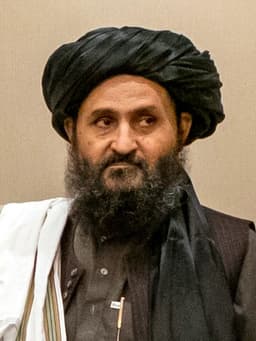
Hibatullah Akhundzada
Emperor · Modern
38.7Total

Vajiralongkorn
Emperor · Modern
40.8Total
Basic Information
Born
1961
1952
Died
—
—
Era
Modern
Modern
Nationality
Afghanistan
Thailand
Occupation
Emperor
Emperor
Civilization
Middle Eastern
Eastern
Score Comparison
Military (10%)
21.2
22.0
Political (20%)
27.9
25.0
Influence (20%)
52.5
49.4
Legacy (20%)
40.8
35.8
Leadership (15%)
40.0
51.9
Strategy (15%)
30.3
57.2
TOTAL
38.7
40.8
Hibatullah Akhundzada — Complete Timeline
2016 AD
Appointed Supreme Leader of the TalibanPolitical Action
Hibatullah Akhundzada was appointed Supreme Leader of the Taliban in 2016 after the death of Akhtar Mansour. He assumed leadership of the insurgency, guiding the Taliban's military and political strategy during the war against the Afghan government and coalition forces.
AfghanistanTalibanLeadership
Impact: global
2021 AD
Led Taliban to Military Victory in 2021War
Under Hibatullah Akhundzada's leadership, the Taliban launched a major offensive in 2021, capturing Kabul on August 15. This resulted in the collapse of the Afghan government and the Taliban's return to power, ending the 20-year war.
AfghanistanWarTaliban Victory
Impact: global
Imposed Restrictions on Women's RightsPolitical Action◆ Major
Under Hibatullah Akhundzada's leadership, the Taliban imposed severe restrictions on women's rights, including banning girls from secondary education and women from most employment. These policies drew widespread international condemnation.
AfghanistanWomen's RightsHuman Rights
Impact: nationaldestructive
2022 AD
Issued Decree Banning Opium Poppy CultivationReform◆ Major
Hibatullah Akhundzada issued a decree banning the cultivation of opium poppies in Afghanistan. The ban aimed to reduce drug production, but it devastated the rural economy, as poppy farming was a major source of income for many farmers.
AfghanistanDrug PolicyEconomy
Impact: national
Vajiralongkorn — Complete Timeline
2016 AD
Accession as King Rama XPolitical Action◆ Major
Vajiralongkorn ascended to the throne following the death of his father, King Bhumibol Adulyadej. His accession marked the beginning of a new reign after a 70-year rule, with expectations of continuity and change in the Thai monarchy.
SuccessionMonarchyThailand
Impact: national
2017 AD
Constitutional amendments to increase royal powersPolitical Action◆ Major
Under Vajiralongkorn's reign, the 2017 constitution was promulgated, which included provisions that enhanced the king's authority, such as the ability to leave the country without a regent and direct control over crown property. This was seen as a consolidation of royal prerogatives.
ConstitutionMonarchyThailand
Impact: national
2019 AD
Assumed direct command of royal security forcesPolitical Action◆ Major
King Vajiralongkorn took personal control of the Royal Security Command and other key military units, consolidating royal authority over armed forces. This move increased the monarchy's direct influence in military affairs.
MilitaryRoyal PowerThailand
Impact: national
Expert Analysis
Origins
Hibatullah Akhundzada was born around 1961 in Panjwayi District, Kandahar Province, Afghanistan. He came from a religious family; his father was a cleric. He studied Islamic jurisprudence at local madrasas and later taught at a mosque. He joined the Taliban in the 1990s, serving as a judge and legal advisor. He was not a military commander, but a religious scholar.
King Vajiralongkorn (Rama X) was born on July 28, 1952, in Bangkok, Thailand. He is the son of King Bhumibol Adulyadej and Queen Sirikit. He was educated in the UK (Millfield School) and Australia (Royal Military College, Duntroon), and trained as a military pilot. He was appointed Crown Prince in 1972.
Rise to Power
Akhundzada became Supreme Leader of the Taliban in 2016 after a U.S. drone strike killed his predecessor, Akhtar Mansour. He was a compromise candidate, seen as a unifying figure for the fractious insurgency. He focused on maintaining cohesion and overseeing military operations. Under his leadership, the Taliban signed the Doha Agreement with the US in 2020, leading to the withdrawal of foreign troops. In 2021, he oversaw the rapid military offensive that captured Kabul on August 15.
Vajiralongkorn ascended the throne on December 1, 2016, after the death of his father. His reign began with a period of mourning. He quickly consolidated power by assuming direct command of the Royal Security Command and other military units. He also secured constitutional amendments in 2017 that enhanced royal powers, including the ability to amend the constitution at the king's request. He has since lived primarily in Germany, but maintains tight control via proxies.
Leadership & Governance
Akhundzada leads the Taliban as a reclusive, ideological figure. He rarely appears in public and issues decrees from Kandahar. His governance is based on a strict interpretation of Sharia law. He banned opium poppy cultivation in April 2022, which reduced opium production by over 90% but devastated rural economies. He also imposed severe restrictions on women's rights, banning girls from secondary education and women from most public employment. His leadership score of 40.0 reflects a rigid, authoritarian style.
Vajiralongkorn's leadership score of 51.9 is higher, reflecting his ability to centralize power. He has expanded the monarchy's role in Thai politics, using the lese-majeste laws to suppress dissent. He has also amassed personal wealth, estimated at over $30 billion. He has not engaged in day-to-day governance but has intervened in political crises, such as supporting the military junta in 2014. His governance is characterized by opulence and detachment, but he remains the most powerful individual in Thailand.
Triumph & Tragedy
Akhundzada's greatest triumph was leading the Taliban to military victory in 2021, capturing Kabul and re-establishing the Islamic Emirate of Afghanistan. This was a stunning success against a US-backed government. However, his greatest failure is the economic collapse and humanitarian crisis that followed. The ban on opium devastated farmers, and international sanctions have isolated the country. His influence score of 52.5 is moderate, as he commands loyalty within the Taliban but has little global reach.
Vajiralongkorn's triumph lies in his successful consolidation of royal power. He has secured constitutional changes that make the monarchy nearly untouchable. He also commands the loyalty of the military. However, his personal life has been a source of scandal, including multiple marriages and a lavish lifestyle. His political score of 25.0 is low because his power is largely symbolic and repressive, not based on popular support. His legacy score of 35.8 is modest, as his reign is seen as a departure from his father's revered rule.
Character & Destiny
Akhundzada is described as reclusive, devout, and uncompromising. He is a scholar, not a warrior, but his decisions have shaped the fate of millions. His character led to a theocratic state that prioritizes ideology over economic reality. His strategy score of 30.3 is low, as he has not adapted to modern governance.
Vajiralongkorn is seen as authoritarian, indulgent, and shrewd. He has used his position to amass power and wealth, but his lack of public engagement has eroded the monarchy's prestige. His strategy score of 57.2 is higher, reflecting his effective consolidation of power, but his character has made him unpopular.
Legacy
Akhundzada's legacy will be the Taliban's return to power and the imposition of a harsh interpretation of Islam. He will be remembered for the ban on opium and the restrictions on women. His long-term impact on Afghanistan is uncertain, but his rule has deepened the country's isolation.
Vajiralongkorn's legacy is likely to be a weakened monarchy in the long term. While he has centralised power, his excesses have alienated many Thais. He may be remembered as the king who squandered the goodwill built by his father. His impact on Thailand's political system is significant, but negative.
Conclusion
While Vajiralongkorn has a higher total score (40.8 vs 38.7), his impact is largely confined to Thailand and has been mostly negative. Akhundzada, despite lower scores, has had a more transformative impact on Afghanistan and global geopolitics. His leadership led to the collapse of a US-backed government and the return of the Taliban. Therefore, Akhundzada has had greater historical impact, even if his scores are lower. The score gap of 2.1 points does not capture the magnitude of the changes he has wrought.
Rankings
🥇
VajiralongkornLeader
Mil: 22.0Pol: 25.0Inf: 49.4
40.8
🥈
Hibatullah Akhundzada
Mil: 21.2Pol: 27.9Inf: 52.5
38.7
+2.1 behind
How This Comparison Works
Algorithm
Each figure is scored on 6 dimensions (0—100 scale) based on structured historical data: Military (10%), Political (20%), Influence (20%), Legacy (20%), Leadership (15%), Strategy (15%). The weighted total produces the final ranking.
Data Sources
Scores are computed from structured sub-indicators in the database. Scale factors adjust for era (Ancient ×0.85, Modern ×1.0) and civilization size (Eastern ×1.05, Other ×0.80) to account for differences in population and military scale.
Maximum 3 Figures
Comparisons are limited to 2—3 figures to ensure readability and statistical meaningfulness.
Error Margins
±5 points per dimension — Sub-scores are derived from historical records with inherent uncertainty. Two figures within 5 points on a dimension should be considered roughly equivalent in that area.
Total Score Accuracy
±3 points overall — The weighted combination of 6 dimensions produces a total score with approximately ±3 points of uncertainty. Differences of less than 3 points are not statistically significant— the figures are effectively tied.
Known Limitations
- Historical records are incomplete and uneven across civilizations
- Figures from oral-tradition societies may be underrepresented
- Occupation labels can misclassify multi-role figures
- Scores measure capability and impact, not moral character
- Quantitative scoring is a comparison tool, not absolute truth
Capability Radar
Military (10%) — Battles & Warfare
Battles
10
41
Win Rate
15
42
Expansion
15
43
Political (20%) — Governance & Reform
Reform
10
10
Diplomacy
30
20
Economy
10
10
Influence (20%) — Cultural & Global Reach
Cultural
20
20
Global
35
15
Legacy (20%) — Historical Impact
Historical
30
15
Longevity
25
10
Leadership (15%) — Power & Stability
Tenure
55
30
Stability
40
15
Strategy (15%) — Tactics & Innovation
Strategy
25
51
Tactics
20
55
Reform
10
55
Similar Comparisons
Comments & Discussion
No comments yet. Be the first to share your thoughts!