Loading...
Henri Christophe vs Joseph II
Henri Christophe leads by 2.7 pts · 2 figures compared
…
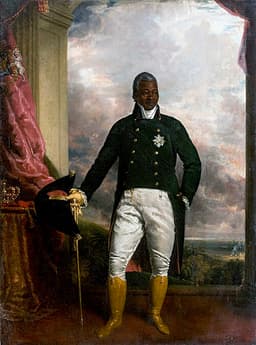
Henri Christophe
Emperor · Modern
59.2Total

Joseph II
Emperor · Modern
56.5Total
Basic Information
Born
1767
1741
Died
1820
1790
Era
Modern
Modern
Nationality
Haiti
Holy Roman Empire
Occupation
Emperor
Emperor
Civilization
Other
Western
Score Comparison
Military (10%)
72.5
50.0
Political (20%)
59.3
59.3
Influence (20%)
58.3
61.0
Legacy (20%)
56.0
50.0
Leadership (15%)
53.2
66.0
Strategy (15%)
65.4
50.0
TOTAL
59.2
56.5
Henri Christophe — Complete Timeline
1805 AD
Construction of the Citadelle LaferrièreCultural◆ Major
Christophe ordered the construction of the Citadelle Laferri
FortressArchitectureIndependence
Impact: nationalconstructive
1811 AD
Proclaimed King of HaitiPolitical Action◆ Major
Henri Christophe proclaimed himself King Henri I of Haiti, establishing a constitutional monarchy in the northern part of the country. He created a nobility and implemented a feudal system of labor.
MonarchyHaitiConstitution
Impact: national
1820 AD
Suicide by GunshotOther◆ Major
Facing a rebellion and paralysis from a stroke, Henri Christophe shot himself with a silver bullet. His death ended the Kingdom of Haiti, and the country was reunified under Jean-Pierre Boyer.
SuicideRebellionEnd of Kingdom
Impact: nationaltragic
Joseph II — Complete Timeline
1778 AD
War of the Bavarian SuccessionWar
Joseph II attempted to exchange the Austrian Netherlands for Bavaria, triggering the War of the Bavarian Succession against Prussia. The conflict, known as the 'Potato War,' ended with the Treaty of Teschen in 1779, which prevented the exchange and left Joseph's ambitions unfulfilled.
War of the Bavarian SuccessionPrussiaTerritorial Exchange
Impact: regional
1781 AD
Abolished serfdom in the Habsburg monarchyReform
Joseph II issued the Serfdom Patent, abolishing serfdom in the Habsburg hereditary lands. Peasants were granted personal freedom, the right to marry without seigneurial permission, and the ability to move freely, though they still owed labor obligations to landlords.
SerfdomReformEnlightenment
Impact: regionalprogressive
Edict of TolerationReform◆ Major
Joseph II issued the Edict of Toleration, granting religious freedom to non-Catholic Christians, including Protestants and Orthodox, in the Habsburg monarchy. Jews also received limited civil rights. This was a major step toward religious pluralism in a Catholic state.
Religious TolerationEnlightenmentReform
Impact: regionalprogressive
1782 AD
Dissolved monasteriesReform◆ Major
Joseph II dissolved over 700 monasteries that were deemed non-contributory to society, using their wealth to fund education, hospitals, and other state institutions. This secularization policy provoked strong opposition from the Catholic Church and conservative nobles.
SecularizationMonasteriesChurch Reform
Impact: regionalconstructive
Expert Analysis
Origins
Henri Christophe was born a slave on October 6, 1767, on the island of Grenada. He gained freedom during the Haitian Revolution and rose through military ranks. His early life was marked by brutality and instability, shaping his authoritarian tendencies. Joseph II was born on March 13, 1741, in Vienna, the eldest son of Empress Maria Theresa and Emperor Francis I. He grew up in the Habsburg court, receiving a rigorous education in Enlightenment philosophy, which profoundly influenced his later reforms.
Rise to Power
Christophe emerged as a key general under Toussaint Louverture and later supported Jean-Jacques Dessalines. After Dessalines' assassination in 1806, Haiti split into two states. Christophe established the Kingdom of Haiti in the north, proclaiming himself King Henri I on March 28, 1811. His rule relied on military force and a strict feudal system. Joseph II became Holy Roman Emperor in 1765 upon his father's death, but only gained full authority after his mother's death in 1780. He immediately launched a series of radical reforms, aiming to centralize power and modernize the Habsburg monarchy.
Leadership & Governance
Christophe ruled as an autocratic monarch, imposing forced labor to build infrastructure, notably the Citadelle Laferrière, a fortress constructed by 20,000 workers. He established a nobility, created a legal code, and promoted education, but his regime was repressive. His military score of 72.5 reflects his ability to maintain control through force. Joseph II, with a leadership score of 66.0, was an enlightened despot who issued over 6,000 decrees, abolishing serfdom in 1781, granting religious toleration, and dissolving monasteries. He attempted to rationalize the state but faced resistance from nobles and clergy.
Triumph & Tragedy
Christophe's greatest triumph was the construction of the Citadelle Laferrière, a symbol of Haitian independence. His tragedy was his fall: a stroke left him paralyzed, and a rebellion forced him to commit suicide on October 8, 1820, with a silver bullet. Joseph II's successes include the abolition of serfdom and the Edict of Toleration, which improved lives of millions. His failures include the War of the Bavarian Succession (1778-1779), which achieved little, and his hasty reforms that provoked widespread opposition, leading to their partial reversal after his death. His political score of 59.3 matches Christophe's, but his legacy score of 50.0 is lower.
Character & Destiny
Christophe was determined and ruthless, but his inability to compromise led to isolation. He believed in strength through discipline, but his harshness alienated his subjects. Joseph II was idealistic and impatient, driven by Enlightenment principles. He ignored political realities, which doomed many reforms. Historian Paul Bernard noted Joseph II 'attempted to do too much too quickly.' Their characters shaped their fates: Christophe's tyranny bred rebellion; Joseph's radicalism bred backlash.
Legacy
Christophe's legacy is the Citadelle, a UNESCO World Heritage site, and the enduring symbol of Haitian resistance. However, his kingdom collapsed after his death, and Haiti reunited under a republic. Joseph II's reforms laid groundwork for modern Austria, influencing later liberal movements. His abolition of serfdom was a milestone, though fully realized only in 1848. Christophe's total score of 59.2 edges Joseph's 56.5 by 2.7 points, primarily due to higher military and strategy scores.
Conclusion
Henri Christophe had a more immediate and tangible impact on Haiti, building a fortress that still stands, but his regime was short-lived. Joseph II's reforms were broader and more enduring, affecting millions across Central Europe. While Christophe's military achievements are notable, Joseph's political and social reforms had greater long-term significance. Therefore, Joseph II had a greater impact overall, despite his lower total score. The score gap reflects the limitations of quantitative comparison; Joseph's influence on modern state-building outweighs Christophe's localized legacy.
Rankings
🥇
Henri ChristopheLeader
Mil: 72.5Pol: 59.3Inf: 58.3
59.2
🥈
Joseph II
Mil: 50.0Pol: 59.3Inf: 61.0
56.5
+2.7 behind
How This Comparison Works
Algorithm
Each figure is scored on 6 dimensions (0—100 scale) based on structured historical data: Military (10%), Political (20%), Influence (20%), Legacy (20%), Leadership (15%), Strategy (15%). The weighted total produces the final ranking.
Data Sources
Scores are computed from structured sub-indicators in the database. Scale factors adjust for era (Ancient ×0.85, Modern ×1.0) and civilization size (Eastern ×1.05, Other ×0.80) to account for differences in population and military scale.
Maximum 3 Figures
Comparisons are limited to 2—3 figures to ensure readability and statistical meaningfulness.
Error Margins
±5 points per dimension — Sub-scores are derived from historical records with inherent uncertainty. Two figures within 5 points on a dimension should be considered roughly equivalent in that area.
Total Score Accuracy
±3 points overall — The weighted combination of 6 dimensions produces a total score with approximately ±3 points of uncertainty. Differences of less than 3 points are not statistically significant— the figures are effectively tied.
Known Limitations
- Historical records are incomplete and uneven across civilizations
- Figures from oral-tradition societies may be underrepresented
- Occupation labels can misclassify multi-role figures
- Scores measure capability and impact, not moral character
- Quantitative scoring is a comparison tool, not absolute truth
Capability Radar
Military (10%) — Battles & Warfare
Battles
65
25
Win Rate
60
30
Expansion
55
15
Political (20%) — Governance & Reform
Reform
75
85
Diplomacy
50
60
Economy
70
65
Influence (20%) — Cultural & Global Reach
Cultural
65
55
Global
55
50
Legacy (20%) — Historical Impact
Historical
70
60
Longevity
60
50
Leadership (15%) — Power & Stability
Tenure
60
70
Stability
40
45
Strategy (15%) — Tactics & Innovation
Strategy
75
25
Tactics
70
20
Reform
80
40
Similar Comparisons
Comments & Discussion
No comments yet. Be the first to share your thoughts!