Loading...
Hayato Ikeda vs Stephen Harper
Hayato Ikeda leads by 8.0 pts · 2 figures compared
…
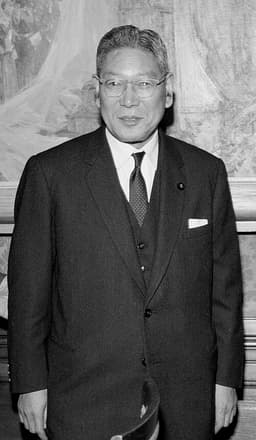
Hayato Ikeda
Politician · Modern
56.3Total

Stephen Harper
Politician · Modern
48.3Total
Basic Information
Born
1899
1959
Died
1965
—
Era
Modern
Modern
Nationality
Japan
Canada
Occupation
Politician
Politician
Civilization
Eastern
Western
Score Comparison
Military (10%)
12.5
10.0
Political (20%)
78.0
45.0
Influence (20%)
59.0
58.0
Legacy (20%)
52.0
45.8
Leadership (15%)
79.8
72.0
Strategy (15%)
35.9
38.3
TOTAL
56.3
48.3
Hayato Ikeda — Complete Timeline
1960 AD
Launch of the Income-Doubling PlanReform
Prime Minister Hayato Ikeda announced the 'Income-Doubling Plan' in December 1960, a ten-year economic program aiming to double the national income through rapid industrial growth, increased productivity, and expanded trade. The plan successfully guided Japan's high-growth era, achieving its target in seven years and transforming the country into an economic powerhouse.
Economic PolicyGrowthJapan
Impact: nationalconstructive
Liberalization of Trade and CapitalReform◆ Major
Ikeda's government pursued gradual liberalization of trade and capital flows, aligning Japan with international economic norms. This included joining the General Agreement on Tariffs and Trade (GATT) and the International Monetary Fund (IMF) Article VIII, which required removing restrictions on current account transactions, boosting foreign trade.
Trade PolicyLiberalizationEconomic Integration
Impact: nationalconstructive
Political Reconciliation with the OppositionPolitical Action
After the violent protests against the US-Japan Security Treaty in 1960, Ikeda adopted a 'low posture' approach, seeking dialogue with the opposition Socialist Party. He focused on economic growth and social welfare to reduce political polarization, successfully stabilizing Japanese politics during his tenure.
Political StrategyStabilityJapan
Impact: nationalconstructive
Stephen Harper — Complete Timeline
2006 AD
Became Prime Minister of CanadaPolitical Action◆ Major
Stephen Harper was sworn in as the 22nd Prime Minister of Canada on February 6, 2006, after leading the Conservative Party to a minority government victory in the 2006 federal election. He ended over 12 years of Liberal rule.
Prime MinisterConservative PartyMinority Government
Impact: national
2008 AD
Official Apology for Indian Residential SchoolsPolitical Action◆ Major
On June 11, 2008, Harper delivered a formal apology in the House of Commons to former students of Indian Residential Schools, acknowledging the government's role in the assimilation policy and its harmful effects on Indigenous peoples.
ApologyIndigenous PeoplesResidential Schools
Impact: nationalconstructive
2011 AD
Withdrawal from Kyoto ProtocolPolitical Action◆ Major
Harper's government formally withdrew Canada from the Kyoto Protocol on December 12, 2011, citing the inability to meet emissions targets and the economic cost of compliance. Canada was the first signatory to withdraw.
Kyoto ProtocolClimate ChangeWithdrawal
Impact: globaldestructive
Majority Government VictoryPolitical Action◆ Major
In the 2011 federal election, Harper led the Conservative Party to a majority government, winning 166 seats. This was the first Conservative majority since 1988 and allowed Harper to implement his agenda without coalition constraints.
Majority GovernmentElection VictoryConservative
Impact: national
Expert Analysis
Origins
Hayato Ikeda was born on December 3, 1899, in Hiroshima Prefecture, Japan, into a sake-brewing family. He studied law at Kyoto Imperial University, graduating in 1925. Ikeda entered the Ministry of Finance in 1927, where he developed expertise in economic policy. His early career was shaped by Japan's post-war reconstruction, and he served as Minister of Finance under Prime Minister Shigeru Yoshida in the 1950s.
Stephen Harper was born on April 30, 1959, in Toronto, Canada, to a middle-class family. He earned a bachelor's degree in economics from the University of Calgary in 1985. Harper worked as an economist and was a founding member of the Reform Party in 1987. His early political involvement focused on conservative fiscal policies and Western Canadian interests.
Rise to Power
Ikeda rose through the ranks of the Liberal Democratic Party (LDP) in Japan. In 1960, after the resignation of Prime Minister Nobusuke Kishi amid protests over the US-Japan Security Treaty, Ikeda was chosen as a compromise candidate. He became Prime Minister on July 19, 1960. His 'low posture' political style aimed to reduce confrontation and focus on economic growth.
Harper entered federal politics in 1993 as a Reform Party MP. He became leader of the newly formed Conservative Party in 2004. After two minority governments, he led the Conservatives to a minority victory in 2006, becoming Prime Minister on February 6, 2006. He won a majority in 2011, holding power until 2015.
Leadership & Governance
Ikeda's governance centered on economic expansion. His Income-Doubling Plan (1960) set a target of 7.2% annual growth, achieved through tax cuts, infrastructure investment, and export promotion. He pursued trade liberalization, joining the GATT and OECD. Politically, he sought reconciliation with opposition parties after the turbulent 1960 protests. His leadership score is 79.8, reflecting his consensus-building approach.
Harper's leadership was characterized by fiscal conservatism and social traditionalism. He reduced corporate taxes from 22% to 15%, introduced the Universal Child Care Benefit, and withdrew Canada from the Kyoto Protocol in 2011. His government passed the Fair Elections Act and strengthened the military. Harper's political score is 45.0, lower due to polarization and ethical controversies.
Triumph & Tragedy
Ikeda's greatest success was the Income-Doubling Plan, which propelled Japan to become the world's second-largest economy by 1968. Real GDP grew at an average of 10% during his tenure. However, his policies contributed to environmental pollution and urban overcrowding. He also failed to fully address social welfare, leaving gaps for future governments.
Harper's achievements include the 2008 apology for Indian Residential Schools, a landmark reconciliation step. He also steered Canada through the 2008 financial crisis with relative stability. His major failure was the withdrawal from Kyoto, damaging Canada's environmental reputation. He also faced criticism for muzzling scientists and partisan use of government advertising.
Character & Destiny
Ikeda was pragmatic and technocratic, focused on economic data rather than ideology. His 'low posture' allowed him to navigate political storms but also made him appear indecisive. He resigned in 1964 due to illness and died in 1965. His destiny was tied to Japan's economic miracle, but his health cut his tenure short.
Harper was strategic and disciplined, but his controlling style alienated allies and the media. He was personally reserved, leading to a perceived lack of charisma. His downfall came in 2015 as voter fatigue and scandals eroded support. His legacy is one of conservative consolidation but limited transformative impact.
Legacy
Ikeda's Income-Doubling Plan set the template for Japan's post-war economic strategy. His policies laid the groundwork for Japan's rise as an economic superpower. He is remembered as the architect of rapid growth, though later environmental and social costs tempered his image. His legacy score is 52.0.
Harper's legacy includes a stronger Conservative Party, tax reductions, and the residential schools apology. However, his environmental policies and democratic reforms are controversial. He is viewed as a competent manager but not a transformative leader. His legacy score is 45.8.
Conclusion
Hayato Ikeda had a greater historical impact than Stephen Harper. Ikeda's economic policies transformed Japan from a war-torn nation to a global economic leader, with sustained growth exceeding 9% annually. Harper's achievements, while significant, were more incremental and less fundamental. Ikeda's total score of 56.3 compared to Harper's 48.3 reflects his higher political and leadership scores. Ikeda's focus on economic development reshaped a nation, whereas Harper's tenure was marked by stability but not structural change.
Rankings
🥇
Hayato IkedaLeader
Mil: 12.5Pol: 78.0Inf: 59.0
56.3
🥈
Stephen Harper
Mil: 10.0Pol: 45.0Inf: 58.0
48.3
+8.0 behind
How This Comparison Works
Algorithm
Each figure is scored on 6 dimensions (0—100 scale) based on structured historical data: Military (10%), Political (20%), Influence (20%), Legacy (20%), Leadership (15%), Strategy (15%). The weighted total produces the final ranking.
Data Sources
Scores are computed from structured sub-indicators in the database. Scale factors adjust for era (Ancient ×0.85, Modern ×1.0) and civilization size (Eastern ×1.05, Other ×0.80) to account for differences in population and military scale.
Maximum 3 Figures
Comparisons are limited to 2—3 figures to ensure readability and statistical meaningfulness.
Error Margins
±5 points per dimension — Sub-scores are derived from historical records with inherent uncertainty. Two figures within 5 points on a dimension should be considered roughly equivalent in that area.
Total Score Accuracy
±3 points overall — The weighted combination of 6 dimensions produces a total score with approximately ±3 points of uncertainty. Differences of less than 3 points are not statistically significant— the figures are effectively tied.
Known Limitations
- Historical records are incomplete and uneven across civilizations
- Figures from oral-tradition societies may be underrepresented
- Occupation labels can misclassify multi-role figures
- Scores measure capability and impact, not moral character
- Quantitative scoring is a comparison tool, not absolute truth
Capability Radar
Military (10%) — Battles & Warfare
Battles
16
0
Win Rate
16
0
Expansion
21
0
Political (20%) — Governance & Reform
Reform
75
55
Diplomacy
70
60
Economy
85
65
Influence (20%) — Cultural & Global Reach
Cultural
30
40
Global
55
40
Legacy (20%) — Historical Impact
Historical
65
45
Longevity
55
30
Leadership (15%) — Power & Stability
Tenure
60
65
Stability
70
60
Strategy (15%) — Tactics & Innovation
Strategy
23
0
Tactics
26
0
Reform
28
10
Similar Comparisons
Comments & Discussion
No comments yet. Be the first to share your thoughts!