Loading...
This comparison has not been analyzed yet.
One-time AI generation (~1 minute). Scores and timeline are already available below.
Haris Silajdzic vs S. M. Krishna
S. M. Krishna leads by 4.4 pts · 2 figures compared
…
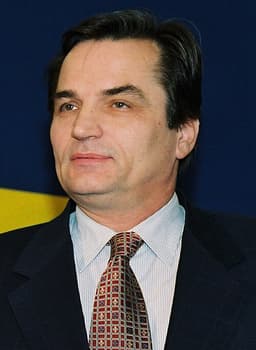
Haris Silajdzic
Politician · Modern
53.2Total

S. M. Krishna
Politician · Modern
57.6Total
Basic Information
Born
1945
1932
Died
—
—
Era
Modern
Modern
Nationality
Bosnia
India
Occupation
Politician
Politician
Civilization
Western
Indian
Score Comparison
Military (10%)
47.1
40.3
Political (20%)
68.0
72.0
Influence (20%)
54.1
57.2
Legacy (20%)
43.3
46.7
Leadership (15%)
65.0
72.0
Strategy (15%)
41.6
60.0
TOTAL
53.2
57.6
Haris Silajdzic — Complete Timeline
1993 AD
Wartime prime ministerPolitical Action◆ Major
Silajdzic served as Prime Minister of Bosnia and Herzegovina from 1993 to 1996 during the Bosnian War. He led the government in Sarajevo under siege, coordinating defense and diplomacy while the country was under attack by Bosnian Serb forces.
Bosnian WarPrime MinisterSiege of Sarajevo
Impact: nationalconstructive
1995 AD
Dayton Peace AgreementPolitical Action
Silajdzic was a key Bosniak negotiator at the Dayton Peace Agreement in November 1995, which ended the Bosnian War. He advocated for a unified Bosnia and opposed the creation of the Republika Srpska entity, but ultimately accepted the agreement.
Peace agreementDaytonDiplomacy
Impact: nationalconstructive
2006 AD
Member of the PresidencyPolitical Action◆ Major
Silajdzic was elected as the Bosniak member of the Presidency of Bosnia and Herzegovina in 2006, serving until 2010. During his term, he pushed for constitutional reforms to strengthen central institutions and reduce ethnic divisions.
PresidencyConstitutional reformEthnic politics
Impact: nationalconstructive
S. M. Krishna — Complete Timeline
1999 AD
Chief Minister of KarnatakaPolitical Action◆ Major
Krishna became Chief Minister of Karnataka in October 1999, leading the Indian National Congress government. He served until 2004, focusing on information technology promotion and infrastructure development, particularly in Bengaluru.
Chief MinisterIT PromotionKarnataka
Impact: regionalconstructive
2000 AD
Promoted Bengaluru as an IT HubReform◆ Major
Krishna's government implemented policies to attract information technology companies to Bengaluru, including tax incentives and infrastructure development. This helped establish Bengaluru as a global IT hub, earning it the nickname 'Silicon Valley of India.'
IT PolicyBengaluruEconomic Development
Impact: globalconstructive
2004 AD
Served as Governor of MaharashtraPolitical Action
Krishna was appointed Governor of Maharashtra in December 2004, serving until March 2008. As governor, he performed constitutional duties including swearing in state governments and addressing the state legislature.
GovernorMaharashtraConstitutional Role
Impact: regional
2009 AD
Served as External Affairs Minister of IndiaPolitical Action◆ Major
Krishna served as India's Minister of External Affairs from 2009 to 2012 under Prime Minister Manmohan Singh. He handled India's foreign policy during a period of growing global engagement, including relations with the United States and China.
Foreign PolicyUnion MinisterIndia
Impact: globalconstructive
This comparison has not been analyzed yet.
One-time AI generation (~1 minute). Scores and timeline are already available below.
Rankings
🥇
S. M. KrishnaLeader
Mil: 40.3Pol: 72.0Inf: 57.2
57.6
🥈
Haris Silajdzic
Mil: 47.1Pol: 68.0Inf: 54.1
53.2
+4.4 behind
How This Comparison Works
Algorithm
Each figure is scored on 6 dimensions (0—100 scale) based on structured historical data: Military (10%), Political (20%), Influence (20%), Legacy (20%), Leadership (15%), Strategy (15%). The weighted total produces the final ranking.
Data Sources
Scores are computed from structured sub-indicators in the database. Scale factors adjust for era (Ancient ×0.85, Modern ×1.0) and civilization size (Eastern ×1.05, Other ×0.80) to account for differences in population and military scale.
Maximum 3 Figures
Comparisons are limited to 2—3 figures to ensure readability and statistical meaningfulness.
Error Margins
±5 points per dimension — Sub-scores are derived from historical records with inherent uncertainty. Two figures within 5 points on a dimension should be considered roughly equivalent in that area.
Total Score Accuracy
±3 points overall — The weighted combination of 6 dimensions produces a total score with approximately ±3 points of uncertainty. Differences of less than 3 points are not statistically significant— the figures are effectively tied.
Known Limitations
- Historical records are incomplete and uneven across civilizations
- Figures from oral-tradition societies may be underrepresented
- Occupation labels can misclassify multi-role figures
- Scores measure capability and impact, not moral character
- Quantitative scoring is a comparison tool, not absolute truth
Capability Radar
Military (10%) — Battles & Warfare
Battles
29
46
Win Rate
34
45
Expansion
38
49
Political (20%) — Governance & Reform
Reform
45
55
Diplomacy
60
70
Economy
30
60
Influence (20%) — Cultural & Global Reach
Cultural
30
30
Global
25
45
Legacy (20%) — Historical Impact
Historical
40
40
Longevity
20
30
Leadership (15%) — Power & Stability
Tenure
55
65
Stability
25
60
Strategy (15%) — Tactics & Innovation
Strategy
36
50
Tactics
40
55
Reform
44
61
Similar Comparisons
Comments & Discussion
No comments yet. Be the first to share your thoughts!