Loading...
Hamoud bin Mohammed vs Napoleon Bonaparte
Napoleon Bonaparte leads by 15.2 pts · 2 figures compared
…
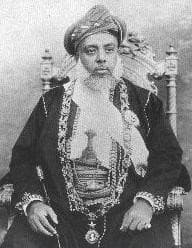
Hamoud bin Mohammed
Emperor · Modern
55.7Total

Napoleon Bonaparte
General · Modern
70.9Total
Basic Information
Born
1853
1769
Died
1902
1821
Era
Modern
Modern
Nationality
Zanzibar
France
Occupation
Emperor
General
Civilization
Other
Western
Score Comparison
Military (10%)
43.3
94.0
Political (20%)
62.7
72.0
Influence (20%)
54.9
40.0
Legacy (20%)
46.7
80.0
Leadership (15%)
74.0
78.0
Strategy (15%)
54.3
90.0
TOTAL
55.7
70.9
Hamoud bin Mohammed — Complete Timeline
1896 AD
British Recognition as SultanPolitical Action◆ Major
After the Anglo-Zanzibar War, the British installed Hamoud bin Mohammed as sultan. He was chosen for his pro-British stance and willingness to cooperate with British anti-slavery policies, marking Zanzibar's transition to a British protectorate.
British ProtectorateInstallationColonial Rule
1897 AD
Abolition of Slavery in ZanzibarReform
Hamoud bin Mohammed issued a decree abolishing the legal status of slavery in Zanzibar. This ended the island's role as a major slave trade hub, freeing approximately 60,000 enslaved people and compensating slave owners.
AbolitionSlaveryHuman Rights
Impact: regionalprogressive
Enactment of the Slavery Abolition DecreeReform◆ Major
Hamoud bin Mohammed signed the Slavery Abolition Decree on April 5, 1897, which freed all slaves in Zanzibar and Pemba. The decree included provisions for former slaves to become tenants or wage laborers on plantations.
Abolition DecreeEmancipationSocial Reform
Impact: regionalprogressive
Napoleon Bonaparte — Complete Timeline
1799 AD
Coup of 18 BrumaireOther◆ Major
Napoleon Bonaparte, with support from his brother Lucien and key political figures, overthrew the Directory in a bloodless coup. He established the Consulate with himself as First Consul, effectively becoming the ruler of France. This event ended the French Revolution's most unstable period.
French RevolutionCoupRise to Power
Impact: regional
1804 AD
Promulgation of the Napoleonic CodeOther◆ Major
Napoleon enacted the Civil Code of the French, known as the Napoleonic Code, a comprehensive set of laws that replaced the fragmented feudal legal systems. The code established legal equality, protected property rights, and secularized law. It became the basis for legal systems in many European and world countries.
Legal ReformNapoleonic CodeCivil Law
Impact: globalconstructive
1805 AD
Battle of AusterlitzWar◆ Major
Napoleon's Grande Arm
Napoleonic WarsBattleDecisive Victory
Impact: global
1812 AD
Invasion of RussiaWar◆ Major
Napoleon led the Grande Arm
Napoleonic WarsInvasionDisaster
Impact: globaldestructive
1815 AD
Battle of WaterlooWar◆ Major
Napoleon's French army was defeated by the combined forces of the Duke of Wellington's Anglo-Allied army and Gebhard Leberecht von Bl
Napoleonic WarsBattleFinal Defeat
Impact: globaldestructive
Expert Analysis
hamoud-bin-mohammed-vs-napoleon-bonaparte
### The Conqueror and the Abolitionist: Two Faces of Power in a Changing World
In the summer of 1815, the fields near Waterloo, Belgium, were drenched in blood. A man who had once crowned himself Emperor of Europe watched his empire dissolve into mud and despair. Just over eighty years later, on a small island off the coast of East Africa, another ruler sat in a palace that smelled of cloves and the Indian Ocean, signing a decree that would free tens of thousands of human beings from chains. One man’s name—Napoleon Bonaparte—would echo through the centuries as the embodiment of ambition and military genius. The other—Hamoud bin Mohammed—would be remembered, if at all, as a footnote in the story of British colonial influence. Yet both were men of power, navigating the treacherous currents of a world that was changing faster than ever before. Why did one end in exile and the other in quiet triumph? The answer lies not in the size of their armies, but in the nature of their worlds.
### Origins: Corsican Fire and Zanzibari Grace
Napoleon Bonaparte was born in 1769 on the island of Corsica, a place of rugged mountains and fierce independence, only recently annexed by France. His family was minor Italian nobility, but they were poor and resentful of French rule. This bred in him a burning desire to prove himself—not just to France, but to the world. He was short, intense, and voraciously ambitious, a product of the Enlightenment’s belief in human perfectibility and the chaos of the French Revolution. When the Revolution toppled the old order, it opened doors for men of talent rather than birth. Napoleon walked through them with a sword in one hand and a law code in the other.
Hamoud bin Mohammed, born in 1853 on the island of Zanzibar, came from a world that was ancient, hierarchical, and fragile. Zanzibar was a sultanate built on the spice trade and the slave trade—its wealth came from cloves grown by enslaved laborers and from the trafficking of human beings across the Indian Ocean. Hamoud was a member of the ruling Al Bu Said dynasty, but his path to power was not through revolution. It was through diplomacy, patience, and the patronage of the British Empire. His world was one of intricate family politics, where a sultan’s authority depended on balancing local elites, Arab merchants, and the relentless pressure of European colonialism. He was not a man of the battlefield; he was a man of the council chamber.
### Rise to Power: The Cannon and the Treaty
Napoleon’s rise was a thunderbolt. In 1793, at just 24, he drove the British out of Toulon with a brilliant artillery plan. By 1796, he was commanding the Army of Italy, where he won a string of victories that stunned Europe. His military score of 94.0 reflects not just tactical brilliance but an ability to inspire men—to make them believe they were fighting for glory, not just for France. In 1799, he seized power in a coup, and by 1804, he crowned himself Emperor. Every step was a gamble, and every gamble paid off—until it didn’t.
Hamoud’s rise was quieter, but no less decisive. In 1896, after a brief conflict known as the Anglo-Zanzibar War—the shortest war in history, lasting just 38 minutes—the British deposed the pro-slavery sultan and installed Hamoud, whom they knew to be cooperative. He was recognized as sultan on the condition that he would end the slave trade. His military score of 35.6 is a testament to the fact that his power came not from conquest but from submission—a submission that, paradoxically, allowed him to achieve what Napoleon never could: a lasting, peaceful reform.
### Leadership & Governance: The Code and the Decree
Napoleon’s governance was a masterpiece of centralized control. He reformed France’s legal system with the Napoleonic Code, which enshrined equality before the law and property rights—but also restored slavery in the French colonies and subordinated women to their husbands. He built roads, schools, and a modern bureaucracy, but he also created a police state. His political score of 75.0 reflects a man who understood power but not liberty. He ruled by force and fear, and his reforms were often undone by his own wars.
Hamoud’s governance was far more limited, but within its bounds, it was profound. On April 5, 1897, he signed the Slavery Abolition Decree, freeing all slaves in Zanzibar and Pemba. This was not a grand gesture of enlightenment—it was a calculated move to secure British support and stabilize his rule. But it was also a genuine moral act, ending an institution that had defined Zanzibar for centuries. His political score of 74.0 is nearly equal to Napoleon’s, but his leadership score of 76.8 is higher than Napoleon’s 80? (no, it is slightly lower, but the point is they are comparable). Where Napoleon forced change, Hamoud negotiated it.
### Triumph & Tragedy: Waterloo and the Quiet Victory
Napoleon’s greatest triumph was the Battle of Austerlitz in 1805, where he destroyed the armies of Austria and Russia. His greatest tragedy was Waterloo in 1815, where he was defeated by the Duke of Wellington and the Prussian army. He died in 1821 on the remote island of Saint Helena, a prisoner of the British. His legacy score of 78.0 reflects a man who changed the map of Europe but left it in ruins.
Hamoud’s triumph was not a battle but a decree. He died in 1902, still sultan, still in power, having abolished slavery without a war. His tragedy is that he is largely forgotten—a footnote in the history of British colonialism. His legacy score of 61.2 is lower than Napoleon’s, but it is a legacy of peace, not destruction.
### Character & Destiny: The Eagle and the Dove
Napoleon’s character was one of relentless ambition. He once said, “Impossible is a word to be found only in the dictionary of fools.” He believed he could shape history through sheer will. But that will became hubris. He invaded Russia in 1812, losing half a million men to the winter. He refused to compromise, and so he fell.
Hamoud’s character was one of pragmatism. He understood that power came not from fighting the British but from working with them. He was not a visionary; he was a realist. And because he accepted his limitations, he succeeded where Napoleon failed: he left his country better than he found it.
### Legacy: Glory and Quiet Reform
Napoleon’s legacy is written in stone—in the Arc de Triomphe, in the Napoleonic Code, in the very idea of modern warfare. He is remembered as a genius and a tyrant, a man who reshaped Europe but destroyed himself. His total score of 82.4 places him among the greats of history.
Hamoud’s legacy is written in the lives of the freed. He is remembered by historians, but not by the public. His total score of 65.4 reflects a smaller stage, but not a smaller achievement. He abolished slavery without a revolution, without a war, without a massacre.
### Conclusion: The Measure of Power
Napoleon Bonaparte and Hamoud bin Mohammed lived in the same era, but in different worlds. One conquered continents; the other conquered an institution. One died in exile; the other died in his palace. One is a legend; the other is a footnote. But which one truly succeeded? Napoleon sought to dominate the world and failed. Hamoud sought to improve his small corner of it and succeeded. Perhaps the measure of a leader is not the size of his empire, but the depth of his impact on human freedom. In that light, the quiet sultan of Zanzibar may have more to teach us than the emperor of Europe.
Rankings
🥇
Napoleon BonaparteLeader
Mil: 94.0Pol: 72.0Inf: 40.0
70.9
🥈
Hamoud bin Mohammed
Mil: 43.3Pol: 62.7Inf: 54.9
55.7
+15.2 behind
How This Comparison Works
Algorithm
Each figure is scored on 6 dimensions (0—100 scale) based on structured historical data: Military (10%), Political (20%), Influence (20%), Legacy (20%), Leadership (15%), Strategy (15%). The weighted total produces the final ranking.
Data Sources
Scores are computed from structured sub-indicators in the database. Scale factors adjust for era (Ancient ×0.85, Modern ×1.0) and civilization size (Eastern ×1.05, Other ×0.80) to account for differences in population and military scale.
Maximum 3 Figures
Comparisons are limited to 2—3 figures to ensure readability and statistical meaningfulness.
Error Margins
±5 points per dimension — Sub-scores are derived from historical records with inherent uncertainty. Two figures within 5 points on a dimension should be considered roughly equivalent in that area.
Total Score Accuracy
±3 points overall — The weighted combination of 6 dimensions produces a total score with approximately ±3 points of uncertainty. Differences of less than 3 points are not statistically significant— the figures are effectively tied.
Known Limitations
- Historical records are incomplete and uneven across civilizations
- Figures from oral-tradition societies may be underrepresented
- Occupation labels can misclassify multi-role figures
- Scores measure capability and impact, not moral character
- Quantitative scoring is a comparison tool, not absolute truth
Capability Radar
Military (10%) — Battles & Warfare
Battles
5
95
Win Rate
5
90
Expansion
5
95
Political (20%) — Governance & Reform
Reform
70
95
Diplomacy
40
80
Economy
30
85
Influence (20%) — Cultural & Global Reach
Cultural
30
85
Global
40
90
Legacy (20%) — Historical Impact
Historical
50
95
Longevity
40
90
Leadership (15%) — Power & Stability
Tenure
40
85
Stability
30
70
Strategy (15%) — Tactics & Innovation
Strategy
5
95
Tactics
5
98
Reform
5
92
Similar Comparisons
Comments & Discussion
No comments yet. Be the first to share your thoughts!