Loading...
Hammurabi vs Napoleon Bonaparte
Napoleon Bonaparte leads by 1.5 pts · 2 figures compared
…
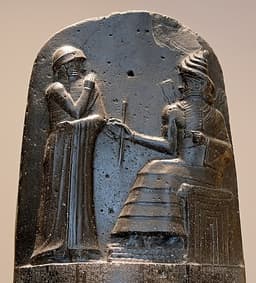
Hammurabi
Emperor · Ancient
69.4Total

Napoleon Bonaparte
General · Modern
70.9Total
Basic Information
Born
-1810
1769
Died
-1750
1821
Era
Ancient
Modern
Nationality
Babylon
France
Occupation
Emperor
General
Civilization
Middle Eastern
Western
Score Comparison
Military (10%)
60.0
94.0
Political (20%)
62.7
72.0
Influence (20%)
68.0
40.0
Legacy (20%)
80.0
80.0
Leadership (15%)
80.0
78.0
Strategy (15%)
50.0
90.0
TOTAL
69.4
70.9
Hammurabi — Complete Timeline
1763 BC
Conquest of MesopotamiaWar◆ Major
Hammurabi conquered the city-states of Larsa, Mari, and Eshnunna, uniting most of Mesopotamia under Babylonian rule. This created the Babylonian Empire and made Babylon the dominant power in the region.
ConquestEmpireBabylon
Impact: regional
1754 BC
Promulgation of the Code of HammurabiCultural
Hammurabi issued a comprehensive legal code inscribed on a stele, containing 282 laws covering trade, property, family, and crime. The code established the principle of lex talionis (eye for an eye) and influenced later legal systems.
LawCodeMesopotamia
Impact: globalconstructive
1750 BC
Construction of Babylon's fortificationsOther
Hammurabi ordered the construction of extensive city walls, canals, and temples in Babylon. These projects strengthened the city's defenses and infrastructure, solidifying its status as a major urban center.
ConstructionInfrastructureBabylon
constructive
Napoleon Bonaparte — Complete Timeline
1799 AD
Coup of 18 BrumaireOther◆ Major
Napoleon Bonaparte, with support from his brother Lucien and key political figures, overthrew the Directory in a bloodless coup. He established the Consulate with himself as First Consul, effectively becoming the ruler of France. This event ended the French Revolution's most unstable period.
French RevolutionCoupRise to Power
Impact: regional
1804 AD
Promulgation of the Napoleonic CodeOther◆ Major
Napoleon enacted the Civil Code of the French, known as the Napoleonic Code, a comprehensive set of laws that replaced the fragmented feudal legal systems. The code established legal equality, protected property rights, and secularized law. It became the basis for legal systems in many European and world countries.
Legal ReformNapoleonic CodeCivil Law
Impact: globalconstructive
1805 AD
Battle of AusterlitzWar◆ Major
Napoleon's Grande Arm
Napoleonic WarsBattleDecisive Victory
Impact: global
1812 AD
Invasion of RussiaWar◆ Major
Napoleon led the Grande Arm
Napoleonic WarsInvasionDisaster
Impact: globaldestructive
1815 AD
Battle of WaterlooWar◆ Major
Napoleon's French army was defeated by the combined forces of the Duke of Wellington's Anglo-Allied army and Gebhard Leberecht von Bl
Napoleonic WarsBattleFinal Defeat
Impact: globaldestructive
Expert Analysis
hammurabi-vs-napoleon-bonaparte
# The Lawgiver and the Conqueror
On a summer morning in 1815, a short, brooding man in a gray overcoat watched his dreams collapse in the muddy fields of Waterloo. Nearly four thousand years earlier, on the banks of the Euphrates, another ruler stood before a towering black stone etched with laws, believing he had brought order to chaos. Napoleon Bonaparte and Hammurabi never met, never could have met, yet both grasped for the same prize: the power to shape the world in their image. Why did one leave a trail of shattered empires and the other a code that still echoes in courtrooms today?
Origins
Hammurabi was born into a world of clay and stars. The eighteenth century before Christ saw Mesopotamia fractured into city-states—Larsa, Mari, Eshnunna—each clinging to its own gods and kings. He inherited Babylon not as a colossus but as a modest kingdom, a speck on the map between the Tigris and Euphrates. His father, Sin-Muballit, had laid some groundwork, but young Hammurabi learned early that survival meant patience. He watched his neighbors fight, waited, and studied the shifting alliances like a merchant reading the wind.
Napoleon, by contrast, arrived on the island of Corsica in 1769, the same year it passed from Genoa to France. His family was minor nobility, poor enough to feel the sting of inferiority but connected enough to send him to French military schools. There, the outsider—speaking with a Corsican accent, mocked by aristocrats—devoured history and artillery tactics. While Hammurabi learned statecraft from priests and scribes, Napoleon learned from Plutarch and Caesar. One was shaped by the slow rhythm of irrigation canals; the other by the gunpowder smoke of the French Revolution.
Rise to Power
Hammurabi’s ascent was a masterclass in indirection. For decades, he played the diplomat, sending gifts to rival kings, forging alliances, waiting for his moment. In his thirtieth year as king, he struck. In 1763 BCE, he crushed Larsa, then Mari, then Eshnunna, each conquest a carefully timed blow. He did not conquer in a frenzy but methodically, like a farmer clearing fields. His letters, unearthed by archaeologists, show a king obsessed with details—canal repairs, grain shipments, border disputes—long before he raised his sword.
Napoleon’s rise was a rocket, not a river. A young artillery officer during the Revolution, he seized his chance at Toulon in 1793, driving out the British with a plan so bold it made him a general at twenty-four. By 1796, he led the Army of Italy, marching through the Alps to crush Austrian armies that had baffled his elders. Each victory—Lodi, Arcola, Rivoli—was a headline. Where Hammurabi built power over decades, Napoleon vaulted into it in months. The difference was not just talent; it was the age. Hammurabi’s world had no printing press, no telegraph, no cult of the individual. Napoleon’s had all three.
Leadership & Governance
As rulers, they diverged like two branches of the same river. Hammurabi governed through law. The Code of Hammurabi, promulgated around 1754 BCE, was not merely a list of punishments but a statement of order: “to cause justice to prevail in the land, to destroy the wicked and the evil, that the strong might not oppress the weak.” Its 282 laws covered everything from interest rates to adultery, from slave rights to medical malpractice. The code was written on stone and set in public squares—anyone could read it, or have it read to them. It was a constitution before the word existed.
Napoleon governed through glory. His Napoleonic Code (1804) was also a legal reform, but it served a different master. Where Hammurabi’s code sought stability, Napoleon’s sought efficiency—centralized, rational, secular. It abolished feudalism, protected property, and enshrined meritocracy. But Napoleon himself ignored its principles when convenient, bending the law to crown himself emperor, to divorce Josephine for a fertile wife, to silence critics. His governance was a paradox: a modern state built by an autocrat.
Militarily, the contrast is starker. Napoleon’s strategic genius—his score of 93 for strategy versus Hammurabi’s 65—is beyond dispute. He invented the corps system, mastered the art of the decisive battle, and campaigned from Egypt to Moscow. Hammurabi’s wars were smaller affairs: sieges of mud-brick walls, battles of a few thousand men. Yet Hammurabi’s conquests stuck; Babylon remained a power for centuries. Napoleon’s empire crumbled within a decade. The difference was not skill but purpose. Hammurabi conquered to unify; Napoleon conquered to dominate.
Triumph & Tragedy
Hammurabi’s greatest moment came not on a battlefield but in a scribe’s workshop. When he dictated the laws that would bear his name, he achieved something deeper than victory: he gave his people a shared identity. The code turned subjects into citizens, bound by common rules. His tragedy was that of all ancient kings: the fragility of memory. After his death in 1750 BCE, his empire frayed, and his code was buried under sand for three millennia.
Napoleon’s triumph was Austerlitz in 1805, where he destroyed a combined Russian and Austrian army with a feigned retreat that still makes generals weep. His tragedy was Russia in 1812—600,000 men marching into snow, only 40,000 returning. That failure was not a mistake of strategy but of character. Napoleon could not stop. He needed war as a plant needs sun, and that need consumed him.
Character & Destiny
Hammurabi was cautious, patient, legalistic. He saw himself as a shepherd, not a god. His inscriptions call him “the king of justice,” not “the terror of the world.” He built walls and canals, not monuments to his own ego. Napoleon was restless, brilliant, and insatiable. “Impossible is a word to be found only in the dictionary of fools,” he said. He believed he could bend history to his will—and for a time, he did. But that same will drove him to Elba, to Waterloo, to a lonely death on Saint Helena.
Their destinies followed their characters. Hammurabi’s legacy is a stone in the Louvre, a set of laws that influenced the Bible, Roman law, and modern jurisprudence. Napoleon’s legacy is a code too, but also a legend—the Little Corporal, the Corsican Ogre, the man who made Europe tremble. One gave the world order; the other gave it a story.
Legacy
Today, Hammurabi is remembered as a lawgiver, a founder of civilization. His code is taught in every law school, a ghost in the courtroom. Napoleon is remembered as a conqueror, a genius, a cautionary tale. His name adorns streets, battles, and a complex of emotions—admiration for his brilliance, revulsion at his ambition.
Yet both men faced the same question: how to make power last. Hammurabi answered with justice; Napoleon with glory. One built a foundation; the other built a flame. The foundation still stands. The flame, for all its brilliance, burned out.
Conclusion
Perhaps the deepest difference lies in what they sought to leave behind. Hammurabi carved his laws in stone, hoping they would outlast him. Napoleon carved his name in history, hoping he would never be forgotten. Both succeeded. But walking through the Louvre today, past the stele of Hammurabi and the paintings of Napoleon, a visitor might wonder: which is more enduring—the rule of law or the memory of a man? The answer, like history itself, is not simple. But it is worth pondering, especially for those who still dream of shaping the world.
Rankings
🥇
Napoleon BonaparteLeader
Mil: 94.0Pol: 72.0Inf: 40.0
70.9
🥈
Hammurabi
Mil: 60.0Pol: 62.7Inf: 68.0
69.4
+1.5 behind
How This Comparison Works
Algorithm
Each figure is scored on 6 dimensions (0—100 scale) based on structured historical data: Military (10%), Political (20%), Influence (20%), Legacy (20%), Leadership (15%), Strategy (15%). The weighted total produces the final ranking.
Data Sources
Scores are computed from structured sub-indicators in the database. Scale factors adjust for era (Ancient ×0.85, Modern ×1.0) and civilization size (Eastern ×1.05, Other ×0.80) to account for differences in population and military scale.
Maximum 3 Figures
Comparisons are limited to 2—3 figures to ensure readability and statistical meaningfulness.
Error Margins
±5 points per dimension — Sub-scores are derived from historical records with inherent uncertainty. Two figures within 5 points on a dimension should be considered roughly equivalent in that area.
Total Score Accuracy
±3 points overall — The weighted combination of 6 dimensions produces a total score with approximately ±3 points of uncertainty. Differences of less than 3 points are not statistically significant— the figures are effectively tied.
Known Limitations
- Historical records are incomplete and uneven across civilizations
- Figures from oral-tradition societies may be underrepresented
- Occupation labels can misclassify multi-role figures
- Scores measure capability and impact, not moral character
- Quantitative scoring is a comparison tool, not absolute truth
Capability Radar
Military (10%) — Battles & Warfare
Battles
65
95
Win Rate
70
90
Expansion
65
95
Political (20%) — Governance & Reform
Reform
90
95
Diplomacy
75
80
Economy
70
85
Influence (20%) — Cultural & Global Reach
Cultural
85
85
Global
80
90
Legacy (20%) — Historical Impact
Historical
90
95
Longevity
95
90
Leadership (15%) — Power & Stability
Tenure
80
85
Stability
75
70
Strategy (15%) — Tactics & Innovation
Strategy
60
95
Tactics
55
98
Reform
50
92
Similar Comparisons
Comments & Discussion
TheCodeCrusher6/17/2026
Sure, Hammurabi's laws were impressive for their time, but let's not pretend they're some timeless legal masterpiece. "An eye for an eye" sounds fair until you realize it applied differently based on social class. Slaves got half the compensation free men did for the same injury. Napoleon's civil code, though flawed, actually attempted universal legal principles—no exemptions for nobles, no class-based justice. Hammurabi codified inequality; Napoleon tried (and yes, sometimes failed) to legislat
法典猎人6/17/2026
说汉谟拉比法典是法治先驱?拜托,那石柱上刻的根本是神权专制的遮羞布。282条法律里,一半都在教你怎么处理逃奴和通奸,连医生手术失败都要砍手。拿破仑法典至少废除了封建特权,确立了合同自由和个人产权。汉谟拉比让祭司阶层当法官,拿破仑却创建了独立的司法系统。一个是恐吓人民的咒语,一个才是现代法律的根基。别把石碑神话当文明灯塔。