Loading...
Hammurabi vs Julius Caesar
Julius Caesar leads by 13.4 pts · 2 figures compared
…
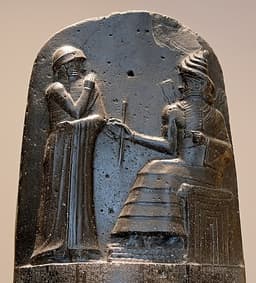
Hammurabi
Emperor · Ancient
69.4Total

Julius Caesar
General · Ancient
82.8Total
Basic Information
Born
-1810
-100
Died
-1750
-44
Era
Ancient
Ancient
Nationality
Babylon
Roman Republic
Occupation
Emperor
General
Civilization
Middle Eastern
Western
Score Comparison
Military (10%)
60.0
88.0
Political (20%)
62.7
78.0
Influence (20%)
68.0
85.0
Legacy (20%)
80.0
82.0
Leadership (15%)
80.0
80.0
Strategy (15%)
50.0
85.0
TOTAL
69.4
82.8
Hammurabi — Complete Timeline
1763 BC
Conquest of MesopotamiaWar◆ Major
Hammurabi conquered the city-states of Larsa, Mari, and Eshnunna, uniting most of Mesopotamia under Babylonian rule. This created the Babylonian Empire and made Babylon the dominant power in the region.
ConquestEmpireBabylon
Impact: regional
1754 BC
Promulgation of the Code of HammurabiCultural
Hammurabi issued a comprehensive legal code inscribed on a stele, containing 282 laws covering trade, property, family, and crime. The code established the principle of lex talionis (eye for an eye) and influenced later legal systems.
LawCodeMesopotamia
Impact: globalconstructive
1750 BC
Construction of Babylon's fortificationsOther
Hammurabi ordered the construction of extensive city walls, canals, and temples in Babylon. These projects strengthened the city's defenses and infrastructure, solidifying its status as a major urban center.
ConstructionInfrastructureBabylon
constructive
Julius Caesar — Complete Timeline
58 BC
Gallic WarsWar◆ Major
Caesar, as proconsul of Gaul, launched a series of campaigns that conquered all of Gaul (modern France, Belgium, and parts of Switzerland). He fought numerous battles, including against the Helvetii, the Belgae, and the Gallic chieftain Vercingetorix. The wars brought immense wealth and a loyal army to Caesar.
Gallic WarsConquestRoman Expansion
Impact: regional
49 BC
Crossing the RubiconPolitical Action◆ Major
Caesar led Legio XIII across the Rubicon River into Italy, defying the Roman Senate's order to disband his army. This act triggered a civil war against Pompey and the Optimates, ultimately leading to Caesar's dictatorship and the end of the Roman Republic.
Roman Civil WarEnd of RepublicPower Struggle
Impact: global
48 BC
Battle of PharsalusWar◆ Major
Caesar's outnumbered army defeated the larger forces of Pompey the Great at Pharsalus in Greece. Caesar's tactical use of a reserve line to counter Pompey's cavalry charge proved decisive. Pompey fled to Egypt, where he was assassinated, leaving Caesar as the undisputed master of the Roman world.
Roman Civil WarBattleDecisive Victory
Impact: regional
44 BC
Appointment as Dictator for LifePolitical Action◆ Major
The Roman Senate appointed Caesar dictator perpetuo (dictator for life), granting him unprecedented personal power. This move concentrated military, legislative, and judicial authority in one person, effectively ending the Roman Republic's traditional system of checks and balances and alarming many senators.
DictatorshipEnd of RepublicPower Consolidation
Impact: regionaldestructive
Assassination on the Ides of MarchPolitical Action◆ Major
A group of Roman senators, led by Marcus Junius Brutus and Gaius Cassius Longinus, stabbed Caesar to death at a meeting of the Senate in the Theatre of Pompey. The assassination was intended to restore the Republic, but instead triggered another civil war that led to the rise of the Roman Empire.
AssassinationRoman PoliticsEnd of Republic
Impact: globaldestructive
Expert Analysis
hammurabi-vs-julius-caesar
# The Lawgiver and the Conqueror: Hammurabi and Caesar, Architects of Power
On a spring morning in 44 BCE, a man in a purple toga fell bleeding at the foot of a marble portico in Rome, stabbed twenty-three times by senators he had once called friends. Two thousand years earlier, a king in distant Babylon stood before a polished black stone, his name carved alongside 282 laws that would outlive his empire by four millennia. Julius Caesar and Hammurabi never met, never corresponded, yet their stories intertwine like two rivers feeding the same sea: both were men who reshaped civilization through the force of will, law, and war. But why did one die betrayed by his own city, while the other died in his bed, his code intact?
Origins
Hammurabi was born around 1810 BCE into a world of mud-brick walls and cuneiform tablets. Babylon was then a minor city-state on the Euphrates, overshadowed by rivals like Larsa and Eshnunna. His father, Sin-Muballit, had begun expanding Babylon’s influence, but the young prince inherited a fragile kingdom. The ancient Near East was a patchwork of warring states, each claiming divine favor, each ready to swallow the weak. Hammurabi’s education would have been steeped in the practical arts of irrigation, taxation, and diplomacy—the tools of survival in a land where a drought could destroy a dynasty.
Julius Caesar, born in 100 BCE, came into a Rome already dominant in the Mediterranean but tearing itself apart. His family, the Julii, claimed descent from the goddess Venus, yet they were not among the city’s richest. Caesar grew up in the shadow of civil wars—Marius versus Sulla, populares versus optimates. His father died when he was sixteen, leaving him to navigate a world where a man’s worth was measured by military glory and political cunning. Where Hammurabi inherited a throne, Caesar had to seize his.
Rise to Power
Hammurabi’s path to dominance was patient and methodical. For the first three decades of his reign, he focused on internal consolidation—building canals, fortifying Babylon’s walls, and securing alliances. He did not rush to conquer. Instead, he waited, playing rival kings against each other. In 1763 BCE, he struck. In a single campaign, he crushed Larsa, then Mari, then Eshnunna. The speed was astonishing: within a year, Mesopotamia was his. His strategy was not pure force but a blend of diplomacy, timing, and the careful use of siege warfare.
Caesar’s rise was a spectacle of ambition. He climbed the Roman political ladder—quaestor, aedile, praetor—each step greased with borrowed money and populist promises. In 58 BCE, he secured command of Gaul, and over eight years he conquered a territory larger than Italy itself, slaughtering a million people and enslaving another million. His *Commentaries* turned his campaigns into propaganda. When the Senate ordered him to disband his army, he crossed the Rubicon River in 49 BCE—an act of war against his own republic. “The die is cast,” he reportedly said, and the Republic died with it.
Leadership & Governance
Hammurabi ruled as a king-priest, his authority rooted in the gods. His great achievement, the Code of Hammurabi, was not a revolution in law but a codification of existing customs. Yet its brilliance lay in its public display: inscribed on a stele in Babylon’s main temple, it declared that justice was visible, predictable, and royal. The laws were harsh—an eye for an eye, death for theft—but they applied to all classes, from slave to noble. Hammurabi built canals, taxed trade, and maintained a standing army. His governance was about order: the king as shepherd, the law as fence.
Caesar’s governance was radical improvisation. As dictator, he reformed the calendar, granted citizenship to Gauls, redistributed land to veterans, and centralized tax collection. He packed the Senate with his supporters and reduced its power. Where Hammurabi’s law was carved in stone, Caesar’s reforms were written in blood and politics. He was a pragmatist: he pardoned enemies, but he also crushed dissent. His rule was personal, not institutional—a man, not a code.
Triumph & Tragedy
Hammurabi’s greatest moment came in 1754 BCE, when he unveiled his code. It was a triumph of civilization: a king declaring that even he was bound by law. His tragedy was that his empire did not outlive him. Within a century of his death, Babylon fell to the Hittites. The code survived, but the kingdom crumbled.
Caesar’s triumph was his conquest of Gaul—a feat that made him the richest man in Rome and the most feared. His tragedy was the Ides of March, 44 BCE. He had become dictator for life, but he could not make himself a king. The senators who killed him thought they were saving the Republic; instead, they unleashed another civil war. Caesar’s tragedy was that his ambition outpaced his political architecture.
Character & Destiny
Hammurabi was cautious, calculating, and patient. He built his legacy stone by stone, law by law. His personality was that of an administrator who happened to be a conqueror. Destiny, for him, was the slow accumulation of power until the moment was ripe.
Caesar was restless, charismatic, and reckless. He gambled his life on every campaign, borrowed beyond reason, and seduced both men and women with equal ease. His personality was fire—he burned through the Republic because he could not imagine a world that did not revolve around him. Destiny, for him, was a stage, and he was the star.
Legacy
Hammurabi’s legacy is the idea of written law. His code influenced later legal systems, from Assyria to Israel, and its principle of “the law is above the ruler” echoes in modern constitutions. He is remembered as a lawgiver, not a conqueror.
Caesar’s legacy is the Roman Empire itself. His name became a title—Kaiser, Tsar—and his reforms shaped Western governance for centuries. He is remembered as a conqueror, a dictator, and a martyr. Yet his assassination proved that even the greatest man cannot escape the consequences of his own ambition.
Conclusion
Hammurabi and Caesar stand at opposite ends of the ancient world, yet they share a common thread: both understood that power must be made visible to endure. Hammurabi carved his laws in stone; Caesar carved his name in history. One died in peace, his code intact; the other died in blood, his empire born from his corpse. Perhaps the difference lies in their ambitions: Hammurabi sought to rule a kingdom, Caesar to become a god. And the gods, as the Greeks knew, are always the first to fall.
Rankings
🥇
Julius CaesarLeader
Mil: 88.0Pol: 78.0Inf: 85.0
82.8
🥈
Hammurabi
Mil: 60.0Pol: 62.7Inf: 68.0
69.4
+13.4 behind
How This Comparison Works
Algorithm
Each figure is scored on 6 dimensions (0—100 scale) based on structured historical data: Military (10%), Political (20%), Influence (20%), Legacy (20%), Leadership (15%), Strategy (15%). The weighted total produces the final ranking.
Data Sources
Scores are computed from structured sub-indicators in the database. Scale factors adjust for era (Ancient ×0.85, Modern ×1.0) and civilization size (Eastern ×1.05, Other ×0.80) to account for differences in population and military scale.
Maximum 3 Figures
Comparisons are limited to 2—3 figures to ensure readability and statistical meaningfulness.
Error Margins
±5 points per dimension — Sub-scores are derived from historical records with inherent uncertainty. Two figures within 5 points on a dimension should be considered roughly equivalent in that area.
Total Score Accuracy
±3 points overall — The weighted combination of 6 dimensions produces a total score with approximately ±3 points of uncertainty. Differences of less than 3 points are not statistically significant— the figures are effectively tied.
Known Limitations
- Historical records are incomplete and uneven across civilizations
- Figures from oral-tradition societies may be underrepresented
- Occupation labels can misclassify multi-role figures
- Scores measure capability and impact, not moral character
- Quantitative scoring is a comparison tool, not absolute truth
Capability Radar
Military (10%) — Battles & Warfare
Battles
65
95
Win Rate
70
92
Expansion
65
97
Political (20%) — Governance & Reform
Reform
90
90
Diplomacy
75
85
Economy
70
82
Influence (20%) — Cultural & Global Reach
Cultural
85
88
Global
80
94
Legacy (20%) — Historical Impact
Historical
90
95
Longevity
95
96
Leadership (15%) — Power & Stability
Tenure
80
75
Stability
75
60
Strategy (15%) — Tactics & Innovation
Strategy
60
94
Tactics
55
96
Reform
50
88
Similar Comparisons
Comments & Discussion
No comments yet. Be the first to share your thoughts!