Loading...
Haile Selassie Gugsa vs Napoleon Bonaparte
Napoleon Bonaparte leads by 34.7 pts · 2 figures compared
…
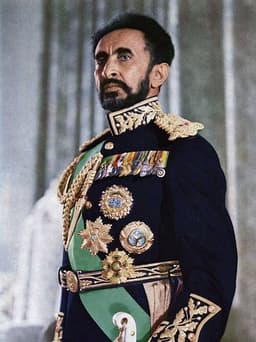
Haile Selassie Gugsa
General · Modern
36.2Total

Napoleon Bonaparte
General · Modern
70.9Total
Basic Information
Born
1880
1769
Died
1947
1821
Era
Modern
Modern
Nationality
Ethiopia
France
Occupation
General
General
Civilization
Other
Western
Score Comparison
Military (10%)
10.2
94.0
Political (20%)
26.4
72.0
Influence (20%)
50.2
40.0
Legacy (20%)
37.5
80.0
Leadership (15%)
35.4
78.0
Strategy (15%)
39.6
90.0
TOTAL
36.2
70.9
Haile Selassie Gugsa — Complete Timeline
1936 AD
Defected to Italian Forces during Second Italo-Ethiopian WarWar◆ Major
Haile Selassie Gugsa, a son-in-law of Emperor Haile Selassie, defected to the Italian invaders. He provided intelligence and support, which contributed to the Italian victory at the Battle of Maychew.
DefectionSecond Italo-Ethiopian WarBetrayal
Impact: regionaldestructive
Appointed Governor of Tigray by ItaliansPolitical Action◆ Major
After his defection, the Italian colonial administration appointed Gugsa as Governor of Tigray. He administered the region under Italian rule until the end of the occupation.
Italian OccupationGovernorCollaboration
Impact: regionaldestructive
Napoleon Bonaparte — Complete Timeline
1799 AD
Coup of 18 BrumaireOther◆ Major
Napoleon Bonaparte, with support from his brother Lucien and key political figures, overthrew the Directory in a bloodless coup. He established the Consulate with himself as First Consul, effectively becoming the ruler of France. This event ended the French Revolution's most unstable period.
French RevolutionCoupRise to Power
Impact: regional
1804 AD
Promulgation of the Napoleonic CodeOther◆ Major
Napoleon enacted the Civil Code of the French, known as the Napoleonic Code, a comprehensive set of laws that replaced the fragmented feudal legal systems. The code established legal equality, protected property rights, and secularized law. It became the basis for legal systems in many European and world countries.
Legal ReformNapoleonic CodeCivil Law
Impact: globalconstructive
1805 AD
Battle of AusterlitzWar◆ Major
Napoleon's Grande Arm
Napoleonic WarsBattleDecisive Victory
Impact: global
1812 AD
Invasion of RussiaWar◆ Major
Napoleon led the Grande Arm
Napoleonic WarsInvasionDisaster
Impact: globaldestructive
1815 AD
Battle of WaterlooWar◆ Major
Napoleon's French army was defeated by the combined forces of the Duke of Wellington's Anglo-Allied army and Gebhard Leberecht von Bl
Napoleonic WarsBattleFinal Defeat
Impact: globaldestructive
Expert Analysis
haile-selassie-gugsa-vs-napoleon-bonaparte
# The General Who Betrayed an Empire
On a crisp morning in October 1935, as Italian bombers droned over the Ethiopian highlands, two men who shared a name stood on opposite sides of history. One was Emperor Haile Selassie, the Lion of Judah, preparing to defend his ancient kingdom against Mussolini’s colonial ambitions. The other was his son-in-law, Ras Haile Selassie Gugsa, a general who would soon become the most infamous turncoat in Ethiopian memory. Their collision course raises a haunting question: What makes one leader die in exile, revered as a martyr, while another lives in comfort, remembered as a traitor?
Origins
Napoleon Bonaparte was born in 1769 on the Mediterranean island of Corsica, a place that had only recently become French. His family belonged to the minor nobility, but they were neither wealthy nor powerful. Corsica’s rugged, independent spirit seeped into his bones. At nine, he entered a military academy in mainland France, where his thick accent and poverty marked him as an outsider. He devoured books on military history and the Enlightenment, dreaming of glory in a nation still reeling from revolution. France in the 1790s was a cauldron of chaos and opportunity—a perfect forge for a man with nothing to lose and everything to prove.
Haile Selassie Gugsa was born in 1880 into the highest echelons of Ethiopian aristocracy. His family was tied to the Solomonic dynasty, and he grew up in a world where loyalty to the emperor was both sacred duty and survival instinct. Ethiopia in the late 19th century had just defeated an Italian invasion at Adwa in 1896, cementing its status as the only African nation never colonized. Gugsa was groomed for command, married to the emperor’s daughter, and given vast lands in Tigray. He inherited power; Napoleon seized it.
Rise to Power
Napoleon’s ascent was a rocket launched by revolution. In 1793, at age twenty-four, he drove British forces from the port of Toulon with a brilliant artillery strategy. By 1796, he commanded the French army in Italy, where he turned ragged soldiers into a conquering force. His victories in Italy and Egypt made him a national hero, and in 1799 he seized power in a coup, becoming First Consul. By 1804, he crowned himself Emperor of the French. Every step was earned through audacity, calculation, and blood.
Gugsa’s rise was quieter, a matter of birth and marriage. He was appointed governor of Tigray, a key northern province, and expected to defend it. But when Mussolini’s modern army invaded in 1935, Gugsa faced a choice: fight with outdated rifles against tanks and poison gas, or negotiate. He chose negotiation. In 1936, he defected to the Italians, providing intelligence on Ethiopian troop movements. The Italians appointed him governor of Tigray—a puppet ruler in a conquered land.
Leadership & Governance
Napoleon was a whirlwind of reform and conquest. He reorganized France’s legal system with the Napoleonic Code, which enshrined equality before the law, protected property rights, and secularized the state. He built schools, roads, and a centralized bureaucracy. His military genius was unmatched: at Austerlitz in 1805, he crushed the armies of Austria and Russia with a feigned retreat that lured them into a trap. Yet his ambition knew no bounds. He invaded Russia in 1812 with 600,000 men; fewer than 100,000 returned. He was a master of strategy but a slave to his own hunger for power.
Gugsa ruled Tigray under Italian supervision. His governance was a shadow of independence. He collected taxes, maintained order, and enforced colonial decrees. He had no code to write, no empire to build—only a province to administer for a foreign master. His military score of 19.9 reflects his one major act: betrayal, not battle. He never commanded a victory; he only surrendered a position.
Triumph & Tragedy
Napoleon’s greatest triumph was the Battle of Austerlitz, where he annihilated a larger coalition army in a single day. His greatest tragedy was Waterloo, where in 1815, after returning from exile, he faced the Duke of Wellington and a Prussian army. A combination of bad weather, late reinforcements, and his own tactical errors led to defeat. He died six years later on the remote island of Saint Helena, a prisoner of the British. His fall was epic, his end lonely.
Gugsa’s triumph was survival. He defected before the war turned desperate, and he lived until 1947, dying in relative peace. But his tragedy was moral. He abandoned his emperor, his people, and his heritage. The Italians used him to divide Ethiopia, and when they were driven out in 1941, he was left with nothing but a legacy of betrayal.
Character & Destiny
Napoleon was driven by an unshakable belief in his own destiny. “Impossible is a word to be found only in the dictionary of fools,” he once said. He was brilliant, ruthless, and charismatic—a man who could inspire soldiers to die for him and then sacrifice them without hesitation. His personality was a paradox: a reformer who crowned himself emperor, a liberator who conquered nations. His flaws were the flip side of his strengths: ambition without limits, pride that blinded him to reality.
Gugsa was a pragmatist in a world that demanded loyalty. He saw the Italian army as unstoppable and chose to save himself. His political score of 58.0 suggests a man who understood power but not honor. He was not evil, but he lacked the vision to see that some causes are worth dying for. His destiny was to be a footnote—a cautionary tale.
Legacy
Napoleon’s legacy is monumental. He reshaped Europe’s borders, inspired nationalism, and spread the ideals of the French Revolution. The Napoleonic Code influences legal systems worldwide. He is studied in every military academy. His name evokes both genius and tyranny.
Haile Selassie Gugsa is remembered only in Ethiopian history books, and then with shame. His legacy score of 48.9 reflects a life that contributed nothing to the world. He is a symbol of betrayal, not leadership. Where Napoleon’s story teaches the heights of human ambition, Gugsa’s teaches the depths of human failure.
Conclusion
We remember Napoleon not because he was good, but because he was great—in the original sense of the word: vast, powerful, and terrifying. He changed the world, for better and worse. Gugsa changed nothing. He was a general who never fought, a leader who never led. In the end, the difference between them is not just talent or opportunity, but choice. Napoleon chose to climb, even if it meant falling. Gugsa chose to stay, even if it meant kneeling. History remembers the climbers, not those who sit.
Rankings
🥇
Napoleon BonaparteLeader
Mil: 94.0Pol: 72.0Inf: 40.0
70.9
🥈
Haile Selassie Gugsa
Mil: 10.2Pol: 26.4Inf: 50.2
36.2
+34.7 behind
How This Comparison Works
Algorithm
Each figure is scored on 6 dimensions (0—100 scale) based on structured historical data: Military (10%), Political (20%), Influence (20%), Legacy (20%), Leadership (15%), Strategy (15%). The weighted total produces the final ranking.
Data Sources
Scores are computed from structured sub-indicators in the database. Scale factors adjust for era (Ancient ×0.85, Modern ×1.0) and civilization size (Eastern ×1.05, Other ×0.80) to account for differences in population and military scale.
Maximum 3 Figures
Comparisons are limited to 2—3 figures to ensure readability and statistical meaningfulness.
Error Margins
±5 points per dimension — Sub-scores are derived from historical records with inherent uncertainty. Two figures within 5 points on a dimension should be considered roughly equivalent in that area.
Total Score Accuracy
±3 points overall — The weighted combination of 6 dimensions produces a total score with approximately ±3 points of uncertainty. Differences of less than 3 points are not statistically significant— the figures are effectively tied.
Known Limitations
- Historical records are incomplete and uneven across civilizations
- Figures from oral-tradition societies may be underrepresented
- Occupation labels can misclassify multi-role figures
- Scores measure capability and impact, not moral character
- Quantitative scoring is a comparison tool, not absolute truth
Capability Radar
Military (10%) — Battles & Warfare
Battles
5
95
Win Rate
5
90
Expansion
5
95
Political (20%) — Governance & Reform
Reform
5
95
Diplomacy
10
80
Economy
5
85
Influence (20%) — Cultural & Global Reach
Cultural
5
85
Global
5
90
Legacy (20%) — Historical Impact
Historical
10
95
Longevity
5
90
Leadership (15%) — Power & Stability
Tenure
10
85
Stability
5
70
Strategy (15%) — Tactics & Innovation
Strategy
10
95
Tactics
10
98
Reform
5
92
Similar Comparisons
Comments & Discussion
RAS_THE_RETREAT6/17/2026
This comparison is absurd. Napoleon was a tactical genius who conquered Europe; Gugsa was a petty turncoat who sold out his country for Italian gold. One fact says it all: at the Battle of Maychew in 1936, Gugsa’s forces barely fired a shot before surrendering, while Napoleon held off coalitions for years at Austerlitz. Gugsa isn’t even in the same league—he’s a footnote in betrayal, not a strategist.
叛徒的遗产6/17/2026
说真的,拿拿破仑和古格萨比简直是侮辱历史。拿破仑在1812年撤退时还能重组军队,古格萨却在1935年战争中一枪没放就叛变了。一个具体的事实:意大利人贿赂他时只给了几千银币,而拿破仑拒绝了百万法郎的停战提议。古格萨根本不懂荣誉,他只配被钉在埃塞俄比亚历史的耻辱柱上。
DATA_SKEPTIC396/17/2026
This "comparison" is emotionally manipulative. The analysis offers zero hard metrics: Napoleon commanded armies of 600,000, while Gugsa led maybe 10,000 poorly armed men. Their contexts aren't comparable—Gugsa faced industrial warfare and his emperor's incompetence; Napoleon thrived in social chaos. Without controlling for technology, scale, and resources, this is just a morality play dressed as history.
战争统计员6/17/2026
数据不会说谎:拿破仑参与了超过60场战役,胜率约80%;古格萨只呆在一场战役里,还投降了。更关键的是,拿破仑在1813年莱比锡战役后依然重建了帝国,古格萨却因叛变在1945年死于贫贱。这不是将军对决,是狮子对老鼠。别被戏剧性叙事骗了。
CLASSICS_SCHOLAR_R6/17/2026
This fails to account for classical leadership virtues. Napoleon embodied Aristotelian "magnanimity"—he led from the front, was wounded multiple times, and inspired cult-like loyalty. Gugsa lacked what Plutarch called "noble ambition"; he chose comfort over sacrifice, betrayal over loyalty. Napoleon's exile at St. Helena proved his virtue: he maintained his dignity. Gugsa lived soft under Italian rule and died forgotten. That's the ancient verdict.
古典的正义6/17/2026
从亚里士多德角度看,拿破仑是悲剧英雄:他有缺陷但伟大,在滑铁卢被打败后仍被历史铭记。古格萨却是埃斯库罗斯笔下的腐败贵族,为了金子和权力出卖祖国。一个具体对比:拿破仑在1814年拒绝背叛法国,古格萨在1935年主动投靠意大利人。这不是实力问题,是人格问题。古典道德观下,古格萨永远是个可鄙的小人。