Loading...
This comparison has not been analyzed yet.
One-time AI generation (~1 minute). Scores and timeline are already available below.
Gustavo Diaz Ordaz vs Sharif Ahmed
Gustavo Diaz Ordaz leads by 3.4 pts · 2 figures compared
…
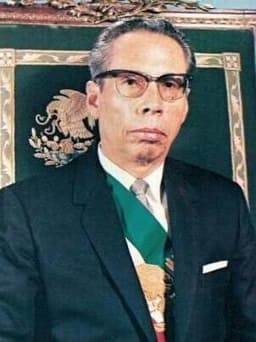
Gustavo Diaz Ordaz
Politician · Modern
48.8Total

Sharif Ahmed
Politician · Modern
45.4Total
Basic Information
Born
1911
1964
Died
1979
—
Era
Modern
Modern
Nationality
Mexico
Somalia
Occupation
Politician
Politician
Civilization
Western
Other
Score Comparison
Military (10%)
49.2
43.3
Political (20%)
39.4
33.6
Influence (20%)
51.8
51.8
Legacy (20%)
43.3
41.7
Leadership (15%)
67.0
48.4
Strategy (15%)
41.8
54.3
TOTAL
48.8
45.4
Gustavo Diaz Ordaz — Complete Timeline
1968 AD
Tlatelolco MassacrePolitical Action
On October 2, 1968, Mexican security forces opened fire on student protesters in the Plaza de las Tres Culturas in Tlatelolco, Mexico City. Hundreds were killed. President Gustavo D
MassacreRepressionStudent Movement
Impact: nationaltragic
1970 AD
Enactment of the 1970 Federal Labor LawReform◆ Major
Díaz Ordaz signed a new Federal Labor Law that expanded workers' rights, including profit-sharing, overtime pay, and job security. This was a progressive reform that strengthened the labor code, though critics noted it also increased state control over unions.
Labor LawWorkers' RightsReform
Impact: nationalconstructive
1971 AD
Corpus Christi Massacre (El Halconazo)Political Action◆ Major
On June 10, 1971, a paramilitary group known as Los Halcones attacked student demonstrators in Mexico City, killing dozens. While D
MassacreParamilitaryRepression
Impact: nationaltragic
Sharif Ahmed — Complete Timeline
2006 AD
Led the Islamic Courts Union to control MogadishuWar◆ Major
As chairman of the Islamic Courts Union (ICU), Sharif Ahmed led the coalition that captured Mogadishu from US-backed warlords. The ICU established sharia law and brought temporary stability to the capital, but was later ousted by Ethiopian forces.
Islamic Courts UnionMogadishuCivil War
Impact: regional
2009 AD
Elected President of SomaliaPolitical Action◆ Major
Sharif Ahmed was elected President of Somalia by the parliament in Djibouti as part of a UN-backed peace process. A former leader of the Islamic Courts Union, his election aimed to stabilize the country after years of civil war and Islamist insurgency.
PresidencyPeace ProcessSomalia
Impact: nationalconstructive
2011 AD
Signed the Kampala AccordPolitical Action
Sharif Ahmed signed the Kampala Accord with the Speaker of Parliament, extending his term by one year in exchange for appointing a new prime minister. The deal was brokered by Uganda to resolve a political crisis, but was criticized by some as undemocratic.
Kampala AccordPolitical CrisisTerm Extension
Impact: national
2012 AD
Lost presidential election to Hassan Sheikh MohamudPolitical Action◆ Major
Sharif Ahmed was defeated in the 2012 presidential election by Hassan Sheikh Mohamud. The election marked the end of the transitional government and the beginning of a new federal government, though Sharif remained a political figure.
ElectionTransitionSomalia
Impact: national
This comparison has not been analyzed yet.
One-time AI generation (~1 minute). Scores and timeline are already available below.
Rankings
🥇
Gustavo Diaz OrdazLeader
Mil: 49.2Pol: 39.4Inf: 51.8
48.8
🥈
Sharif Ahmed
Mil: 43.3Pol: 33.6Inf: 51.8
45.4
+3.4 behind
How This Comparison Works
Algorithm
Each figure is scored on 6 dimensions (0—100 scale) based on structured historical data: Military (10%), Political (20%), Influence (20%), Legacy (20%), Leadership (15%), Strategy (15%). The weighted total produces the final ranking.
Data Sources
Scores are computed from structured sub-indicators in the database. Scale factors adjust for era (Ancient ×0.85, Modern ×1.0) and civilization size (Eastern ×1.05, Other ×0.80) to account for differences in population and military scale.
Maximum 3 Figures
Comparisons are limited to 2—3 figures to ensure readability and statistical meaningfulness.
Error Margins
±5 points per dimension — Sub-scores are derived from historical records with inherent uncertainty. Two figures within 5 points on a dimension should be considered roughly equivalent in that area.
Total Score Accuracy
±3 points overall — The weighted combination of 6 dimensions produces a total score with approximately ±3 points of uncertainty. Differences of less than 3 points are not statistically significant— the figures are effectively tied.
Known Limitations
- Historical records are incomplete and uneven across civilizations
- Figures from oral-tradition societies may be underrepresented
- Occupation labels can misclassify multi-role figures
- Scores measure capability and impact, not moral character
- Quantitative scoring is a comparison tool, not absolute truth
Capability Radar
Military (10%) — Battles & Warfare
Battles
31
10
Win Rate
30
15
Expansion
35
10
Political (20%) — Governance & Reform
Reform
20
25
Diplomacy
30
30
Economy
40
15
Influence (20%) — Cultural & Global Reach
Cultural
20
20
Global
30
20
Legacy (20%) — Historical Impact
Historical
40
25
Longevity
30
15
Leadership (15%) — Power & Stability
Tenure
60
30
Stability
10
10
Strategy (15%) — Tactics & Innovation
Strategy
39
15
Tactics
39
20
Reform
43
10
Similar Comparisons
Comments & Discussion
No comments yet. Be the first to share your thoughts!