Loading...
Gunthamund vs Napoleon Bonaparte
Napoleon Bonaparte leads by 30.1 pts · 2 figures compared
…
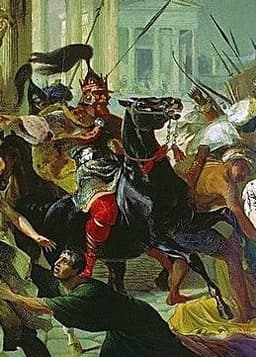
Gunthamund
Emperor · Ancient
40.8Total

Napoleon Bonaparte
General · Modern
70.9Total
Basic Information
Born
450
1769
Died
496
1821
Era
Ancient
Modern
Nationality
Vandals
France
Occupation
Emperor
General
Civilization
Western
Western
Score Comparison
Military (10%)
22.6
94.0
Political (20%)
39.4
72.0
Influence (20%)
45.5
40.0
Legacy (20%)
35.8
80.0
Leadership (15%)
55.3
78.0
Strategy (15%)
39.6
90.0
TOTAL
40.8
70.9
Gunthamund — Complete Timeline
484 AD
Easing of Catholic PersecutionCultural◆ Major
Gunthamund reversed the harsh anti-Catholic policies of his predecessor Huneric. He allowed Catholic worship to resume, returned confiscated churches, and released imprisoned clergy. This eased religious tensions in the Vandal Kingdom.
Religious ToleranceCatholic ChurchVandal Kingdom
Impact: regionalconstructive
Accession to the Vandal ThronePolitical Action
Gunthamund became king of the Vandals after the death of his uncle Huneric. His reign focused on internal consolidation and rebuilding the kingdom's economy after years of persecution.
KingshipSuccessionVandal Kingdom
Impact: national
490 AD
Defense Against Moorish RaidsWar
Gunthamund led campaigns against Moorish tribes in the interior of North Africa, securing Vandal control over key trade routes. These raids threatened the kingdom's stability, and his efforts provided temporary relief.
Military CampaignMoorish ConflictVandal Kingdom
Impact: regionalconstructive
Napoleon Bonaparte — Complete Timeline
1799 AD
Coup of 18 BrumaireOther◆ Major
Napoleon Bonaparte, with support from his brother Lucien and key political figures, overthrew the Directory in a bloodless coup. He established the Consulate with himself as First Consul, effectively becoming the ruler of France. This event ended the French Revolution's most unstable period.
French RevolutionCoupRise to Power
Impact: regional
1804 AD
Promulgation of the Napoleonic CodeOther◆ Major
Napoleon enacted the Civil Code of the French, known as the Napoleonic Code, a comprehensive set of laws that replaced the fragmented feudal legal systems. The code established legal equality, protected property rights, and secularized law. It became the basis for legal systems in many European and world countries.
Legal ReformNapoleonic CodeCivil Law
Impact: globalconstructive
1805 AD
Battle of AusterlitzWar◆ Major
Napoleon's Grande Arm
Napoleonic WarsBattleDecisive Victory
Impact: global
1812 AD
Invasion of RussiaWar◆ Major
Napoleon led the Grande Arm
Napoleonic WarsInvasionDisaster
Impact: globaldestructive
1815 AD
Battle of WaterlooWar◆ Major
Napoleon's French army was defeated by the combined forces of the Duke of Wellington's Anglo-Allied army and Gebhard Leberecht von Bl
Napoleonic WarsBattleFinal Defeat
Impact: globaldestructive
Expert Analysis
gunthamund-vs-napoleon-bonaparte
# The Emperor and the King: Two Faces of Power in a Fractured World
On a June morning in 1815, Napoleon Bonaparte watched his dreams of European dominion dissolve in the mud of Waterloo. Less than a century earlier, another ruler had faced a quieter, though no less decisive, reckoning: Gunthamund, king of the Vandals, who chose mercy over persecution when he eased the Catholic crackdown in North Africa. One man’s fall shook a continent; the other’s reign faded into near obscurity. Why did these two leaders, both inheritors of ancient legacies, take such radically different paths, and what drove their wildly divergent outcomes?
Origins
Napoleon was born in 1769 on the island of Corsica, a land of rugged independence that had only recently passed from Genoa to France. His family, minor nobility, scraped by on modest means. The French Revolution, erupting in 1789, shattered the old order and opened doors that had been locked for centuries. A young artillery officer with a sharp mind and an even sharper ambition found himself catapulted into a world where talent, not birth, could command armies. Gunthamund, by contrast, entered history around 450 as a prince of the Vandals, a Germanic people who had carved out a kingdom in North Africa after the fall of Rome. His uncle, King Huneric, had waged a brutal campaign against Catholics, burning churches and exiling bishops. Gunthamund inherited not a revolution but a legacy of religious violence—and a choice: continue the fire or douse it.
Rise to Power
Napoleon’s ascent was a dizzying spiral of military brilliance and political cunning. At twenty-four, he crushed a royalist uprising in Paris with a “whiff of grapeshot.” At twenty-six, he led a ragged army across the Alps into Italy, winning battles that made him a national hero. By 1804, he crowned himself Emperor of the French, a title he earned not through blood but through victory. Gunthamund’s rise was quieter: in 484, upon Huneric’s death, he simply took the throne. There was no coup, no grand campaign—just a succession in a kingdom still reeling from its founder’s excesses. Where Napoleon seized opportunity, Gunthamund accepted responsibility.
Leadership & Governance
Napoleon governed with the energy of a man who believed he could reshape the world. His Napoleonic Code standardized law across Europe, abolishing feudalism and enshrining property rights. He built roads, schools, and a centralized bureaucracy. Yet his genius for administration was matched by a hunger for conquest: from 1805 to 1812, he marched from Madrid to Moscow, winning battles at Austerlitz and Jena, but losing his Grande Armée to the Russian winter. Gunthamund’s rule was the opposite: defensive, conciliatory, and inward-looking. In 490, he led campaigns against Moorish raiders in the interior of North Africa, securing trade routes rather than expanding borders. His greatest political act—easing Catholic persecution in 484—was a quiet reversal, not a grand reform. He sought stability, not glory.
Triumph & Tragedy
Napoleon’s triumph was a masterpiece of ambition: at its peak, his empire stretched from the Pyrenees to the Polish plains. His tragedy was hubris—the invasion of Russia in 1812, the disastrous retreat, and finally, defeat at Waterloo in 1815. Exiled to Saint Helena, he died in 1821, a prisoner of his own dreams. Gunthamund’s triumph was subtler: he preserved a kingdom that might have torn itself apart. His tragedy was that the peace he bought was temporary. After his death in 496, his successors returned to persecution and infighting, and within a century, the Vandal kingdom was erased by the Byzantine Empire.
Character & Destiny
Napoleon was a whirlwind of will, intelligence, and insecurity. “Impossible,” he once said, “is a word to be found only in the dictionary of fools.” That confidence drove him to conquer Europe, but it also blinded him to limits. He could not stop. Gunthamund, by contrast, seems to have understood the value of restraint. His decision to ease Catholic persecution was a calculated act of consolidation, not compassion—but it was still a choice to break with his uncle’s violence. Where Napoleon’s character pushed him toward the infinite, Gunthamund’s pulled him toward the finite: a kingdom to hold, not an empire to build.
Legacy
Napoleon’s legacy is a paradox: a tyrant who spread liberal ideas, a conqueror who unified Europe’s legal systems, a hero whose name still adorns streets and codes. His military strategies are studied in war colleges; his influence on nationalism and state-building is incalculable. Gunthamund’s legacy is a footnote. His score of 47.3 out of 100 in historical metrics reflects a reign that was neither catastrophic nor transformative—just competent. He is remembered, if at all, as the Vandal king who stopped burning churches. But that quiet mercy is a legacy too, a reminder that not all power is measured in conquest.
Conclusion
Standing at the edge of history, we see two men who faced the same fundamental question: What do you do with power? Napoleon answered with a thunderclap that still echoes. Gunthamund answered with a whisper that was almost lost. Perhaps the difference lies not in their eras or their nations, but in their understanding of time. Napoleon believed he could bend the future to his will; Gunthamund seems to have known that the future would bend him. In the end, both were broken by forces larger than themselves—one by the winter of Russia, the other by the slow erosion of a kingdom. But in their choices, they reveal that history’s judgment is not always just. Sometimes, the quiet king deserves as much attention as the roaring emperor.
Rankings
🥇
Napoleon BonaparteLeader
Mil: 94.0Pol: 72.0Inf: 40.0
70.9
🥈
Gunthamund
Mil: 22.6Pol: 39.4Inf: 45.5
40.8
+30.1 behind
How This Comparison Works
Algorithm
Each figure is scored on 6 dimensions (0—100 scale) based on structured historical data: Military (10%), Political (20%), Influence (20%), Legacy (20%), Leadership (15%), Strategy (15%). The weighted total produces the final ranking.
Data Sources
Scores are computed from structured sub-indicators in the database. Scale factors adjust for era (Ancient ×0.85, Modern ×1.0) and civilization size (Eastern ×1.05, Other ×0.80) to account for differences in population and military scale.
Maximum 3 Figures
Comparisons are limited to 2—3 figures to ensure readability and statistical meaningfulness.
Error Margins
±5 points per dimension — Sub-scores are derived from historical records with inherent uncertainty. Two figures within 5 points on a dimension should be considered roughly equivalent in that area.
Total Score Accuracy
±3 points overall — The weighted combination of 6 dimensions produces a total score with approximately ±3 points of uncertainty. Differences of less than 3 points are not statistically significant— the figures are effectively tied.
Known Limitations
- Historical records are incomplete and uneven across civilizations
- Figures from oral-tradition societies may be underrepresented
- Occupation labels can misclassify multi-role figures
- Scores measure capability and impact, not moral character
- Quantitative scoring is a comparison tool, not absolute truth
Capability Radar
Military (10%) — Battles & Warfare
Battles
10
95
Win Rate
10
90
Expansion
5
95
Political (20%) — Governance & Reform
Reform
40
95
Diplomacy
35
80
Economy
30
85
Influence (20%) — Cultural & Global Reach
Cultural
20
85
Global
10
90
Legacy (20%) — Historical Impact
Historical
20
95
Longevity
15
90
Leadership (15%) — Power & Stability
Tenure
30
85
Stability
40
70
Strategy (15%) — Tactics & Innovation
Strategy
10
95
Tactics
10
98
Reform
5
92
Similar Comparisons
Comments & Discussion
No comments yet. Be the first to share your thoughts!