Loading...
Govinda III vs Napoleon Bonaparte
Napoleon Bonaparte leads by 7.4 pts · 2 figures compared
…
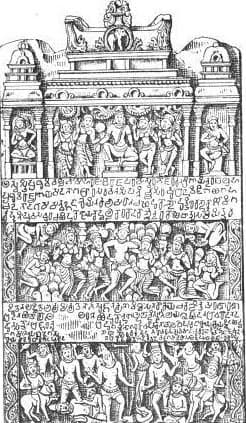
Govinda III
Emperor · Medieval
63.5Total

Napoleon Bonaparte
General · Modern
70.9Total
Basic Information
Born
778
1769
Died
814
1821
Era
Medieval
Modern
Nationality
India
France
Occupation
Emperor
General
Civilization
Indian
Western
Score Comparison
Military (10%)
78.0
94.0
Political (20%)
72.0
72.0
Influence (20%)
60.0
40.0
Legacy (20%)
52.0
80.0
Leadership (15%)
72.0
78.0
Strategy (15%)
61.2
90.0
TOTAL
63.5
70.9
Govinda III — Complete Timeline
800 AD
Expedition to the VindhyasWar
Govinda III launched a military expedition into the Vindhya region, subduing the Kalachuri king Shankaragana. He annexed parts of the Kalachuri kingdom, extending Rashtrakuta control into central India. This campaign secured the northern frontier.
Central IndiaKalachuri WarTerritorial Expansion
Impact: regionaldestructive
803 AD
Conquest of KanchipuramWar◆ Major
Govinda III led a campaign against the Pallava king Dantivarman and captured Kanchipuram. He then marched south, receiving tribute from the Chola, Pandya, and Chera kings. This established Rashtrakuta hegemony over the entire Tamil country.
Southern CampaignPallava WarTamil Nadu
Impact: regionaldestructive
805 AD
Defeat of the Gurjara-PratiharasWar◆ Major
Govinda III defeated the Gurjara-Pratihara king Nagabhata II in a battle near the Ganges. He captured the Pratihara capital of Kannauj and forced Nagabhata to flee. This victory made the Rashtrakutas the dominant power in northern India.
North Indian CampaignPratihara WarKannauj
Impact: regionaldestructive
Napoleon Bonaparte — Complete Timeline
1799 AD
Coup of 18 BrumaireOther◆ Major
Napoleon Bonaparte, with support from his brother Lucien and key political figures, overthrew the Directory in a bloodless coup. He established the Consulate with himself as First Consul, effectively becoming the ruler of France. This event ended the French Revolution's most unstable period.
French RevolutionCoupRise to Power
Impact: regional
1804 AD
Promulgation of the Napoleonic CodeOther◆ Major
Napoleon enacted the Civil Code of the French, known as the Napoleonic Code, a comprehensive set of laws that replaced the fragmented feudal legal systems. The code established legal equality, protected property rights, and secularized law. It became the basis for legal systems in many European and world countries.
Legal ReformNapoleonic CodeCivil Law
Impact: globalconstructive
1805 AD
Battle of AusterlitzWar◆ Major
Napoleon's Grande Arm
Napoleonic WarsBattleDecisive Victory
Impact: global
1812 AD
Invasion of RussiaWar◆ Major
Napoleon led the Grande Arm
Napoleonic WarsInvasionDisaster
Impact: globaldestructive
1815 AD
Battle of WaterlooWar◆ Major
Napoleon's French army was defeated by the combined forces of the Duke of Wellington's Anglo-Allied army and Gebhard Leberecht von Bl
Napoleonic WarsBattleFinal Defeat
Impact: globaldestructive
Expert Analysis
Origins
**Govinda III** was born around 793 CE into the Rashtrakuta dynasty, a prominent power in the Deccan region of India. His father, Dhruva Dharavarsha, was a successful emperor who expanded the kingdom significantly. Govinda III received a traditional Kshatriya education in statecraft, military tactics, and administration, preparing him for rule from a young age. He grew up in the royal court at Manyakheta, surrounded by courtiers and generals.
**Napoleon Bonaparte** was born on August 15, 1769, in Ajaccio, Corsica, to a minor noble family. His father, Carlo Bonaparte, was a lawyer who secured a scholarship for Napoleon to attend the Brienne Military Academy in France. Napoleon studied artillery and military strategy, graduating in 1785 as a second lieutenant. His Corsican heritage and modest nobility shaped his early ambitions. He was influenced by Enlightenment ideas and the revolutionary fervor sweeping France.
Rise to Power
**Govinda III** ascended the throne around 794 CE after his father's retirement. His early reign was marked by rebellions from vassals, which he crushed swiftly. The key turning point was his campaign against the Pallava king Dantivarman around 800 CE. Govinda III captured Kanchipuram, the Pallava capital, and marched south, extracting tribute from the Chola and Pandya kingdoms. This established his dominance over the Deccan. His defeat of the Gurjara-Pratihara king Nagabhata II near the Ganges around 806 CE further expanded his influence, capturing Kannauj and forcing Nagabhata to flee. By 810 CE, Govinda III controlled a vast territory from central India to the southern tip.
**Napoleon Bonaparte** rose during the French Revolution. He first gained fame in 1793 for his role in the Siege of Toulon, where he led artillery to capture the city from royalist forces. Promoted to brigadier general, he later commanded the Army of Italy in 1796, winning a series of battles against Austria and Sardinia, forcing peace treaties. His Egyptian campaign (1798-1799) boosted his reputation despite military setbacks. The Coup of 18 Brumaire (November 9, 1799) made him First Consul, effectively dictator. He then consolidated power through military victories and political maneuvering, crowning himself Emperor in 1804.
Leadership & Governance
**Govinda III** ruled through a feudal system, appointing governors and collecting tribute from vassals. He maintained control by frequent military campaigns and strategic marriages. His governance was decentralized, relying on local chiefs to administer provinces. He patronized Jainism and Hinduism, supporting temple construction. His tax policies were moderate, ensuring economic stability. However, his reign lacked deep institutional reforms; power rested on personal loyalty.
**Napoleon** implemented centralised reforms. The Napoleonic Code (1804) standardised French law, emphasising equality before the law, property rights, and secularism. He reorganized education, creating lycées and universities. He established the Bank of France to stabilise the economy. His government was efficient but authoritarian, with a secret police suppressing dissent. He promoted meritocracy, appointing officials based on ability. His leadership style was hands-on, often leading armies personally. He scored 78.0 in leadership, reflecting his ability to inspire and command.
Triumph & Tragedy
**Govinda III**'s greatest success was his military expansion, achieving a score of 78.0 in military. He conquered Kanchipuram and defeated the Pratiharas, extending Rashtrakuta power to the Ganges. His greatest failure was the ephemeral nature of his conquests; after his death around 814 CE, the empire quickly fragmented under his successor. He left no lasting administrative or cultural legacy comparable to his military feats.
**Napoleon** triumphed at Austerlitz (1805), crushing the Third Coalition. His military score of 94.0 reflects his tactical genius. The Napoleonic Code remains influential in many legal systems. His tragedy was the Invasion of Russia (1812), where his Grande Armée of over 600,000 men was destroyed by winter and scorched-earth tactics. He was exiled to Elba, returned for the Hundred Days, but finally defeated at Waterloo (1815). His ambition led to his downfall, costing France millions of lives.
Character & Destiny
**Govinda III** was ambitious and militaristic, typical of Indian emperors of his era. He was decisive in battle but lacked foresight in state-building. His character shaped a destiny of short-lived glory; his empire crumbled due to over-reliance on personal authority. Historical assessments view him as a capable conqueror but not a transformative ruler.
**Napoleon** was a brilliant strategist (score 90.0) and charismatic leader, but also egotistical and overconfident. His character drove him to conquer Europe, but his inability to compromise led to his isolation and defeat. He was a workaholic, micromanaging details. Historians note his genius for war but criticize his hubris. His destiny was a meteoric rise and catastrophic fall, a classic tragedy.
Legacy
**Govinda III**'s legacy is limited to regional Indian history. He expanded the Rashtrakuta empire to its zenith, but his achievements were overshadowed by later empires like the Cholas. His influence score of 60.0 reflects modest long-term impact. He is remembered as a warrior-king, but no major institutions or cultural movements stem from his reign.
**Napoleon**'s legacy is global. The Napoleonic Code influenced civil law in Europe, Latin America, and beyond. He reorganized European borders, dismantled the Holy Roman Empire, and spread nationalism. His military tactics are studied in academies worldwide. His legacy score of 80.0 indicates lasting impact. However, his wars caused immense suffering, and his authoritarianism set precedents for dictators.
Conclusion
Napoleon Bonaparte had greater overall impact than Govinda III. Napoleon scored 70.9 total vs 63.5, a gap of 7.4 points. In military, Napoleon's 94.0 far exceeds Govinda III's 78.0. Napoleon's political reforms (score 72.0) were more influential than Govinda III's (72.0, same but context differs). Napoleon's legacy (80.0) dwarfs Govinda III's (52.0). While Govinda III was a significant regional conqueror, Napoleon transformed Europe and left enduring legal and military systems. Therefore, Napoleon Bonaparte is the more impactful figure.
Rankings
🥇
Napoleon BonaparteLeader
Mil: 94.0Pol: 72.0Inf: 40.0
70.9
🥈
Govinda III
Mil: 78.0Pol: 72.0Inf: 60.0
63.5
+7.4 behind
How This Comparison Works
Algorithm
Each figure is scored on 6 dimensions (0—100 scale) based on structured historical data: Military (10%), Political (20%), Influence (20%), Legacy (20%), Leadership (15%), Strategy (15%). The weighted total produces the final ranking.
Data Sources
Scores are computed from structured sub-indicators in the database. Scale factors adjust for era (Ancient ×0.85, Modern ×1.0) and civilization size (Eastern ×1.05, Other ×0.80) to account for differences in population and military scale.
Maximum 3 Figures
Comparisons are limited to 2—3 figures to ensure readability and statistical meaningfulness.
Error Margins
±5 points per dimension — Sub-scores are derived from historical records with inherent uncertainty. Two figures within 5 points on a dimension should be considered roughly equivalent in that area.
Total Score Accuracy
±3 points overall — The weighted combination of 6 dimensions produces a total score with approximately ±3 points of uncertainty. Differences of less than 3 points are not statistically significant— the figures are effectively tied.
Known Limitations
- Historical records are incomplete and uneven across civilizations
- Figures from oral-tradition societies may be underrepresented
- Occupation labels can misclassify multi-role figures
- Scores measure capability and impact, not moral character
- Quantitative scoring is a comparison tool, not absolute truth
Capability Radar
Military (10%) — Battles & Warfare
Battles
75
95
Win Rate
80
90
Expansion
80
95
Political (20%) — Governance & Reform
Reform
65
95
Diplomacy
70
80
Economy
70
85
Influence (20%) — Cultural & Global Reach
Cultural
55
85
Global
45
90
Legacy (20%) — Historical Impact
Historical
60
95
Longevity
50
90
Leadership (15%) — Power & Stability
Tenure
75
85
Stability
70
70
Strategy (15%) — Tactics & Innovation
Strategy
75
95
Tactics
70
98
Reform
60
92
Similar Comparisons
Comments & Discussion
No comments yet. Be the first to share your thoughts!