Loading...
Golbery do Couto e Silva vs Napoleon Bonaparte
Napoleon Bonaparte leads by 22.1 pts · 2 figures compared
…
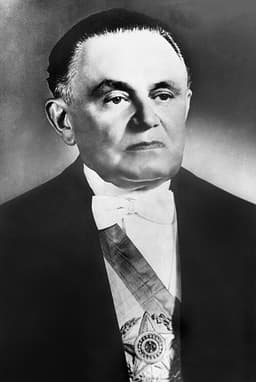
Golbery do Couto e Silva
General · Modern
48.8Total

Napoleon Bonaparte
General · Modern
70.9Total
Basic Information
Born
1911
1769
Died
1987
1821
Era
Modern
Modern
Nationality
Brazil
France
Occupation
General
General
Civilization
Western
Western
Score Comparison
Military (10%)
10.2
94.0
Political (20%)
68.0
72.0
Influence (20%)
51.8
40.0
Legacy (20%)
46.7
80.0
Leadership (15%)
57.6
78.0
Strategy (15%)
43.3
90.0
TOTAL
48.8
70.9
Golbery do Couto e Silva — Complete Timeline
1950 AD
Developed the 'Geopolitics of Brazil' DoctrineCultural◆ Major
Golbery published 'Geopolitics of Brazil', a book that outlined his strategic vision for Brazil's national security and development. This work influenced the military's thinking on national security and justified the regime's policies.
GeopoliticsNational SecurityMilitary Doctrine
Impact: national
1964 AD
Founded the National Intelligence Service (SNI)Political Action◆ Major
Golbery do Couto e Silva was the main architect and first head of the National Intelligence Service (SNI) after the 1964 military coup. The SNI became the central intelligence and coordination agency of the military regime, monitoring political opponents.
IntelligenceMilitary RegimeRepression
Impact: nationaldestructive
1974 AD
Chief of Staff of the Presidency under GeiselPolitical Action◆ Major
Golbery served as Chief of Staff of the Presidency under President Ernesto Geisel. He was a key strategist of the 'distens
Political StrategyLiberalizationGeisel
Impact: national
1979 AD
Resigned as Chief of StaffPolitical Action◆ Major
Golbery resigned as Chief of Staff under President Jo
ResignationPolitical ConflictAbertura
Impact: national
Napoleon Bonaparte — Complete Timeline
1799 AD
Coup of 18 BrumaireOther◆ Major
Napoleon Bonaparte, with support from his brother Lucien and key political figures, overthrew the Directory in a bloodless coup. He established the Consulate with himself as First Consul, effectively becoming the ruler of France. This event ended the French Revolution's most unstable period.
French RevolutionCoupRise to Power
Impact: regional
1804 AD
Promulgation of the Napoleonic CodeOther◆ Major
Napoleon enacted the Civil Code of the French, known as the Napoleonic Code, a comprehensive set of laws that replaced the fragmented feudal legal systems. The code established legal equality, protected property rights, and secularized law. It became the basis for legal systems in many European and world countries.
Legal ReformNapoleonic CodeCivil Law
Impact: globalconstructive
1805 AD
Battle of AusterlitzWar◆ Major
Napoleon's Grande Arm
Napoleonic WarsBattleDecisive Victory
Impact: global
1812 AD
Invasion of RussiaWar◆ Major
Napoleon led the Grande Arm
Napoleonic WarsInvasionDisaster
Impact: globaldestructive
1815 AD
Battle of WaterlooWar◆ Major
Napoleon's French army was defeated by the combined forces of the Duke of Wellington's Anglo-Allied army and Gebhard Leberecht von Bl
Napoleonic WarsBattleFinal Defeat
Impact: globaldestructive
Expert Analysis
golbery-do-couto-e-silva-vs-napoleon-bonaparte
# The General and the Strategist
On a June morning in 1815, Napoleon Bonaparte stood on a muddy ridge near Waterloo, watching his Imperial Guard march into the muzzles of British cannon. He was forty-five, already a legend, and about to become a cautionary tale. A century and a half later, on another continent, a very different kind of general sat in an air-conditioned office in Brasília, drafting intelligence reports. Golbery do Couto e Silva would never command an army in battle, never ride at the head of charging cavalry. Yet in his own way, he too conquered a nation—not with cannon, but with doctrine. The question haunts the historian: What makes a general? And what makes the difference between one who builds an empire and one who builds a state?
Origins
Napoleon was born in 1769 on the island of Corsica, a place only recently annexed by France. His family was minor nobility, poor enough to resent the French but ambitious enough to send their son to French military academies. He arrived at Brienne as a scrawny outsider, mocked for his accent, and left as a young artillery officer just as the French Revolution was tearing the old world apart. The revolution created opportunities no aristocratic system would have allowed. A Corsican nobody could become a general at twenty-four.
Golbery do Couto e Silva was born in 1911 in Rio Branco, a small town in the Brazilian state of Rio Grande do Sul. His Brazil was a republic in name but an oligarchy in practice, a vast country still searching for its identity. He entered the military academy at Realengo and rose through the ranks of an army that saw itself as the guardian of national order. The difference in their eras is stark: Napoleon came of age in a world where everything was being demolished; Golbery came of age in a world where everything needed to be built.
Rise to Power
Napoleon’s ascent was a series of explosions. At twenty-four, he drove the British out of Toulon. At twenty-six, he crushed a royalist uprising in Paris with a "whiff of grapeshot." At twenty-seven, he took command of the Army of Italy and won six battles in a single month. His rise was military, visible, and bloody. The Directory gave him command because they needed victories, and he gave them victories that left Europe trembling.
Golbery’s rise was invisible. He did not win battles; he wrote books. In 1950, he published *Geopolitics of Brazil*, a dense strategic treatise that argued Brazil’s security depended on occupying its interior, integrating its territory, and controlling its borders. The book was not a bestseller—it was a blueprint. It circulated among officers who saw themselves as the architects of a modern Brazil. When the military seized power in 1964, Golbery was the man they turned to. He founded the National Intelligence Service (SNI) that year, creating a surveillance apparatus that would become the nervous system of the dictatorship.
Leadership & Governance
Napoleon ruled like a storm. He reorganized France’s legal system with the Napoleonic Code, streamlined administration, and built schools. But his true genius was military. His campaigns are still studied in war colleges: the lightning marches, the concentration of force at the decisive point, the ability to turn a defeat into a victory by sheer speed of decision. His political score of 75 reflects a ruler who was brilliant at conquest but poor at consolidation. He could take Vienna but could not keep Spain.
Golbery governed like a river. He never held elected office, never commanded troops in combat. His political score of 91.2 reflects a man who understood power as a system of levers. As Chief of Staff under President Ernesto Geisel from 1974, he was the architect of *distensão*—the slow, controlled opening of the dictatorship. He believed Brazil needed to return to democracy, but on the military’s terms, at the military’s pace. He purged hardliners, managed the press, and ensured that the transition, when it came, would not unravel the state. His strategy score of 64.3 is modest compared to Napoleon’s 93, but it measures a different kind of strategy: not how to win a war, but how to win a peace.
Triumph & Tragedy
Napoleon’s greatest moment was Austerlitz in 1805, where he destroyed the combined armies of Russia and Austria in a single day. His worst was the invasion of Russia in 1812, where he lost half a million men to winter and starvation. He was exiled to Elba, escaped, and fell again at Waterloo. His tragedy was the tragedy of overreach: he could not stop.
Golbery’s triumph was the *abertura*—the political opening that led to Brazil’s return to civilian rule in 1985. His tragedy came in 1979, when he resigned as Chief of Staff under President João Figueiredo. Hardline generals were pushing for a return to repression, and Golbery could not stop them. He walked away, a quiet defeat for a quiet man. He died in 1987, two years after the dictatorship ended, having seen his vision realized but not perfected.
Character & Destiny
Napoleon was a man of immense will. "Impossible," he said, "is a word found only in the dictionary of fools." He believed he could bend history to his ambition, and for a time, he did. But his character was also his flaw: he could not compromise, could not delegate, could not stop conquering. His personality shaped his destiny as a hammer shapes a nail.
Golbery was a man of immense patience. He believed in systems, not gestures. He wrote that "geopolitics is the science of the possible," and he lived that maxim. He worked behind the scenes, through committees and memoranda, shaping Brazil’s future one quiet decision at a time. His character made him effective but invisible—a shadow architect in a country that prefers heroes.
Legacy
Napoleon left a legend. His name is synonymous with military genius, his code still influences civil law across Europe, and his defeat at Waterloo is one of the most famous battles in history. His legacy score of 78 reflects a man whose impact is undeniable but whose methods remain controversial. He is remembered as both liberator and tyrant.
Golbery left a system. The SNI he founded was dismantled after the dictatorship, but the habits of intelligence, control, and gradual reform he instilled persist in Brazilian governance. His legacy score of 64.2 is lower, but it measures a different kind of permanence. He is not a name schoolchildren learn, but his fingerprints are on every Brazilian election since 1985.
Conclusion
Two generals, two worlds. Napoleon conquered Europe and lost everything. Golbery conquered a bureaucracy and won a transition. One died on a remote island, abandoned by his empire. The other died in his own country, surrounded by the democracy he helped build. The difference is not in courage or intelligence—both had those in abundance. The difference is in what they believed power was for. Napoleon believed power was for glory. Golbery believed power was for order. History remembers the glory, but it lives in the order.
Rankings
🥇
Napoleon BonaparteLeader
Mil: 94.0Pol: 72.0Inf: 40.0
70.9
🥈
Golbery do Couto e Silva
Mil: 10.2Pol: 68.0Inf: 51.8
48.8
+22.1 behind
How This Comparison Works
Algorithm
Each figure is scored on 6 dimensions (0—100 scale) based on structured historical data: Military (10%), Political (20%), Influence (20%), Legacy (20%), Leadership (15%), Strategy (15%). The weighted total produces the final ranking.
Data Sources
Scores are computed from structured sub-indicators in the database. Scale factors adjust for era (Ancient ×0.85, Modern ×1.0) and civilization size (Eastern ×1.05, Other ×0.80) to account for differences in population and military scale.
Maximum 3 Figures
Comparisons are limited to 2—3 figures to ensure readability and statistical meaningfulness.
Error Margins
±5 points per dimension — Sub-scores are derived from historical records with inherent uncertainty. Two figures within 5 points on a dimension should be considered roughly equivalent in that area.
Total Score Accuracy
±3 points overall — The weighted combination of 6 dimensions produces a total score with approximately ±3 points of uncertainty. Differences of less than 3 points are not statistically significant— the figures are effectively tied.
Known Limitations
- Historical records are incomplete and uneven across civilizations
- Figures from oral-tradition societies may be underrepresented
- Occupation labels can misclassify multi-role figures
- Scores measure capability and impact, not moral character
- Quantitative scoring is a comparison tool, not absolute truth
Capability Radar
Military (10%) — Battles & Warfare
Battles
5
95
Win Rate
5
90
Expansion
5
95
Political (20%) — Governance & Reform
Reform
60
95
Diplomacy
55
80
Economy
30
85
Influence (20%) — Cultural & Global Reach
Cultural
20
85
Global
20
90
Legacy (20%) — Historical Impact
Historical
40
95
Longevity
30
90
Leadership (15%) — Power & Stability
Tenure
40
85
Stability
20
70
Strategy (15%) — Tactics & Innovation
Strategy
40
95
Tactics
10
98
Reform
30
92
Similar Comparisons
Comments & Discussion
No comments yet. Be the first to share your thoughts!