Loading...
Ghulam Muhammad vs Jomo Kenyatta
Jomo Kenyatta leads by 16.5 pts · 2 figures compared
…

Ghulam Muhammad
Politician · Modern
41.6Total
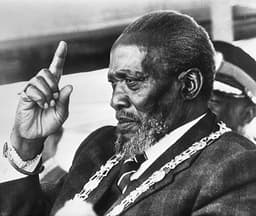
Jomo Kenyatta
Politician · Modern
58.1Total
Basic Information
Born
1895
1897
Died
1956
1978
Era
Modern
Modern
Nationality
Pakistan
Kenya
Occupation
Politician
Politician
Civilization
Indian
Other
Score Comparison
Military (10%)
41.5
25.9
Political (20%)
26.4
72.0
Influence (20%)
45.5
65.0
Legacy (20%)
37.5
55.0
Leadership (15%)
45.0
72.0
Strategy (15%)
60.0
39.3
TOTAL
41.6
58.1
Ghulam Muhammad — Complete Timeline
1954 AD
Dissolution of the Constituent AssemblyPolitical Action◆ Major
As Governor-General of Pakistan, Ghulam Muhammad dissolved the Constituent Assembly on October 24, 1954, claiming it had lost the confidence of the people. This act was widely criticized as a blow to democracy and led to a constitutional crisis.
Constitutional CrisisGovernor-GeneralPakistan
Impact: nationaldestructive
1955 AD
Imposition of Governor-General's RulePolitical Action
Following the dissolution of the assembly, Ghulam Muhammad imposed Governor-General's rule, effectively taking over executive powers. He appointed a new cabinet and called for a new constituent assembly, further centralizing authority.
Governor-General's RuleAuthoritarianismPakistan
Impact: nationaldestructive
Jomo Kenyatta — Complete Timeline
1952 AD
Mau Mau Uprising and DetentionPolitical Action◆ Major
Kenyatta was arrested and tried for his alleged involvement in the Mau Mau rebellion against British rule. He was sentenced to seven years' imprisonment, becoming a symbol of African nationalism. His detention galvanized support for independence.
Mau MauImprisonmentNationalism
Impact: regional
1963 AD
Kenya IndependencePolitical Action
Jomo Kenyatta became the first Prime Minister of independent Kenya after negotiations with British colonial authorities. His leadership marked the end of British rule and the beginning of Kenya's sovereignty, with Kenyatta advocating for racial reconciliation and economic development.
IndependenceDecolonizationPrime Minister
Impact: nationalconstructive
1964 AD
Presidency and One-Party StatePolitical Action◆ Major
Kenyatta became the first President of Kenya and established a de facto one-party state under the Kenya African National Union (KANU). He consolidated power, suppressed opposition, and promoted a capitalist economy, diverging from the socialist paths of other African leaders.
PresidencyOne-Party StateKANU
Impact: national
1965 AD
Land Redistribution PoliciesReform◆ Major
Kenyatta implemented land redistribution programs that transferred large tracts of land from white settlers to Africans. However, the policies favored his political allies and ethnic Kikuyu supporters, leading to land inequality and ethnic tensions that persisted for decades.
Land ReformEthnic PoliticsEconomic Policy
Impact: national
Expert Analysis
Origins
Ghulam Muhammad was born in 1895 in what is now Uttar Pradesh, India, to a middle-class Muslim family. He studied at Aligarh Muslim University and later qualified as a chartered accountant, one of the first Indians to do so. His early career was in finance, working for the Nizam of Hyderabad and later for the British Indian government. This background gave him expertise in economic management but little in mass politics.
Jomo Kenyatta was born around 1894 in Gatundu, British East Africa (now Kenya), to Kikuyu farmers. He attended mission schools and later studied at the London School of Economics and University College London. His early life was shaped by colonial land alienation and Kikuyu grievances. He became a prominent voice in the Kikuyu Central Association, advocating for land rights and political representation.
Rise to Power
Ghulam Muhammad rose through bureaucratic and financial channels. He served as Financial Member of the Viceroy's Executive Council (1946-1947) and after Pakistan's creation became Finance Minister. In 1951, he was appointed Governor-General by Prime Minister Liaquat Ali Khan, largely due to his administrative competence. His rise was not through popular support but through elite networks.
Jomo Kenyatta's rise was through political activism and nationalist struggle. He represented Kenya at the Pan-African Congress in 1945 and returned to lead the Kenya African Union (KAU) in 1947. His arrest in 1952 for alleged Mau Mau involvement made him a martyr. After his release in 1961, he negotiated independence terms at Lancaster House conferences, becoming Prime Minister in 1963 and President in 1964.
Leadership & Governance
Ghulam Muhammad's leadership was autocratic and legalistic. In 1954, he dissolved the Constituent Assembly, claiming it had lost the people's confidence, and imposed Governor-General's rule. He appointed a cabinet of civil servants and allies, bypassing democratic processes. His governance style was top-down, relying on constitutional loopholes rather than popular mandate. This led to political instability and set a precedent for military intervention.
Jomo Kenyatta led Kenya through a transition from colony to independent republic. He pursued a policy of reconciliation, urging forgiveness for former colonists and promoting African capitalism. He consolidated power by establishing a de facto one-party state under KANU, suppressing opposition through detention and co-optation. His land redistribution programs favored loyalists and created economic disparities but also prevented large-scale unrest.
Triumph & Tragedy
Ghulam Muhammad's greatest success was stabilizing Pakistan's economy in the early 1950s, managing foreign exchange and industrial policy. His greatest failure was the 1954 assembly dissolution, which undermined democratic development and led to his own eventual removal by the Supreme Court in 1955. His actions scored 41.5 in military (low), 26.4 in politics, and 45.5 in influence, reflecting his limited positive impact.
Jomo Kenyatta's triumph was leading Kenya to independence peacefully in 1963, avoiding a prolonged war. He also maintained stability during the Cold War, aligning with the West. His tragedy was the authoritarian turn: by 1969, he had banned all opposition parties, jailed rivals, and concentrated land and wealth in a small elite. His political score of 72.0 reflects his skill, but his legacy of 55.0 shows mixed outcomes.
Character & Destiny
Ghulam Muhammad was pragmatic, aloof, and legalistic. He saw himself as a guardian of the state above partisan politics. His character led him to act decisively but without broad support, ultimately isolating himself. The Supreme Court's unanimous decision to remove him in 1955 showed that even his legal maneuvers could not sustain his authority.
Kenyatta was charismatic, shrewd, and patient. He cultivated an image of the wise elder (Mzee) and used his detention to build legitimacy. His character enabled him to unite disparate factions but also to tolerate corruption and authoritarianism. His destiny was to be revered as the Father of the Nation, but his methods left a centralized, elite-dominated system.
Legacy
Ghulam Muhammad's legacy is largely negative in Pakistani history. He is remembered for precipitating the first constitutional crisis and opening the door to military rule. His actions scored 37.5 in legacy, reflecting his role as a cautionary figure. The 1954 dissolution is taught as a failure of early democratic institutions.
Kenyatta's legacy is more complex. He is celebrated as the founding father and symbol of independence, but his one-party state and land policies sowed seeds of later ethnic tensions and economic inequality. His legacy score of 55.0 acknowledges his foundational role but also the authoritarian turn. Kenya's subsequent history of political competition and ethnic violence can be traced partly to his choices.
Conclusion
Jomo Kenyatta had a greater impact than Ghulam Muhammad. With a total score of 58.1 compared to 41.6, Kenyatta's influence on Kenya's formation and identity is undeniable. He led a successful independence movement and governed for 15 years, shaping institutions that persist. Ghulam Muhammad's tenure was brief and destructive, setting back Pakistan's democracy. While both operated in challenging post-colonial contexts, Kenyatta's role as a nation-builder outweighs Muhammad's as a constitutional wrecker.
Rankings
🥇
Jomo KenyattaLeader
Mil: 25.9Pol: 72.0Inf: 65.0
58.1
🥈
Ghulam Muhammad
Mil: 41.5Pol: 26.4Inf: 45.5
41.6
+16.5 behind
How This Comparison Works
Algorithm
Each figure is scored on 6 dimensions (0—100 scale) based on structured historical data: Military (10%), Political (20%), Influence (20%), Legacy (20%), Leadership (15%), Strategy (15%). The weighted total produces the final ranking.
Data Sources
Scores are computed from structured sub-indicators in the database. Scale factors adjust for era (Ancient ×0.85, Modern ×1.0) and civilization size (Eastern ×1.05, Other ×0.80) to account for differences in population and military scale.
Maximum 3 Figures
Comparisons are limited to 2—3 figures to ensure readability and statistical meaningfulness.
Error Margins
±5 points per dimension — Sub-scores are derived from historical records with inherent uncertainty. Two figures within 5 points on a dimension should be considered roughly equivalent in that area.
Total Score Accuracy
±3 points overall — The weighted combination of 6 dimensions produces a total score with approximately ±3 points of uncertainty. Differences of less than 3 points are not statistically significant— the figures are effectively tied.
Known Limitations
- Historical records are incomplete and uneven across civilizations
- Figures from oral-tradition societies may be underrepresented
- Occupation labels can misclassify multi-role figures
- Scores measure capability and impact, not moral character
- Quantitative scoring is a comparison tool, not absolute truth
Capability Radar
Military (10%) — Battles & Warfare
Battles
41
20
Win Rate
48
26
Expansion
51
24
Political (20%) — Governance & Reform
Reform
10
65
Diplomacy
20
70
Economy
15
55
Influence (20%) — Cultural & Global Reach
Cultural
5
65
Global
5
55
Legacy (20%) — Historical Impact
Historical
15
70
Longevity
10
60
Leadership (15%) — Power & Stability
Tenure
30
60
Stability
5
50
Strategy (15%) — Tactics & Innovation
Strategy
50
33
Tactics
57
34
Reform
60
38
Similar Comparisons
Comments & Discussion
No comments yet. Be the first to share your thoughts!