Loading...
Gerd von Rundstedt vs Hurshid Pasha
Hurshid Pasha leads by 5.6 pts · 2 figures compared
…
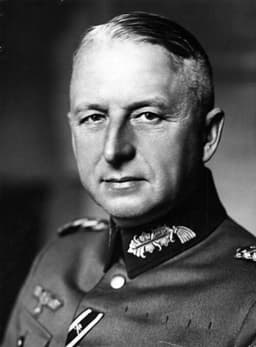
Gerd von Rundstedt
General · Modern
53.9Total

Hurshid Pasha
General · Modern
59.5Total
Basic Information
Born
1875
1770
Died
1953
1822
Era
Modern
Modern
Nationality
Germany
Ottoman Empire
Occupation
General
General
Civilization
Western
Middle Eastern
Score Comparison
Military (10%)
60.0
70.0
Political (20%)
36.5
68.0
Influence (20%)
62.0
58.0
Legacy (20%)
54.0
45.8
Leadership (15%)
50.7
71.0
Strategy (15%)
58.0
57.5
TOTAL
53.9
59.5
Gerd von Rundstedt — Complete Timeline
1940 AD
Command in the Battle of FranceWar◆ Major
Rundstedt commanded Army Group A during the invasion of France. His forces executed the Manstein Plan, advancing through the Ardennes and cutting off Allied forces in Belgium. The campaign resulted in the rapid defeat of France and the evacuation of British forces from Dunkirk.
World War IIBattle of FranceBlitzkrieg
Impact: global
1941 AD
Command of Army Group South in Operation BarbarossaWar◆ Major
Rundstedt commanded Army Group South during the invasion of the Soviet Union. His forces captured Kiev in September 1941, encircling and destroying a large Soviet force. However, he was relieved of command in December 1941 after ordering a retreat from Rostov against Hitler's orders.
World War IIEastern FrontInvasion
Impact: globaldestructive
1942 AD
Supreme Commander WestWar◆ Major
Rundstedt was appointed Commander-in-Chief West in March 1942, responsible for defending the Atlantic Wall against Allied invasion. He oversaw the construction of coastal defenses but clashed with Hitler over strategy, particularly regarding the placement of armored reserves.
World War IIWestern FrontDefense
Impact: regional
1944 AD
Dismissal and Recall during the Normandy CampaignWar◆ Major
Rundstedt was dismissed as Commander-in-Chief West in July 1944 after telling Hitler to make peace. He was recalled in September 1944 to command the Ardennes Offensive, but was again dismissed in March 1945 after the failure of the offensive.
World War IIWestern FrontCommand Change
Impact: regional
1945 AD
Capture and ImprisonmentPolitical Action
Rundstedt was captured by American forces in May 1945. He was held as a prisoner of war and later charged with war crimes, but was never tried due to his age and poor health. He was released in 1949.
World War IIPost-WarPrisoner
Impact: nationaltragic
Hurshid Pasha — Complete Timeline
1821 AD
Grand Vizier AppointmentPolitical Action
Hurshid Pasha was appointed grand vizier by Sultan Mahmud II during the Greek Revolution. His appointment was intended to bring military experience to the role, but his tenure was marked by the ongoing conflict and internal dissent.
AppointmentGreek RevolutionMilitary
Impact: national
1822 AD
Suppression of the Greek RevolutionWar◆ Major
Hurshid Pasha led Ottoman forces in suppressing the Greek War of Independence. He recaptured key cities and executed Greek leaders, but his harsh tactics fueled further resistance and international intervention.
Greek War of IndependenceSuppressionOttoman
Impact: regionaldestructive
SuicideOther◆ Major
Hurshid Pasha died by suicide after being dismissed as grand vizier and facing accusations of failure in the Greek campaign. He took poison, reflecting the immense pressure and political instability of the Ottoman court.
SuicideOttoman PoliticsFailure
Impact: nationaltragic
Expert Analysis
Origins
Gerd von Rundstedt was born on December 12, 1875, in Aschersleben, Prussia, into a noble military family. He attended the Prussian Cadet Corps and was commissioned as a lieutenant in 1893. His early career was marked by staff roles in World War I, where he served on the Western and Eastern fronts.
Hurshid Pasha was born around 1780 in the Ottoman Empire, likely in the Balkans. Little is known of his early life; he rose through the Ottoman military and administrative ranks. He served as a governor and commander, gaining experience in suppressing rebellions and maintaining order in the empire.
Rise to Power
Rundstedt's rise accelerated after World War I, where he remained in the Reichswehr. By 1938, he was a colonel general commanding Army Group South during the invasion of Poland. His success in the Battle of France (May-June 1940) cemented his reputation: his Army Group A executed the Manstein Plan, advancing through the Ardennes and encircling Allied forces, leading to the fall of France. He was promoted to field marshal in July 1940.
Hurshid Pasha rose through provincial governorships and military commands. In 1821, the Greek War of Independence broke out, and Sultan Mahmud II appointed him serasker (commander-in-chief) and later grand vizier in 1822. He was tasked with crushing the rebellion, which he did by recapturing cities like Missolonghi and executing Greek leaders, but his harsh methods fueled further resistance.
Leadership & Governance
Rundstedt was a traditional Prussian officer, focused on operational command and delegating tactical decisions. He was known for his calm demeanor and strategic insight, but often clashed with Hitler over strategic decisions. For instance, during the Normandy campaign, he advocated for a flexible defense, while Hitler insisted on static defenses. Rundstedt's leadership score of 50.7 reflects his competence but also his inability to influence Hitler's decisions.
Hurshid Pasha was an authoritarian leader, using brutal force to suppress the Greek revolt. As grand vizier, he combined military command with civil administration, but his governance was marked by execution and repression. His leadership score of 71.0 indicates his effectiveness in commanding loyal troops and suppressing dissent, but his political score of 68.0 reflects his success in navigating Ottoman court politics until his dismissal.
Triumph & Tragedy
Rundstedt's greatest triumph was the Battle of France, where his forces captured over 1.5 million Allied soldiers in six weeks. Another major success was the capture of Kiev in September 1941, where his Army Group South encircled and destroyed a Soviet force of over 600,000. However, his tragedy was the failure in the Normandy campaign; he was dismissed after telling Hitler to make peace. He was later captured by Americans in 1945 and faced war crimes charges, though never tried.
Hurshid Pasha's triumph was the suppression of the Greek Revolution, recapturing key territories and executing leaders like Alexandros Ypsilantis. However, his harsh tactics prolonged the war and led to international intervention (Battle of Navarino in 1827). His tragedy was his suicide in 1828 after being dismissed as grand vizier, accused of failure. He took poison, reflecting the volatile nature of Ottoman politics.
Character & Destiny
Rundstedt was a cautious, methodical planner, often pessimistic about Germany's chances. He was loyal to the military code but not to Nazism, which led to his dismissal. His character score in strategy (58.0) reflects his operational competence but lack of political maneuvering. His destiny was to be a respected commander overshadowed by Hitler's interference.
Hurshid Pasha was ambitious and ruthless, willing to use extreme measures to achieve his goals. His political skills (68.0) allowed him to rise to grand vizier, but his failure to fully suppress the Greek revolt led to his downfall. His suicide suggests a man unable to face disgrace, a common fate in Ottoman politics.
Legacy
Rundstedt is remembered as a competent German field marshal, though his legacy is tainted by service to the Nazi regime. His military influence (62.0) is studied in military academies for his role in the Blitzkrieg campaigns. However, he left no lasting political or institutional reforms.
Hurshid Pasha's legacy is mixed: he is remembered in Greece as a brutal oppressor, while in Turkey he is noted as a loyal servant of the sultan. His suppression of the Greek revolt ultimately failed, as Greece gained independence in 1830. His influence score of 58.0 reflects his role in Ottoman history, but his legacy (45.8) is overshadowed by the eventual Greek victory.
Conclusion
Hurshid Pasha scores higher overall (59.5 vs 53.9), with superior military (70.0 vs 60.0), political (68.0 vs 36.5), and leadership (71.0 vs 50.7) scores. While Rundstedt commanded larger forces in a global war, his impact was limited by his subordinate role and the Nazi regime's collapse. Hurshid Pasha, despite his ultimate failure, achieved high office and shaped the course of the Greek War of Independence, influencing the balance of power in the Eastern Mediterranean. Therefore, Hurshid Pasha had a greater impact relative to his context, though Rundstedt's strategic influence in World War II is more widely recognized.
Rankings
🥇
Hurshid PashaLeader
Mil: 70.0Pol: 68.0Inf: 58.0
59.5
🥈
Gerd von Rundstedt
Mil: 60.0Pol: 36.5Inf: 62.0
53.9
+5.6 behind
How This Comparison Works
Algorithm
Each figure is scored on 6 dimensions (0—100 scale) based on structured historical data: Military (10%), Political (20%), Influence (20%), Legacy (20%), Leadership (15%), Strategy (15%). The weighted total produces the final ranking.
Data Sources
Scores are computed from structured sub-indicators in the database. Scale factors adjust for era (Ancient ×0.85, Modern ×1.0) and civilization size (Eastern ×1.05, Other ×0.80) to account for differences in population and military scale.
Maximum 3 Figures
Comparisons are limited to 2—3 figures to ensure readability and statistical meaningfulness.
Error Margins
±5 points per dimension — Sub-scores are derived from historical records with inherent uncertainty. Two figures within 5 points on a dimension should be considered roughly equivalent in that area.
Total Score Accuracy
±3 points overall — The weighted combination of 6 dimensions produces a total score with approximately ±3 points of uncertainty. Differences of less than 3 points are not statistically significant— the figures are effectively tied.
Known Limitations
- Historical records are incomplete and uneven across civilizations
- Figures from oral-tradition societies may be underrepresented
- Occupation labels can misclassify multi-role figures
- Scores measure capability and impact, not moral character
- Quantitative scoring is a comparison tool, not absolute truth
Capability Radar
Military (10%) — Battles & Warfare
Battles
75
65
Win Rate
65
60
Expansion
60
50
Political (20%) — Governance & Reform
Reform
20
40
Diplomacy
30
50
Economy
15
45
Influence (20%) — Cultural & Global Reach
Cultural
30
30
Global
50
30
Legacy (20%) — Historical Impact
Historical
55
40
Longevity
40
25
Leadership (15%) — Power & Stability
Tenure
30
55
Stability
20
35
Strategy (15%) — Tactics & Innovation
Strategy
75
60
Tactics
80
55
Reform
40
30
Similar Comparisons
Comments & Discussion
No comments yet. Be the first to share your thoughts!