Loading...
Gao Wei vs Napoleon Bonaparte
Napoleon Bonaparte leads by 30.3 pts · 2 figures compared
…
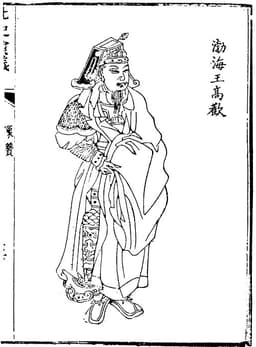
Gao Wei
Emperor · Medieval
40.6Total

Napoleon Bonaparte
General · Modern
70.9Total
Basic Information
Born
557
1769
Died
577
1821
Era
Medieval
Modern
Nationality
China
France
Occupation
Emperor
General
Civilization
Eastern
Western
Score Comparison
Military (10%)
50.0
94.0
Political (20%)
26.4
72.0
Influence (20%)
45.5
40.0
Legacy (20%)
35.8
80.0
Leadership (15%)
49.9
78.0
Strategy (15%)
38.6
90.0
TOTAL
40.6
70.9
Gao Wei — Complete Timeline
565 AD
Accession as Emperor of Northern QiPolitical Action◆ Major
Gao Wei ascended the throne as emperor of Northern Qi at age eight, with his mother Empress Dowager Hu and officials serving as regents. His reign was marked by incompetence, corruption, and neglect of state affairs, leading to the dynasty's decline.
Northern QiSuccessionDecline
Impact: national
577 AD
Defeat and capture by Northern ZhouWar
Northern Zhou forces under Emperor Wu conquered Northern Qi. Gao Wei was captured and later executed, ending the Northern Qi dynasty. His incompetence, including favoring eunuchs and neglecting defense, was a major cause of the defeat.
Northern QiConquestExecution
Impact: regionaltragic
Napoleon Bonaparte — Complete Timeline
1799 AD
Coup of 18 BrumaireOther◆ Major
Napoleon Bonaparte, with support from his brother Lucien and key political figures, overthrew the Directory in a bloodless coup. He established the Consulate with himself as First Consul, effectively becoming the ruler of France. This event ended the French Revolution's most unstable period.
French RevolutionCoupRise to Power
Impact: regional
1804 AD
Promulgation of the Napoleonic CodeOther◆ Major
Napoleon enacted the Civil Code of the French, known as the Napoleonic Code, a comprehensive set of laws that replaced the fragmented feudal legal systems. The code established legal equality, protected property rights, and secularized law. It became the basis for legal systems in many European and world countries.
Legal ReformNapoleonic CodeCivil Law
Impact: globalconstructive
1805 AD
Battle of AusterlitzWar◆ Major
Napoleon's Grande Arm
Napoleonic WarsBattleDecisive Victory
Impact: global
1812 AD
Invasion of RussiaWar◆ Major
Napoleon led the Grande Arm
Napoleonic WarsInvasionDisaster
Impact: globaldestructive
1815 AD
Battle of WaterlooWar◆ Major
Napoleon's French army was defeated by the combined forces of the Duke of Wellington's Anglo-Allied army and Gebhard Leberecht von Bl
Napoleonic WarsBattleFinal Defeat
Impact: globaldestructive
Expert Analysis
gao-wei-vs-napoleon-bonaparte
# The Emperor and the General: Two Falls from Grace
On a June morning in 1815, the most feared man in Europe stood on a muddy field near Waterloo, watching his Imperial Guard march into a storm of British cannon fire. Forty-six years earlier, on the other side of the world, an eight-year-old boy was placed on a dragon throne in Ye, capital of the Northern Qi dynasty, surrounded by eunuchs and regents who would soon destroy him. Napoleon Bonaparte and Gao Wei never met, never heard each other’s names. Yet both rose to supreme power, both saw their empires crumble, and both died in captivity. The difference is not in their fates—it is in what they did with the years between the crown and the fall.
Origins
Napoleon was born in 1769 on the island of Corsica, a year after France bought it from Genoa. His family was minor Italian nobility, scraping by on a hillside estate. He spoke French with a thick accent, was mocked at military school for his short stature and provincial manners, and devoured books on artillery and Alexander the Great. Corsica had been conquered only recently; Napoleon grew up with the smell of gunpowder and the dream of glory.
Gao Wei was born in 557 into the imperial Xianbei clan of Northern Qi, a kingdom that ruled much of northern China. His father, Emperor Wucheng, was a debauched tyrant who drank heavily and executed officials on whims. Gao Wei never knew hunger, never heard a cannon, never read a military manual. He was surrounded by eunuchs, concubines, and Buddhist monks who told him he was a living god. By the time he took the throne at age eight in 565, his world was a palace of silk screens and poisoned wine.
The difference in their upbringings is not merely one of wealth versus poverty. Napoleon was forged by scarcity and humiliation; Gao Wei was melted by indulgence and flattery.
Rise to Power
Napoleon’s path was a ladder of blood and brilliance. At twenty-four, he cleared the streets of royalist rebels with a “whiff of grapeshot”—a ruthless artillery barrage that made him famous overnight. At twenty-seven, he conquered Italy with an army that had been starving and unpaid, winning battles by marching faster and thinking sharper than his enemies. By thirty, he had seized control of France in the coup of 18 Brumaire. Every step was earned by audacity, calculation, and the willingness to risk everything.
Gao Wei’s path was a throne handed to a child. He had no rivals to defeat, no campaigns to win. His regents, the general Hulü Guang and the official Zu Ting, fought each other for control of the boy-emperor. Gao Wei did nothing but play games. When he grew older, he appointed his pet dog as a court official and gave his favorite concubine, Feng Xiaolian, the title of “Left Prime Minister.” His rise was not a climb—it was a slide into a golden chair.
Leadership & Governance
Napoleon governed like a machine. He wrote the Napoleonic Code, which standardized French law, abolished feudalism, and protected property rights. He created the Bank of France, reformed education, and established the Legion of Honor. He was a workaholic who read reports at 3 a.m. and dictated letters to seven secretaries simultaneously. His military genius is beyond dispute: he fought more than sixty battles and lost only seven, with a strategic score of 93—one of the highest in history.
Gao Wei governed like a dreamer lost in a dream. He spent tax revenue on a giant artificial lake with a mechanical dragon that spouted water. He built a “Palace of the Immortals” where he dressed as a Buddhist deity and demanded worship. When Northern Zhou invaded in 576, he was told the enemy was coming—and replied, “Let them come. I will defeat them with my magic.” He did not. His total leadership score of 31.4 reflects a ruler who abandoned every responsibility.
The contrast is not just in competence but in purpose. Napoleon saw power as a tool to reshape the world. Gao Wei saw power as a toy to amuse himself.
Triumph & Tragedy
Napoleon’s greatest moment was Austerlitz in 1805, where he lured the Austrian and Russian armies into a frozen trap and crushed them. His empire stretched from Spain to Poland. His tragedy was the invasion of Russia in 1812—600,000 men marched east; fewer than 40,000 returned. He was exiled to Elba, escaped, and then lost at Waterloo in 1815. His final years were spent on the remote island of Saint Helena, dictating memoirs and dying of stomach cancer at age fifty-one.
Gao Wei’s greatest moment was, perhaps, the day he was crowned. His tragedy was everything after. In 577, Northern Zhou armies conquered his capital. He was captured, paraded through the streets of Chang’an, and later executed by poison. He was twenty years old. His kingdom, Northern Qi, vanished forever.
Character & Destiny
Napoleon’s character was a storm of ambition, intelligence, and arrogance. He believed he was destiny’s chosen instrument, and for a time, he was right. But his refusal to compromise, his endless warring, and his disastrous invasion of Russia were choices driven by a personality that could not stop. He once said, “Power is my mistress.” It was a love affair that ended in exile.
Gao Wei’s character was a void. He had no ambition, no intelligence, no arrogance—only a bottomless appetite for pleasure. He did not choose his fate; he drifted into it. His biography reads not as a tragedy but as a warning: give absolute power to a child, and you get a child who destroys an empire.
Legacy
Napoleon’s legacy is enormous. The Napoleonic Code still shapes legal systems across Europe and the Americas. His military tactics are taught in war colleges. He is remembered as both a tyrant and a genius, a man who spread revolution with one hand and tyranny with the other. His total legacy score of 78 reflects a figure who transformed the modern world.
Gao Wei’s legacy is a footnote. He is remembered only as the last emperor of a failed dynasty, a cautionary tale in Chinese histories. His legacy score of 48 is a measure of how completely he was erased. No one studies his tactics. No one quotes his laws. He left nothing behind but a name that means “incompetent ruler.”
Conclusion
Why did one man conquer Europe and the other lose a kingdom? The answer is not in their circumstances but in their souls. Napoleon was born poor and fought to the top; Gao Wei was born a king and never fought at all. Napoleon read Plutarch and Caesar; Gao Wei listened to eunuchs and concubines. Napoleon spent his life building a machine of law and war; Gao Wei spent his life building a mechanical dragon. One died in a cold Atlantic island, writing his memoirs. The other died in a foreign capital, forgotten. Both fell from grace. But one fell from a height he had climbed himself—and the other fell from a throne he never deserved.
Rankings
🥇
Napoleon BonaparteLeader
Mil: 94.0Pol: 72.0Inf: 40.0
70.9
🥈
Gao Wei
Mil: 50.0Pol: 26.4Inf: 45.5
40.6
+30.3 behind
How This Comparison Works
Algorithm
Each figure is scored on 6 dimensions (0—100 scale) based on structured historical data: Military (10%), Political (20%), Influence (20%), Legacy (20%), Leadership (15%), Strategy (15%). The weighted total produces the final ranking.
Data Sources
Scores are computed from structured sub-indicators in the database. Scale factors adjust for era (Ancient ×0.85, Modern ×1.0) and civilization size (Eastern ×1.05, Other ×0.80) to account for differences in population and military scale.
Maximum 3 Figures
Comparisons are limited to 2—3 figures to ensure readability and statistical meaningfulness.
Error Margins
±5 points per dimension — Sub-scores are derived from historical records with inherent uncertainty. Two figures within 5 points on a dimension should be considered roughly equivalent in that area.
Total Score Accuracy
±3 points overall — The weighted combination of 6 dimensions produces a total score with approximately ±3 points of uncertainty. Differences of less than 3 points are not statistically significant— the figures are effectively tied.
Known Limitations
- Historical records are incomplete and uneven across civilizations
- Figures from oral-tradition societies may be underrepresented
- Occupation labels can misclassify multi-role figures
- Scores measure capability and impact, not moral character
- Quantitative scoring is a comparison tool, not absolute truth
Capability Radar
Military (10%) — Battles & Warfare
Battles
5
95
Win Rate
5
90
Expansion
0
95
Political (20%) — Governance & Reform
Reform
0
95
Diplomacy
5
80
Economy
5
85
Influence (20%) — Cultural & Global Reach
Cultural
5
85
Global
5
90
Legacy (20%) — Historical Impact
Historical
10
95
Longevity
5
90
Leadership (15%) — Power & Stability
Tenure
10
85
Stability
5
70
Strategy (15%) — Tactics & Innovation
Strategy
5
95
Tactics
5
98
Reform
0
92
Similar Comparisons
Comments & Discussion
GunpowderGlory6/17/2026
Napoleon earned every star on his epaulets through blood and brilliance at Toulon and Austerlitz. Gao Wei just inherited a silk robe. One climbed from Corsican obscurity to dominate Europe; the other was handed a throne and still crashed his dynasty in a generation. There is no comparison—it’s a tragedy of merit versus mediocrity.
数据密探6/17/2026
说拿破仑和北齐后主一样?可拉倒吧。拿破仑打输了滑铁卢,但军事改革和法典流传至今。高纬呢?把国家玩没了,还抱着琵琶唱亡国之音。数据上,法兰西帝国撑了十年,北齐就二十八年,但拿破仑的战绩带过十万大军,高纬只会让太监带兵。这对比太离谱了。
ClassicsSage6/17/2026
Both fell from grace, but Napoleon’s fall was a symphony—Waterloo, exile, a return, then St. Helena. Gao Wei’s was a farce—abdication, drunken palace intrigue, death by poison in captivity. Napoleon wrote memoirs; Gao Wei left behind a tragic opera aria. One dies as history’s villain-hero, the other as a footnote.
历史老炮儿6/17/2026
别把拿破仑和高纬放一块。拿破仑是猛虎,高纬顶多是只病猫。高纬当皇帝八年,杀了一堆忠臣,宠信冯小怜,最后北周打来直接投降。拿破仑好歹打到欧洲没了敌手,输也是输在反法同盟集体围殴。不是一个量级,别碰瓷了。
RevisionistEcho6/17/2026
Everyone romanticizes Napoleon’s rise and fall as a dramatic epic. But Gao Wei’s story is more honest—pure decadence, zero agency. Napoleon at least chose his battles; Gao Wei chose his concubines. The comparison flatters the Chinese emperor. Glory and ruin require agency; Gao Wei just had luck and a weak father. That’s not tragedy, that’s entropy.