Loading...
Gao of Mali vs Napoleon Bonaparte
Napoleon Bonaparte leads by 31.3 pts · 2 figures compared
…
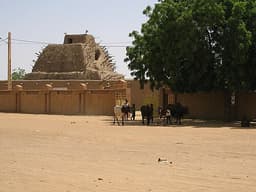
Gao of Mali
Emperor · Medieval
39.6Total

Napoleon Bonaparte
General · Modern
70.9Total
Basic Information
Born
1280
1769
Died
1310
1821
Era
Medieval
Modern
Nationality
Mali Empire
France
Occupation
Emperor
General
Civilization
Other
Western
Score Comparison
Military (10%)
21.2
94.0
Political (20%)
29.3
72.0
Influence (20%)
48.6
40.0
Legacy (20%)
40.0
80.0
Leadership (15%)
48.4
78.0
Strategy (15%)
36.8
90.0
TOTAL
39.6
70.9
Napoleon Bonaparte — Complete Timeline
1799 AD
Coup of 18 BrumaireOther◆ Major
Napoleon Bonaparte, with support from his brother Lucien and key political figures, overthrew the Directory in a bloodless coup. He established the Consulate with himself as First Consul, effectively becoming the ruler of France. This event ended the French Revolution's most unstable period.
French RevolutionCoupRise to Power
Impact: regional
1804 AD
Promulgation of the Napoleonic CodeOther◆ Major
Napoleon enacted the Civil Code of the French, known as the Napoleonic Code, a comprehensive set of laws that replaced the fragmented feudal legal systems. The code established legal equality, protected property rights, and secularized law. It became the basis for legal systems in many European and world countries.
Legal ReformNapoleonic CodeCivil Law
Impact: globalconstructive
1805 AD
Battle of AusterlitzWar◆ Major
Napoleon's Grande Arm
Napoleonic WarsBattleDecisive Victory
Impact: global
1812 AD
Invasion of RussiaWar◆ Major
Napoleon led the Grande Arm
Napoleonic WarsInvasionDisaster
Impact: globaldestructive
1815 AD
Battle of WaterlooWar◆ Major
Napoleon's French army was defeated by the combined forces of the Duke of Wellington's Anglo-Allied army and Gebhard Leberecht von Bl
Napoleonic WarsBattleFinal Defeat
Impact: globaldestructive
Expert Analysis
gao-of-mali-vs-napoleon-bonaparte
The Emperor and the Shadow King
In the winter of 1812, Napoleon Bonaparte watched his Grand Army burn the Kremlin, convinced he had crushed the Russian bear. Six months later, he fled back to France, leaving half a million men dead in the snow. Seven centuries earlier, on the other side of the world, a man named Gao ruled the Mali Empire from its golden heart, his name barely a whisper in the historical record. One man’s life became a storm that reshaped a continent; the other’s reign is a footnote. What separates a titan from a ghost? The answer lies not in the stars, but in the raw materials of ambition, opportunity, and the brutal logic of power.
Origins
Napoleon Bonaparte was born in 1769 on the island of Corsica, a place of fierce independence recently annexed by France. His family was minor nobility, poor enough to be hungry, proud enough to resent their new masters. This was a crucible of fire. He learned French as a second language, mocked by classmates for his accent, and channeled his fury into books and mathematics. The Enlightenment was in full bloom; Voltaire and Rousseau were in the air. Napoleon absorbed the ideals of meritocracy and reason, but he also internalized the lesson that the world belonged to those who seized it.
By contrast, Gao of Mali was born around 1280 into a dynasty that already commanded unimaginable wealth. The Mali Empire, founded by Sundiata Keita, controlled the gold and salt trades of West Africa. Gao inherited a machine of power: a trained army, a bureaucracy of Muslim scholars, and the legendary city of Timbuktu. He was born at the top, but the summit was crowded. His predecessors had set the bar high, and his successors—most famously Mansa Musa—would eclipse him entirely. Gao’s world was one of stability and ritual, where a ruler’s duty was to preserve, not to conquer. The difference was fundamental: Napoleon was forged in a furnace of revolution; Gao was cast in a mold of tradition.
Rise to Power
Napoleon’s ascent was a masterpiece of opportunism. The French Revolution had shattered the old order, and a young artillery officer with a talent for mathematics and a hunger for glory found his moment at the Siege of Toulon in 1793. He was just 24. By 1796, he commanded the Army of Italy, where his lightning campaigns humiliated the Austrians and made him a national hero. He didn’t just win battles; he understood that in a revolutionary age, a general could become a politician. In 1799, he staged a coup and made himself First Consul. By 1804, he crowned himself Emperor of the French. Each step was a gamble, calculated and ruthless.
Gao’s path was quieter. He became Mansa—emperor—around 1280, likely through dynastic succession. There is no record of a dramatic coup or a decisive battle that launched his reign. He inherited the throne as a matter of course, surrounded by courtiers, clerics, and a system that valued continuity over change. His power was real, but it was the power of a caretaker. While Napoleon clawed his way up a broken ladder, Gao simply stepped onto a throne that had been waiting for him. The difference in their rises explains everything that followed.
Leadership & Governance
As emperor, Napoleon was a force of nature. He reorganized France into a modern state: the Napoleonic Code established equality before the law, abolished feudalism, and protected property rights. He created a centralized bureaucracy, a national education system, and a bank that stabilized the currency. But his genius was inseparable from his tyranny. He censored the press, suppressed dissent, and reestablished slavery in French colonies. His governance was a paradox—liberal in theory, authoritarian in practice. His military strategy was equally dual: he won spectacular victories at Austerlitz (1805) and Jena (1806) by using speed, deception, and overwhelming force at a single point. But he could never stop fighting. Peace was not in his vocabulary.
Gao’s rule is so poorly documented that we can only infer his style. The Mali Empire under his predecessors was known for its efficient administration, its tolerance of local customs, and its integration of Islamic law with traditional African governance. Gao likely maintained this system. His military score of 58.9 and strategy of 30.0 suggest he was no conqueror. He was a steward. While Napoleon redrew the map of Europe with blood and ink, Gao kept the trade routes open, the gold flowing, and the peace. It was a different kind of leadership—less dramatic, but perhaps more sustainable in a world where empires rose and fell with the seasons.
Triumph & Tragedy
Napoleon’s greatest moment was Austerlitz, where he crushed the combined armies of Russia and Austria in a single day. It was the perfect battle: he tricked his enemies into attacking his weakened right flank, then smashed their center with a hidden corps. The victory was so complete that the Austrian emperor sued for peace that night. But his tragedy was equally colossal. The invasion of Russia in 1812 was a catastrophic overreach. He won every battle, but the Russian winter, the scorched earth, and his own stubborn refusal to retreat destroyed his army. He was exiled to Elba, returned for a hundred days, and was finally defeated at Waterloo in 1815. He ended his life on a remote island in the South Atlantic, abandoned by everyone.
Gao’s triumphs and tragedies are lost. He ruled for perhaps thirty years, but we know no great battles, no famous speeches, no dramatic falls. His tragedy is the tragedy of silence: he was a king whose entire life is reduced to a few lines in a chronicle. The Mali Empire would reach its zenith under Mansa Musa, who made the legendary pilgrimage to Mecca and gave away so much gold that he crashed the Egyptian economy. Gao was the prelude to that symphony. His greatest achievement may have been to keep the empire stable enough for his successor to shine.
Character & Destiny
Napoleon was driven by an insatiable hunger for glory. “Impossible is a word to be found only in the dictionary of fools,” he once said. He believed he was a man of destiny, and he bent the world to his will. But his character was also his flaw: he could not stop, could not compromise, could not share power. His ambition burned so brightly that it consumed everything—including himself. He died at 51, a prisoner, still dreaming of a second act.
Gao’s character is a mystery. Perhaps he was wise enough to know that a stable empire needed a steady hand, not a brilliant one. Perhaps he was simply average. But his destiny was shaped by his era. In the medieval world, a ruler’s fame depended on chroniclers, and chroniclers favored spectacle. Gao offered no spectacle, so he vanished. Napoleon, by contrast, lived in an age of newspapers, memoirs, and mass literacy. He wrote his own legend, and the world believed him.
Legacy
Napoleon’s legacy is everywhere. The Napoleonic Code influenced legal systems from Europe to Latin America. His military tactics are still studied at war colleges. He shattered the old monarchies and paved the way for nationalism and modern statehood. But he also left a trail of war, death, and bitterness that poisoned Europe for a century. He is remembered as both a liberator and a tyrant, a genius and a madman.
Gao’s legacy is almost invisible. He is a name in a list, a placeholder in a dynasty. The Mali Empire fell, and its glories were buried under sand and time. But perhaps that is a different kind of success: to rule so well that no one remembers you, because nothing went wrong. In a world that worships the spectacular, the quiet competence of a forgotten king might be the truest lesson of all.
Conclusion
Napoleon and Gao stand at opposite ends of the spectrum of historical memory. One burned across the sky like a comet; the other was a steady star, soon forgotten. The difference was not in their intrinsic worth—both were rulers of great empires—but in the circumstances of their birth, the nature of their ambition, and the age in which they lived. Napoleon’s world was one of revolution, where a man could remake himself and his nation. Gao’s world was one of tradition, where a man could only preserve what he inherited. In the end, history remembers the fire, not the foundation. But without the foundation, the fire would have nothing to burn.
Rankings
🥇
Napoleon BonaparteLeader
Mil: 94.0Pol: 72.0Inf: 40.0
70.9
🥈
Gao of Mali
Mil: 21.2Pol: 29.3Inf: 48.6
39.6
+31.3 behind
How This Comparison Works
Algorithm
Each figure is scored on 6 dimensions (0—100 scale) based on structured historical data: Military (10%), Political (20%), Influence (20%), Legacy (20%), Leadership (15%), Strategy (15%). The weighted total produces the final ranking.
Data Sources
Scores are computed from structured sub-indicators in the database. Scale factors adjust for era (Ancient ×0.85, Modern ×1.0) and civilization size (Eastern ×1.05, Other ×0.80) to account for differences in population and military scale.
Maximum 3 Figures
Comparisons are limited to 2—3 figures to ensure readability and statistical meaningfulness.
Error Margins
±5 points per dimension — Sub-scores are derived from historical records with inherent uncertainty. Two figures within 5 points on a dimension should be considered roughly equivalent in that area.
Total Score Accuracy
±3 points overall — The weighted combination of 6 dimensions produces a total score with approximately ±3 points of uncertainty. Differences of less than 3 points are not statistically significant— the figures are effectively tied.
Known Limitations
- Historical records are incomplete and uneven across civilizations
- Figures from oral-tradition societies may be underrepresented
- Occupation labels can misclassify multi-role figures
- Scores measure capability and impact, not moral character
- Quantitative scoring is a comparison tool, not absolute truth
Capability Radar
Military (10%) — Battles & Warfare
Battles
10
95
Win Rate
10
90
Expansion
10
95
Political (20%) — Governance & Reform
Reform
20
95
Diplomacy
20
80
Economy
30
85
Influence (20%) — Cultural & Global Reach
Cultural
20
85
Global
10
90
Legacy (20%) — Historical Impact
Historical
20
95
Longevity
20
90
Leadership (15%) — Power & Stability
Tenure
30
85
Stability
30
70
Strategy (15%) — Tactics & Innovation
Strategy
10
95
Tactics
10
98
Reform
10
92
Similar Comparisons
Comments & Discussion
KremlinSmasher6/17/2026
Napoleon's retreat from Moscow wasn't just a tactical blunder—it was a logistical disaster that makes Gao's administrative stability look like genius. While Bonaparte gambled his Grand Army on a single catastrophic campaign, Gao ruled from the Niger's banks for decades, managing gold flows that funded half the Mediterranean's mints. One man built an empire that crumbled in a winter; the other maintained one for generations. Napoleon's ambition was bright but brittle. Gao's quiet competence? That
漠北铁骑6/17/2026
别拿拿破仑的失败和加奥的平稳相比!拿破仑改变了世界军事史,贡献了现代战争的艺术。加奥只是躺在祖先财富上的傀儡皇帝,连一次像样的征服战役都没留下。马里帝国再辉煌,也不过是历史教科书里的一行字。而拿破仑的《法典》至今还在影响欧洲法律。一个靠遗产,一个凭奋斗,高下立判。我选那个挥舞军刀的科西嘉矮子。
ShadowSkeptic6/17/2026
Comparing a ghost to a storm is dishonest. Gao's "reign" is barely attested in any primary sources—we don't even know his real name, let alone his policies or battles. Napoleon left us letters, memoirs, and battle plans. This analysis fabricates a narrative around an almost mythical figure just to contrast him with a fully documented emperor. It's intellectually lazy. Either both men should be judged by identical evidentiary standards, or we admit this is poetry, not history. I'd rather study re
汴梁刀客6/17/2026
加奥是个被遗忘的君王,这本身就说明问题。历史不会埋没真正的伟人。拿破仑在圣赫勒拿岛都能让欧洲颤抖,马里皇帝的名字却连学者都要争论。你说他控制黄金贸易?那又怎样,蒙古人骑着马横扫亚洲,成吉思汗的名字谁不知道?权力不只是财富,更是能留下的印记。拿破仑印下了,加奥没有。历史法庭的判决:星光黯淡者不值一提。
RevisionistFlame6/17/2026
Enough with the Napoleon worship. The man left Europe in ruins, imposed a Continental System that backfired, and crowned himself emperor—betraying every Revolutionary ideal. Gao silently managed an empire that rivaled any in wealth while avoiding the self-destructive wars that define Bonaparte's legacy. We measure success by casualties and body counts because that's what "history" values—violence. But if prosperity, stability, and cultural patronage matter, Gao outshines Napoleon ten times over.