Loading...
Analysis will be generated on first visit.
Scores and timeline are available below. The page will refresh automatically when ready.
Galileo Galilei vs Napoleon Bonaparte
Napoleon Bonaparte leads by 34.9 pts · 2 figures compared
…

Galileo Galilei
Scientist · Modern
47.5Total
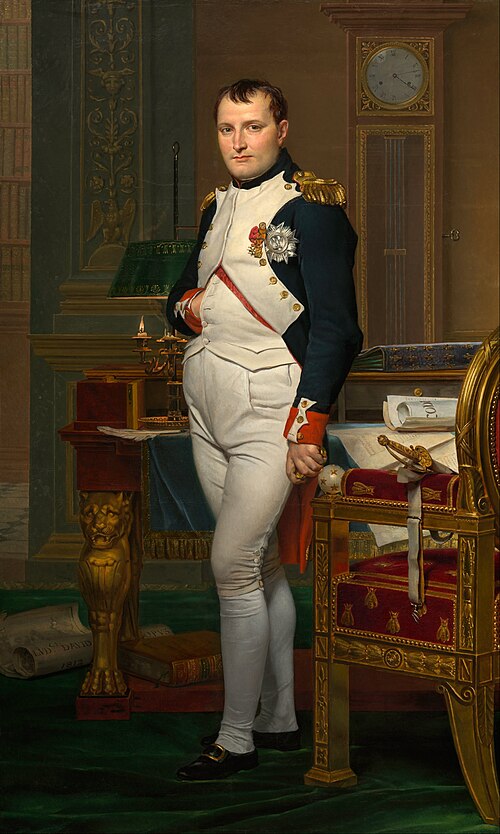
Napoleon Bonaparte
General · Modern
82.4Total
Basic Information
Born
1564
1769
Died
1642
1821
Era
Modern
Modern
Nationality
Italy
France
Occupation
Scientist
General
Civilization
Western
Western
Score Comparison
Military (10%)
24.1
94.0
Political (20%)
24.8
75.0
Influence (20%)
68.0
82.0
Legacy (20%)
78.0
78.0
Leadership (15%)
19.2
80.0
Strategy (15%)
53.4
93.0
TOTAL
47.5
82.4
Rankings
🥇
Napoleon BonaparteLeader
Mil: 94.0Pol: 75.0Inf: 82.0
82.4
🥈
Galileo Galilei
Mil: 24.1Pol: 24.8Inf: 68.0
47.5
+34.9 behind
How This Comparison Works
Algorithm
Each figure is scored on 6 dimensions (0—100 scale) based on structured historical data: Military (10%), Political (20%), Influence (20%), Legacy (20%), Leadership (15%), Strategy (15%). The weighted total produces the final ranking.
Data Sources
Scores are computed from structured sub-indicators in the database. Scale factors adjust for era (Ancient ×0.85, Modern ×1.0) and civilization size (Eastern ×1.05, Other ×0.80) to account for differences in population and military scale.
Maximum 3 Figures
Comparisons are limited to 2—3 figures to ensure readability and statistical meaningfulness.
Error Margins
±5 points per dimension — Sub-scores are derived from historical records with inherent uncertainty. Two figures within 5 points on a dimension should be considered roughly equivalent in that area.
Total Score Accuracy
±3 points overall — The weighted combination of 6 dimensions produces a total score with approximately ±3 points of uncertainty. Differences of less than 3 points are not statistically significant— the figures are effectively tied.
Known Limitations
- Historical records are incomplete and uneven across civilizations
- Figures from oral-tradition societies may be underrepresented
- Occupation labels can misclassify multi-role figures
- Scores measure capability and impact, not moral character
- Quantitative scoring is a comparison tool, not absolute truth
Capability Radar
Military (10%) — Battles & Warfare
Battles
16
95
Win Rate
18
90
Expansion
21
95
Political (20%) — Governance & Reform
Reform
10
95
Diplomacy
15
80
Economy
5
85
Influence (20%) — Cultural & Global Reach
Cultural
85
85
Global
90
90
Legacy (20%) — Historical Impact
Historical
90
95
Longevity
95
90
Leadership (15%) — Power & Stability
Tenure
5
85
Stability
5
70
Strategy (15%) — Tactics & Innovation
Strategy
23
95
Tactics
26
98
Reform
33
92
Analysis will be generated on first visit.
Scores and timeline are available below. The page will refresh automatically when ready.
Galileo Galilei — Complete Timeline
1609 AD
Improvement of the telescopeInvention
Galileo improved the Dutch telescope, achieving 20x magnification. He used it to observe the Moon's craters, Jupiter's moons, and the phases of Venus. These observations provided evidence for the Copernican heliocentric model and challenged Aristotelian cosmology.
TelescopeAstronomyScientific revolution
Impact: globalprogressive
1610 AD
Discovery of Jupiter's moonsInvention◆ Major
Galileo discovered four moons orbiting Jupiter (Io, Europa, Ganymede, Callisto). This observation demonstrated that not all celestial bodies orbit Earth, contradicting geocentric models. He published the findings in Sidereus Nuncius.
AstronomyDiscoveryHeliocentrism
Impact: globalprogressive
1616 AD
Conflict with the Catholic ChurchPolitical Action◆ Major
The Catholic Church declared heliocentrism heretical and ordered Galileo to abandon his support for Copernican theory. He was warned not to teach or defend heliocentrism. This marked the beginning of his conflict with Church authorities.
ReligionScienceConflict
Impact: globaldestructive
1632 AD
Publication of Dialogue Concerning the Two Chief World SystemsCultural◆ Major
Galileo published a dialogue comparing Ptolemaic and Copernican systems, arguing for heliocentrism. The book was seen as violating the 1616 injunction. It led to his trial and condemnation by the Inquisition.
PublicationScienceControversy
Impact: globalprogressive
1633 AD
Trial and house arrestPolitical Action
The Roman Inquisition tried Galileo for heresy, forcing him to recant his heliocentric views. He was sentenced to house arrest for life, where he continued scientific work. This event symbolized the conflict between science and religious authority.
TrialInquisitionScience
Impact: globaltragic
Similar Comparisons
Comments & Discussion
No comments yet. Be the first to share your thoughts!