Loading...
This comparison has not been analyzed yet.
One-time AI generation (~1 minute). Scores and timeline are already available below.
Fuad Pasha vs Kukrit Pramoj
Fuad Pasha leads by 7.7 pts · 2 figures compared
…
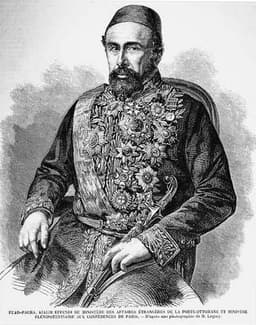
Fuad Pasha
Politician · Modern
60.0Total

Kukrit Pramoj
Politician · Modern
52.3Total
Basic Information
Born
1814
1911
Died
1869
1995
Era
Modern
Modern
Nationality
Ottoman Empire
Thailand
Occupation
Politician
Politician
Civilization
Middle Eastern
Eastern
Score Comparison
Military (10%)
40.8
10.2
Political (20%)
78.0
62.7
Influence (20%)
60.0
60.0
Legacy (20%)
49.2
50.0
Leadership (15%)
85.0
74.0
Strategy (15%)
41.8
33.1
TOTAL
60.0
52.3
Fuad Pasha — Complete Timeline
1860 AD
Suppression of the 1860 Mount Lebanon ConflictPolitical Action◆ Major
As Foreign Minister, Fuad Pasha was sent to Lebanon in 1860 to restore order after sectarian violence between Maronites and Druze. He implemented a harsh crackdown, executing dozens of Druze leaders and imposing a new administrative structure that created the Mount Lebanon Mutasarrifate.
InterventionSectarian ConflictLebanon
Impact: regionaldestructive
1861 AD
Appointment as Grand VizierPolitical Action◆ Major
Fuad Pasha was appointed Grand Vizier for the first time in 1861. He had previously served as Foreign Minister and was a key architect of the Tanzimat reforms alongside Mehmed Emin Ali Pasha. His tenure focused on administrative centralization and legal modernization.
AppointmentTanzimatReform
Impact: nationalconstructive
1864 AD
Promotion of the Ottoman Law of VilayetsReform◆ Major
Fuad Pasha helped draft and implement the Ottoman Law of Vilayets in 1864, which reorganized provincial administration. The law created larger provinces (vilayets) with appointed governors and councils, aiming to improve governance and centralize control, though implementation was uneven.
ReformAdministrationTanzimat
Impact: nationalconstructive
1867 AD
Diplomatic Mission to EuropePolitical Action
Fuad Pasha traveled to Europe in 1867 to negotiate with European powers over Ottoman debts and reforms. He secured a loan from France and Britain and discussed the future of Crete and the Balkans, but failed to prevent increasing European intervention in Ottoman affairs.
DiplomacyDebtEuropean Relations
Impact: regional
1869 AD
Death in OfficePolitical Action
Fuad Pasha died in 1869 while serving as Grand Vizier. His death, along with that of Mehmed Emin Ali Pasha two years later, removed the leading Tanzimat reformers from power, contributing to the slowdown of reforms in the late Ottoman Empire.
DeathTanzimatOttoman Politics
Impact: national
Kukrit Pramoj — Complete Timeline
1950 AD
Performed Traditional Thai DanceCultural
Kukrit Pramoj was a skilled practitioner of traditional Thai dance, performing publicly and promoting the art form. His involvement helped preserve and popularize classical dance in modern Thailand.
DanceCultural PreservationTraditional Arts
Impact: nationalconstructive
1953 AD
Authored the Novel 'Four Reigns'Cultural◆ Major
Kukrit Pramoj published 'Four Reigns', a historical novel depicting life in the Thai royal court across four reigns. The work became a classic of Thai literature, widely read and adapted into television series.
LiteratureThai CultureHistorical Fiction
Impact: nationalconstructive
1974 AD
Founded the Social Action PartyPolitical Action◆ Major
Kukrit Pramoj established the Social Action Party as a conservative political vehicle. The party became a major force in Thai politics, winning elections and forming coalition governments, with Kukrit as its leader.
Political PartyThai PoliticsCoalition
Impact: nationalconstructive
1975 AD
Became Prime Minister of ThailandPolitical Action◆ Major
Kukrit Pramoj was appointed Prime Minister after leading his Social Action Party to a coalition victory. He served from March 1975 to January 1976, implementing policies to reduce military influence and promote democratic governance.
Prime MinisterDemocracyCoalition Government
Impact: nationalconstructive
Oversaw the Withdrawal of US Forces from ThailandPolitical Action◆ Major
As Prime Minister, Kukrit Pramoj negotiated the withdrawal of US military forces from Thai bases following the end of the Vietnam War. This decision reduced American influence and aligned Thailand with regional neutrality.
Foreign PolicyUS RelationsVietnam War
Impact: regional
This comparison has not been analyzed yet.
One-time AI generation (~1 minute). Scores and timeline are already available below.
Rankings
🥇
Fuad PashaLeader
Mil: 40.8Pol: 78.0Inf: 60.0
60.0
🥈
Kukrit Pramoj
Mil: 10.2Pol: 62.7Inf: 60.0
52.3
+7.7 behind
How This Comparison Works
Algorithm
Each figure is scored on 6 dimensions (0—100 scale) based on structured historical data: Military (10%), Political (20%), Influence (20%), Legacy (20%), Leadership (15%), Strategy (15%). The weighted total produces the final ranking.
Data Sources
Scores are computed from structured sub-indicators in the database. Scale factors adjust for era (Ancient ×0.85, Modern ×1.0) and civilization size (Eastern ×1.05, Other ×0.80) to account for differences in population and military scale.
Maximum 3 Figures
Comparisons are limited to 2—3 figures to ensure readability and statistical meaningfulness.
Error Margins
±5 points per dimension — Sub-scores are derived from historical records with inherent uncertainty. Two figures within 5 points on a dimension should be considered roughly equivalent in that area.
Total Score Accuracy
±3 points overall — The weighted combination of 6 dimensions produces a total score with approximately ±3 points of uncertainty. Differences of less than 3 points are not statistically significant— the figures are effectively tied.
Known Limitations
- Historical records are incomplete and uneven across civilizations
- Figures from oral-tradition societies may be underrepresented
- Occupation labels can misclassify multi-role figures
- Scores measure capability and impact, not moral character
- Quantitative scoring is a comparison tool, not absolute truth
Capability Radar
Military (10%) — Battles & Warfare
Battles
22
16
Win Rate
25
20
Expansion
27
20
Political (20%) — Governance & Reform
Reform
75
55
Diplomacy
70
65
Economy
55
50
Influence (20%) — Cultural & Global Reach
Cultural
40
60
Global
50
40
Legacy (20%) — Historical Impact
Historical
55
55
Longevity
40
45
Leadership (15%) — Power & Stability
Tenure
60
40
Stability
50
45
Strategy (15%) — Tactics & Innovation
Strategy
29
23
Tactics
35
26
Reform
38
30
Similar Comparisons
Comments & Discussion
No comments yet. Be the first to share your thoughts!