Loading...
Frederick the Fair vs Julius Caesar
Julius Caesar leads by 46.5 pts · 2 figures compared
…
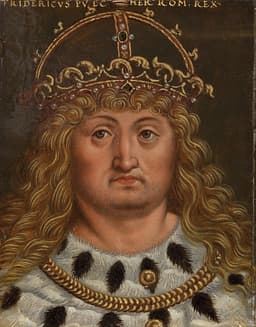
Frederick the Fair
Emperor · Medieval
36.3Total

Julius Caesar
General · Ancient
82.8Total
Basic Information
Born
1289
-100
Died
1330
-44
Era
Medieval
Ancient
Nationality
Holy Roman Empire
Roman Republic
Occupation
Emperor
General
Civilization
Western
Western
Score Comparison
Military (10%)
21.2
88.0
Political (20%)
32.1
78.0
Influence (20%)
45.5
85.0
Legacy (20%)
35.8
82.0
Leadership (15%)
33.6
80.0
Strategy (15%)
39.6
85.0
TOTAL
36.3
82.8
Frederick the Fair — Complete Timeline
1314 AD
Elected Anti-King of GermanyPolitical Action◆ Major
Frederick the Fair was elected anti-king of Germany by a faction of prince-electors, opposing Louis IV of Bavaria. This election was part of a double election that led to a civil war between the Habsburg and Wittelsbach dynasties.
ElectionHabsburgDouble Election
Impact: regional
1322 AD
Defeated and Captured at the Battle of MühldorfWar◆ Major
Frederick the Fair was defeated and captured by Louis IV of Bavaria at the Battle of M
BattleDefeatHabsburg
Impact: regionaltragic
1325 AD
Released from CaptivityPolitical Action
Frederick the Fair was released from captivity after agreeing to recognize Louis IV as king. However, he later renounced this agreement, leading to continued tensions between the Habsburgs and Wittelsbachs.
ReleaseHabsburgAgreement
Impact: regional
1330 AD
Died in GutensteinOther◆ Major
Frederick the Fair died in Gutenstein, Austria, without ever fully securing the German throne. His death ended his claim and allowed Louis IV to rule unchallenged, though the Habsburg dynasty continued to hold power in Austria.
DeathHabsburgEnd of Claim
Impact: regional
Julius Caesar — Complete Timeline
58 BC
Gallic WarsWar◆ Major
Caesar, as proconsul of Gaul, launched a series of campaigns that conquered all of Gaul (modern France, Belgium, and parts of Switzerland). He fought numerous battles, including against the Helvetii, the Belgae, and the Gallic chieftain Vercingetorix. The wars brought immense wealth and a loyal army to Caesar.
Gallic WarsConquestRoman Expansion
Impact: regional
49 BC
Crossing the RubiconPolitical Action◆ Major
Caesar led Legio XIII across the Rubicon River into Italy, defying the Roman Senate's order to disband his army. This act triggered a civil war against Pompey and the Optimates, ultimately leading to Caesar's dictatorship and the end of the Roman Republic.
Roman Civil WarEnd of RepublicPower Struggle
Impact: global
48 BC
Battle of PharsalusWar◆ Major
Caesar's outnumbered army defeated the larger forces of Pompey the Great at Pharsalus in Greece. Caesar's tactical use of a reserve line to counter Pompey's cavalry charge proved decisive. Pompey fled to Egypt, where he was assassinated, leaving Caesar as the undisputed master of the Roman world.
Roman Civil WarBattleDecisive Victory
Impact: regional
44 BC
Appointment as Dictator for LifePolitical Action◆ Major
The Roman Senate appointed Caesar dictator perpetuo (dictator for life), granting him unprecedented personal power. This move concentrated military, legislative, and judicial authority in one person, effectively ending the Roman Republic's traditional system of checks and balances and alarming many senators.
DictatorshipEnd of RepublicPower Consolidation
Impact: regionaldestructive
Assassination on the Ides of MarchPolitical Action◆ Major
A group of Roman senators, led by Marcus Junius Brutus and Gaius Cassius Longinus, stabbed Caesar to death at a meeting of the Senate in the Theatre of Pompey. The assassination was intended to restore the Republic, but instead triggered another civil war that led to the rise of the Roman Empire.
AssassinationRoman PoliticsEnd of Republic
Impact: globaldestructive
Expert Analysis
frederick-the-fair-vs-julius-caesar
# The Shadow King and the Titan: Frederick the Fair and Julius Caesar
On a winter morning in January of 49 BCE, a Roman general stood at the banks of a small river called the Rubicon. He knew that crossing it with his army meant civil war, dictatorship, and the death of a republic that had stood for nearly five centuries. He crossed anyway, uttering words that would echo through history: *"Alea iacta est"* — the die is cast. Just over thirteen centuries later, in September of 1322, another would-be ruler, Frederick the Fair, faced his own Rubicon on the fields of Mühldorf in Bavaria. He too fought for supreme power. But where Caesar crossed into immortality, Frederick stumbled into a prison cell. Why did one man reshape the world while the other vanished into obscurity? The answer lies not merely in talent, but in the currents of their ages.
Origins
Julius Caesar was born into a patrician family in 100 BCE, at a time when the Roman Republic was already cracking under the weight of its own ambition. His uncle by marriage was Gaius Marius, the great populist general, and his aunt was married to Sulla, the conservative dictator. Caesar thus grew up in a world where politics was a blood sport and the old rules were dying. The Roman aristocracy had long competed for glory, but by Caesar’s youth, that competition had turned murderous. He learned early that survival required both charm and ruthlessness.
Frederick the Fair, born in 1289, emerged into a very different world. The Holy Roman Empire was a patchwork of principalities, bishoprics, and free cities, held together by little more than tradition. Frederick was a Habsburg, a family that had learned to accumulate power not through conquest but through marriage, inheritance, and patient diplomacy. His father, Albert I, had been assassinated, and the empire was torn between rival claimants. Frederick’s Germany was a place where kings were elected, not born, and where power was scattered among dozens of prince-electors who jealously guarded their privileges. The stage was smaller, the stakes lower, and the tools available to a would-be ruler far more limited.
Rise to Power
Caesar’s path to power was a masterpiece of calculated audacity. He rose through the traditional Roman cursus honorum — quaestor, aedile, praetor — but he did so with a flair that set him apart. He borrowed enormous sums to stage lavish games, winning the love of the Roman mob. He formed the First Triumvirate with Pompey and Crassus, an informal alliance that allowed him to secure the governorship of Gaul. Then, between 58 and 50 BCE, he did something extraordinary: he conquered a vast territory, wrote about it in elegant Latin, and turned his legions into a personal army devoted not to the Republic but to him.
Frederick the Fair’s rise was far more constrained. In 1314, a faction of prince-electors, opposed to the Bavarian Louis IV, elected Frederick as anti-king of Germany. But an anti-king was precisely that — a king without a kingdom. Frederick controlled Austria and some Habsburg lands, but he could not command the loyalty of the empire’s great cities or the powerful electors. His was a throne built on a faction, not a movement. He spent years trying to assert his claim, but his resources were thin and his allies unreliable. Where Caesar could raise legions from conquered Gauls, Frederick could barely raise enough knights to face his rival.
Leadership & Governance
Caesar governed as he fought: with speed, clarity, and an unerring sense of what the moment required. As dictator, he reformed the calendar, extended citizenship to provincials, launched public works projects, and centralized authority in his own hands. His military genius was inseparable from his political vision. He understood that a general who won battles but lost the peace was no leader at all. After defeating Pompey, he pardoned his enemies — a calculated mercy that disarmed opposition. His reforms were not merely expedient; they were structural, designed to solve problems that had plagued the Republic for generations.
Frederick the Fair never had the chance to govern. His only significant act as a would-be ruler was to fight — and lose — the Battle of Mühldorf in 1322. The battle was a decisive defeat. Frederick was captured and spent three years in a castle prison near Trausnitz. In 1325, he was released only after agreeing to recognize Louis IV as king. But he later renounced that agreement, perhaps under pressure from his Habsburg kin, and died in 1330 in Gutenstein, Austria, his claim unresolved. He was not a bad man, nor a foolish one; he was simply a man born into a system that gave him no real lever to move the world.
Triumph & Tragedy
Caesar’s greatest triumph was not a single battle but the transformation of the Roman world. His conquest of Gaul added a vast, wealthy province to Rome and gave him the military machine that would carry him to supreme power. His crossing of the Rubicon was a moment of breathtaking courage — or breathtaking arrogance, depending on one’s view. His tragedy, of course, was the Ides of March in 44 BCE, when sixty senators stabbed him to death on the floor of the Senate. He had centralized power so completely that his murderers believed they could restore the Republic by killing him. Instead, they unleashed a civil war that ended the Republic forever.
Frederick’s triumph was, at best, a draw. He was elected anti-king, which meant he had been recognized as a legitimate contender by a significant faction. But his defeat at Mühldorf was total. His tragedy was not assassination but irrelevance. He died not as a martyr or a tyrant, but as a footnote — a Habsburg who had tried and failed to seize the German throne. His greatest legacy, perhaps, was that he kept the Habsburg claim alive during a difficult period, allowing his descendants to eventually dominate the empire.
Character & Destiny
Caesar was driven by an almost inhuman ambition, tempered by a keen intelligence and a genuine charisma that made men follow him to the ends of the earth. He was also a writer, a lover, a gambler — a man who lived as though the world were a stage built for his performance. His personality shaped his destiny because he refused to accept the limits that the Republic placed on him. He saw that the old system was broken and decided to break it himself.
Frederick the Fair, by contrast, seems to have been a man of conventional ambition in an age that required something more. He was a Habsburg, which meant he was patient, cautious, and family-minded. But the Holy Roman Empire of the early fourteenth century was not a place for patient men. It was a chaos of competing interests, and to win, a ruler needed either overwhelming force or extraordinary political cunning. Frederick had neither. His personality was not flawed; it was simply insufficient for the scale of the challenge.
Legacy
Caesar’s legacy is immeasurable. His name became a title — Kaiser, Tsar, Caesar — and his reforms laid the groundwork for the Roman Empire that would endure for another five centuries in the West and a thousand more in the East. He is remembered as a military genius, a political revolutionary, and a cautionary tale about the dangers of unchecked power. Every schoolchild knows his name, his death, his words.
Frederick the Fair is remembered, if at all, as a minor figure in the long, tangled history of the Holy Roman Empire. His scores — Military: 30, Political: 36.6, Legacy: 47.1 — tell the story of a man who was outmatched by his era. He did not fail because he was incompetent; he failed because the system in which he operated was designed to prevent any one man from succeeding too completely. In that sense, he was a victim of the very medieval politics that Caesar’s Rome had long since transcended.
Conclusion
The contrast between Caesar and Frederick is not simply one of genius versus mediocrity. It is a contrast between two different worlds. Caesar lived at the end of a republic that was ripe for transformation, and he had the tools — military, political, intellectual — to force that transformation. Frederick lived in a world where power was so fragmented that even victory could not guarantee rule. Caesar crossed the Rubicon and changed history. Frederick crossed the field at Mühldorf and was taken prisoner. One man’s ambition matched the moment; the other’s ambition was swallowed by it. In the end, history remembers not just what we do, but when we do it — and whether the world is ready to be remade.
Rankings
🥇
Julius CaesarLeader
Mil: 88.0Pol: 78.0Inf: 85.0
82.8
🥈
Frederick the Fair
Mil: 21.2Pol: 32.1Inf: 45.5
36.3
+46.5 behind
How This Comparison Works
Algorithm
Each figure is scored on 6 dimensions (0—100 scale) based on structured historical data: Military (10%), Political (20%), Influence (20%), Legacy (20%), Leadership (15%), Strategy (15%). The weighted total produces the final ranking.
Data Sources
Scores are computed from structured sub-indicators in the database. Scale factors adjust for era (Ancient ×0.85, Modern ×1.0) and civilization size (Eastern ×1.05, Other ×0.80) to account for differences in population and military scale.
Maximum 3 Figures
Comparisons are limited to 2—3 figures to ensure readability and statistical meaningfulness.
Error Margins
±5 points per dimension — Sub-scores are derived from historical records with inherent uncertainty. Two figures within 5 points on a dimension should be considered roughly equivalent in that area.
Total Score Accuracy
±3 points overall — The weighted combination of 6 dimensions produces a total score with approximately ±3 points of uncertainty. Differences of less than 3 points are not statistically significant— the figures are effectively tied.
Known Limitations
- Historical records are incomplete and uneven across civilizations
- Figures from oral-tradition societies may be underrepresented
- Occupation labels can misclassify multi-role figures
- Scores measure capability and impact, not moral character
- Quantitative scoring is a comparison tool, not absolute truth
Capability Radar
Military (10%) — Battles & Warfare
Battles
15
95
Win Rate
10
92
Expansion
5
97
Political (20%) — Governance & Reform
Reform
5
90
Diplomacy
15
85
Economy
10
82
Influence (20%) — Cultural & Global Reach
Cultural
5
88
Global
5
94
Legacy (20%) — Historical Impact
Historical
10
95
Longevity
5
96
Leadership (15%) — Power & Stability
Tenure
20
75
Stability
10
60
Strategy (15%) — Tactics & Innovation
Strategy
10
94
Tactics
10
96
Reform
5
88
Similar Comparisons
Comments & Discussion
No comments yet. Be the first to share your thoughts!