Loading...
Frederick I Barbarossa vs Napoleon Bonaparte
Napoleon Bonaparte leads by 10.6 pts · 2 figures compared
…
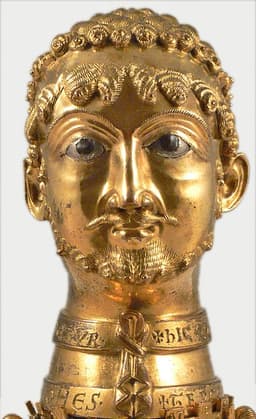
Frederick I Barbarossa
Emperor · Medieval
60.3Total

Napoleon Bonaparte
General · Modern
70.9Total
Basic Information
Born
1122
1769
Died
1190
1821
Era
Medieval
Modern
Nationality
Holy Roman Empire
France
Occupation
Emperor
General
Civilization
Western
Western
Score Comparison
Military (10%)
67.3
94.0
Political (20%)
55.0
72.0
Influence (20%)
56.7
40.0
Legacy (20%)
55.0
80.0
Leadership (15%)
72.0
78.0
Strategy (15%)
66.3
90.0
TOTAL
60.3
70.9
Frederick I Barbarossa — Complete Timeline
1158 AD
Diet of RoncagliaPolitical Action◆ Major
Frederick I convened a diet at Roncaglia in northern Italy. He proclaimed the Regalian Rights, asserting imperial authority over Italian cities. The diet declared that all public authority derived from the emperor, leading to conflict with the Lombard League.
Imperial AuthorityItalyLegislation
Impact: regional
1176 AD
Battle of LegnanoWar
Frederick I Barbarossa was defeated by the Lombard League at Legnano in northern Italy. The League's infantry used a carroccio (war wagon) as a rallying point. This defeat forced Frederick to recognize the autonomy of Italian communes in the Peace of Venice.
Lombard LeagueItalian CampaignsDefeat
Impact: regional
1177 AD
Peace of VenicePolitical Action◆ Major
Frederick I signed a treaty with Pope Alexander III and the Lombard League in Venice. He recognized Alexander III as pope and agreed to a six-year truce with the Italian communes. The peace ended the schism in the Church and temporarily halted imperial campaigns in Italy.
TreatyPapacyLombard League
Impact: regionalconstructive
1190 AD
Death on the Third CrusadeWar◆ Major
Frederick I drowned in the Saleph River in Cilicia while leading the Third Crusade. His death caused the German contingent to largely return home, weakening the crusade. He was buried in Antioch, and his body later moved to Tyre.
CrusadeDeathAccident
Impact: globaltragic
Napoleon Bonaparte — Complete Timeline
1799 AD
Coup of 18 BrumaireOther◆ Major
Napoleon Bonaparte, with support from his brother Lucien and key political figures, overthrew the Directory in a bloodless coup. He established the Consulate with himself as First Consul, effectively becoming the ruler of France. This event ended the French Revolution's most unstable period.
French RevolutionCoupRise to Power
Impact: regional
1804 AD
Promulgation of the Napoleonic CodeOther◆ Major
Napoleon enacted the Civil Code of the French, known as the Napoleonic Code, a comprehensive set of laws that replaced the fragmented feudal legal systems. The code established legal equality, protected property rights, and secularized law. It became the basis for legal systems in many European and world countries.
Legal ReformNapoleonic CodeCivil Law
Impact: globalconstructive
1805 AD
Battle of AusterlitzWar◆ Major
Napoleon's Grande Arm
Napoleonic WarsBattleDecisive Victory
Impact: global
1812 AD
Invasion of RussiaWar◆ Major
Napoleon led the Grande Arm
Napoleonic WarsInvasionDisaster
Impact: globaldestructive
1815 AD
Battle of WaterlooWar◆ Major
Napoleon's French army was defeated by the combined forces of the Duke of Wellington's Anglo-Allied army and Gebhard Leberecht von Bl
Napoleonic WarsBattleFinal Defeat
Impact: globaldestructive
Expert Analysis
frederick-i-barbarossa-vs-napoleon-bonaparte
# The Emperor and the Red Beard: Two Visions of Power in Different Ages
On a June morning in 1815, Napoleon Bonaparte watched his Imperial Guard march into the cannon smoke at Waterloo, the fate of Europe hanging on a single volley. Seven hundred years earlier, in the summer of 1190, Frederick Barbarossa spurred his horse into the cold waters of the Saleph River in Anatolia, never to emerge alive. Both men died in failure—one on a remote Atlantic island, the other in a foreign stream. Yet their lives, separated by centuries, reveal how character, circumstance, and the very nature of power shaped two of the West's most ambitious rulers. Why did one conquer a continent while the other spent decades fighting for a single Italian province? The answer lies not merely in their talents, but in the worlds they inherited.
Origins
Napoleon Bonaparte was born in 1769 on Corsica, a Mediterranean island that had passed from Italian to French control just months before his birth. His family were minor nobles in a place where loyalty meant survival, and survival meant adaptability. The French Revolution, which erupted when he was twenty, shattered the old order and created a vacuum that a brilliant young artillery officer could fill. Napoleon was a child of modernity—of mass armies, nationalism, and the Enlightenment's cold logic.
Frederick I Barbarossa, born in 1122, came from a very different world. He was a Swabian duke of the Hohenstaufen dynasty, raised in the high medieval dream of a unified Christendom under emperor and pope. His red beard became legendary not just for its color but for what it symbolized: the fiery ambition to restore the glory of Charlemagne's empire. Where Napoleon's world was cracking open, Barbarossa's was still being built—stone by stone, oath by oath, in a landscape of feudal loyalties and sacred obligations.
Rise to Power
Napoleon's ascent was meteoric. In 1793, at age twenty-four, he drove the British from Toulon with a cannonade that earned him a general's star. By 1796, he commanded the Army of Italy, turning starving soldiers into a conquering force. His Italian campaign of 1796-1797 was a masterpiece of speed and deception—he defeated four Austrian armies in a year, dictating peace terms before he was thirty. The path to power was open because the Revolution had cleared away the old nobility, and talent was the only currency that mattered.
Barbarossa's rise was slower, more traditional. Elected King of Germany in 1152 at age thirty, he spent years consolidating power among fractious German dukes. His coronation as Holy Roman Emperor in 1155 required a march to Rome and a tense negotiation with Pope Adrian IV. Unlike Napoleon, who could seize power with a coup d'état in 1799, Barbarossa had to earn every crown through diplomacy, marriage alliances, and patient military campaigns. The medieval world demanded legitimacy, not genius.
Leadership & Governance
Napoleon governed as a modernizer. His Napoleonic Code, enacted in 1804, swept away feudal privileges and established legal equality, property rights, and secular administration across Europe. He centralized the French state, created the Bank of France, and built a network of lycées to train future bureaucrats. His military genius—rated 94.0 in strategic ability—lay in his ability to concentrate force at decisive points, as at Austerlitz in 1805, where he crushed the combined armies of Russia and Austria. But his political score of 75.0 reflects a fatal flaw: he could conquer but not consolidate, alienating the very peoples he liberated.
Barbarossa ruled through the medieval arts of compromise and symbol. The Diet of Roncaglia in 1158 was his attempt to assert imperial authority over the wealthy cities of northern Italy, proclaiming the Regalian Rights that gave the emperor control over tolls, mines, and taxes. But the Lombard League—a coalition of cities like Milan and Bologna—resisted. At the Battle of Legnano in 1176, Barbarossa's knights were shattered by infantry wielding the carroccio, a sacred war wagon that embodied civic pride. His leadership score of 79.3 reflects a ruler who understood power's limits: he signed the Peace of Venice in 1177, recognizing Pope Alexander III and abandoning his Italian ambitions. He was flexible where Napoleon was rigid.
Triumph & Tragedy
Napoleon's greatest moment came in 1805, when he crowned himself Emperor of the French in Notre Dame, taking the crown from the Pope's hands and placing it on his own head. It was the ultimate symbol of his self-made destiny. His tragedy unfolded in Russia in 1812, when the Grande Armée of 600,000 men marched into the snow and only 100,000 returned. The failure was not military but political—he could not understand that a nation's soul could not be conquered with bayonets.
Barbarossa's triumph was different. He never won a decisive battle like Austerlitz, but he held the Holy Roman Empire together for nearly four decades, navigating popes, princes, and rebellious cities. His tragedy came in 1190 on the Third Crusade, when the sixty-eight-year-old emperor drowned in the Saleph River, possibly from a heart attack or a simple misstep. His death caused the German contingent to dissolve, and the crusade collapsed. Where Napoleon died in exile, alone with his memoirs, Barbarossa passed into legend—medieval folklore said he slept in a cave beneath a mountain, waiting to return and restore German glory.
Character & Destiny
Napoleon's character was forged in the crucible of revolution. He was ruthless, calculating, and driven by an insatiable hunger for glory. "I live only for posterity," he once said, and he meant it. His decisions were coldly rational—he divorced Josephine for political reasons, created a new nobility from his generals, and manipulated every institution to serve his ambition. This rationality became his undoing: he could not grasp that nations like Spain and Russia would fight not for strategy but for pride and faith.
Barbarossa was a man of his age, shaped by chivalry and faith. He believed in the unity of Christendom, the sacred duty of the emperor, and the power of personal loyalty. When he failed, he negotiated; when he was defeated, he adapted. The Peace of Venice in 1177 was not a surrender but a recognition that power in the medieval world required consent, not coercion. His personality—pragmatic, patient, and deeply religious—allowed him to survive where Napoleon's rigidity destroyed him.
Legacy
Napoleon's legacy is written in the laws, institutions, and boundaries of modern Europe. The Napoleonic Code influences civil law from France to Louisiana to Japan. He redrew the map of the continent, spreading nationalism and meritocracy. His military campaigns are still studied in war colleges, and his name remains synonymous with ambition and genius. But his total score of 82.4 reflects a mixed judgment: a liberator who became a tyrant, a reformer who left Europe in ruins.
Barbarossa's legacy is more symbolic. His reign stabilized the Holy Roman Empire for centuries, and his myth inspired German nationalism in the nineteenth century. The Nazi regime appropriated his image, but that is a later corruption. His true legacy is the medieval ideal of a universal empire—a dream that died with him in the Saleph River, but that still haunts the European imagination.
Conclusion
Standing at Waterloo, Napoleon could not have imagined Barbarossa drowning in a Turkish river. The Corsican lived in a world of nations and mass armies; the Swabian lived in a world of oaths and relics. Yet both were driven by the same human desire: to leave a mark on history, to build something that outlasts the flesh. Napoleon built with iron and law; Barbarossa built with faith and compromise. One failed because he could not stop conquering; the other succeeded because he knew when to stop. In the end, the difference between them is not talent but wisdom—and the wisdom to understand that power, however great, must bow to the world it seeks to rule.
Rankings
🥇
Napoleon BonaparteLeader
Mil: 94.0Pol: 72.0Inf: 40.0
70.9
🥈
Frederick I Barbarossa
Mil: 67.3Pol: 55.0Inf: 56.7
60.3
+10.6 behind
How This Comparison Works
Algorithm
Each figure is scored on 6 dimensions (0—100 scale) based on structured historical data: Military (10%), Political (20%), Influence (20%), Legacy (20%), Leadership (15%), Strategy (15%). The weighted total produces the final ranking.
Data Sources
Scores are computed from structured sub-indicators in the database. Scale factors adjust for era (Ancient ×0.85, Modern ×1.0) and civilization size (Eastern ×1.05, Other ×0.80) to account for differences in population and military scale.
Maximum 3 Figures
Comparisons are limited to 2—3 figures to ensure readability and statistical meaningfulness.
Error Margins
±5 points per dimension — Sub-scores are derived from historical records with inherent uncertainty. Two figures within 5 points on a dimension should be considered roughly equivalent in that area.
Total Score Accuracy
±3 points overall — The weighted combination of 6 dimensions produces a total score with approximately ±3 points of uncertainty. Differences of less than 3 points are not statistically significant— the figures are effectively tied.
Known Limitations
- Historical records are incomplete and uneven across civilizations
- Figures from oral-tradition societies may be underrepresented
- Occupation labels can misclassify multi-role figures
- Scores measure capability and impact, not moral character
- Quantitative scoring is a comparison tool, not absolute truth
Capability Radar
Military (10%) — Battles & Warfare
Battles
75
95
Win Rate
70
90
Expansion
70
95
Political (20%) — Governance & Reform
Reform
75
95
Diplomacy
72
80
Economy
68
85
Influence (20%) — Cultural & Global Reach
Cultural
65
85
Global
60
90
Legacy (20%) — Historical Impact
Historical
75
95
Longevity
70
90
Leadership (15%) — Power & Stability
Tenure
80
85
Stability
60
70
Strategy (15%) — Tactics & Innovation
Strategy
78
95
Tactics
72
98
Reform
65
92
Similar Comparisons
Comments & Discussion
RedBeardWrecked6/17/2026
Barbarossa spent 30 years chasing Italian cities while Napoleon conquered all of Europe in a decade. The real question isn't "who was better?"—it's "why did Frederick waste his prime on Lombard communes?" His obsession with papal legitimacy and imperial titles made him a medieval dinosaur. Napoleon didn't need a pope to crown himself; he took the diadem from Pius VII's hands at Notre Dame. That's the difference between a man who rules by birthright and one who rules by sheer will. Barbarossa was
骑鹤观史6/17/2026
拿法国王不是死于滑铁卢,而是死于1812年的俄国寒冬。而红胡子巴巴罗萨呢?淹死在一条小溪里,连个像样的战场都没找到。这两位谁更失败?拿破仑至少把欧洲贵族吓得魂飞魄散,建立了一个横跨大陆的帝国。巴巴罗萨除了在意大利打过几场无意义的围城战,还干过什么?他那个所谓的神圣罗马帝国,不过是一堆领主和主教组成的拼盘,永远在争吵中浪费机会。
IronSkeptic6/17/2026
Let's talk numbers: Napoleon commanded armies of 600,000 men across campaigns spanning from Egypt to Moscow. Barbarossa's "massive" force at Legnano in 1176 was maybe 12,000 men. That's not an emperor—that's a duke with delusions. The medieval economy simply couldn't support the scale of strategic operations Napoleon took for granted. You can't compare their "genius" when one had marshals and statistical staff, and the other had knights who argued over spoils. The gap isn't talent; it's infrastr
兵戈春秋6/17/2026
说拿破仑是军事天才的人,大概忘了他入侵俄国的惨败,忘了半岛战争的无底洞。而巴巴罗萨呢?他才是真正的十字军骑士,死在征途上,比老死在床上更有英雄气概。拿破仑最后在圣赫勒拿岛写回忆录粉饰太平,巴巴罗萨却变成了传说中的“沉睡皇帝”,等待德国复兴的那一天。谁留下了更持久的传奇?红胡子虽然兵败溺水,但他变成了神话;拿破仑不过是历史课本里的一个战例。
ClassicsCorax6/17/2026
Barbarossa represents the medieval ideal: rule through symbolic legitimacy, chivalric honor, and imperial tradition. Napoleon embodies the modern: meritocracy, administrative efficiency, and total war. They're not comparable as commanders—they're comparable as archetypes. Frederick's failure in Italy came from his inability to modernize his feudal army; Napoleon's failure came from overreaching his logistical limits. One man died on crusade for Christendom; the other on an island prison for secu