Loading...
Franklin D. Roosevelt vs Mustafa Kemal Ataturk
Mustafa Kemal Ataturk leads by 9.0 pts · 2 figures compared
…
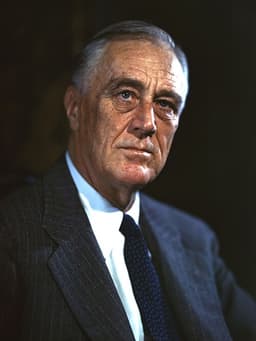
Franklin D. Roosevelt
Politician · Modern
71.0Total
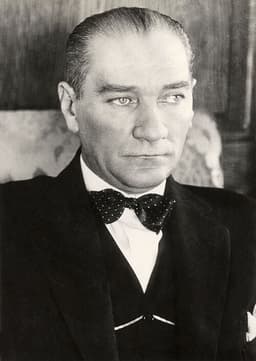
Mustafa Kemal Ataturk
Politician · Modern
80.0Total
Basic Information
Born
1882
1881
Died
1945
1938
Era
Modern
Modern
Nationality
United States
Turkey
Occupation
Politician
Politician
Civilization
Western
Middle Eastern
Score Comparison
Military (10%)
45.0
75.0
Political (20%)
85.0
85.0
Influence (20%)
75.0
75.0
Legacy (20%)
65.0
90.0
Leadership (15%)
85.0
80.0
Strategy (15%)
60.0
65.0
TOTAL
71.0
80.0
Franklin D. Roosevelt — Complete Timeline
1933 AD
Inaugurated as 32nd PresidentOther◆ Major
Franklin D. Roosevelt was inaugurated as President of the United States on March 4, 1933, during the Great Depression. His inaugural address declared 'the only thing we have to fear is fear itself,' and he immediately called Congress into special session to address the banking crisis.
Great DepressionPresidencyInauguration
Impact: national
Enacted the New DealOther◆ Major
Roosevelt launched the New Deal in 1933, a series of federal programs including the Civilian Conservation Corps, the Agricultural Adjustment Act, and the Tennessee Valley Authority. These measures aimed to provide relief, recovery, and reform during the Great Depression, fundamentally expanding the role of the federal government.
Great DepressionEconomic PolicySocial Reform
Impact: nationalconstructive
1935 AD
Signed the Social Security ActOther◆ Major
Roosevelt signed the Social Security Act into law on August 14, 1935, establishing a federal system of old-age pensions, unemployment insurance, and aid for dependent children. This created the modern American welfare state and provided a safety net for millions of citizens.
Social WelfareLegislationNew Deal
Impact: nationalconstructive
1941 AD
Lend-Lease ActOther◆ Major
Roosevelt signed the Lend-Lease Act on March 11, 1941, authorizing the transfer of military equipment and supplies to Allied nations, particularly Britain and the Soviet Union. This program provided critical material support to countries fighting the Axis powers before U.S. entry into World War II.
World War IIForeign PolicyMilitary Aid
Impact: globalconstructive
Declaration of War on JapanPolitical Action◆ Major
Following the Japanese attack on Pearl Harbor on December 7, 1941, Roosevelt delivered his 'Day of Infamy' speech to Congress the next day, requesting a declaration of war. Congress approved the declaration, bringing the United States into World War II.
World War IIPearl HarborDeclaration of War
Impact: globaldestructive
1942 AD
Executive Order 9066Other◆ Major
Roosevelt signed Executive Order 9066 on February 19, 1942, authorizing the forced relocation and internment of Japanese Americans living on the West Coast. Over 110,000 people, mostly U.S. citizens, were incarcerated in camps for the duration of the war, a decision later widely condemned as a violation of civil rights.
World War IICivil RightsInternment
Impact: nationaldestructive
1944 AD
Elected to Fourth TermOther◆ Major
Roosevelt was elected to an unprecedented fourth term as president in November 1944, defeating Republican Thomas E. Dewey. This election occurred during the final stages of World War II, and Roosevelt's continued leadership ensured stability in the war effort and post-war planning.
PresidencyElectionWorld War II
Impact: national
1945 AD
Yalta ConferenceOther◆ Major
Roosevelt met with Winston Churchill and Joseph Stalin at the Yalta Conference in February 1945 to discuss post-war Europe. Agreements included the division of Germany, Soviet entry into the war against Japan, and the creation of the United Nations, shaping the post-war world order.
World War IIDiplomacyPost-War Planning
Impact: global
Mustafa Kemal Ataturk — Complete Timeline
1915 AD
Battle of GallipoliWar
As a colonel, Mustafa Kemal commanded Ottoman forces at Gallipoli, successfully repelling Allied landings. His leadership at critical points like Chunuk Bair made him a national hero and laid the foundation for his political career.
World War IOttoman EmpireMilitary Victory
Impact: regional
1919 AD
Turkish War of IndependenceWar
Kemal organized and led the Turkish National Movement against the Allied occupation of Anatolia and the Treaty of S
Independence WarNational MovementAnkara
Impact: nationalconstructive
1922 AD
Abolition of the SultanatePolitical Action◆ Major
The Grand National Assembly of Turkey, under Kemal's leadership, abolished the Ottoman Sultanate, ending 600 years of imperial rule. This severed the link with the old regime and paved the way for the proclamation of the Republic.
SultanateRepublicPolitical Reform
Impact: nationalprogressive
1923 AD
Proclamation of the Republic of TurkeyPolitical Action
Kemal declared Turkey a republic, becoming its first president. He moved the capital to Ankara and initiated a series of radical reforms to modernize and secularize the state, including the adoption of a new legal code and the Latin alphabet.
RepublicModernizationSecularism
Impact: globalprogressive
1925 AD
Adoption of the Hat LawReform◆ Major
Kemal introduced the Hat Law, banning the fez and encouraging Western-style hats. This was part of his broader cultural revolution to secularize and Westernize Turkish society, symbolizing the break with Ottoman traditions.
Cultural ReformSecularismWesternization
Impact: nationalprogressive
1934 AD
Granting of Women's SuffrageReform◆ Major
Kemal's government granted women the right to vote and stand for election in national elections, ahead of many European countries. This reform was part of his commitment to gender equality and modernization of Turkish society.
Women's RightsSuffrageModernization
Impact: nationalprogressive
Expert Analysis
Franklin D. Roosevelt vs Mustafa Kemal Ataturk
### The Man Who Saved Democracy, and the Man Who Rebuilt a Nation
On a cold March day in 1933, Franklin Delano Roosevelt placed his hand on a family Bible and swore to lead a nation paralyzed by fear. Across the Atlantic, a decade earlier, a grizzled Ottoman general named Mustafa Kemal had stood on a dusty Anatolian hilltop, watching his ragtag army turn back the world’s mightiest empires. One man inherited a crisis of confidence; the other, a civilization in ruins. Both would reshape their worlds, yet their paths diverged as sharply as the oceans that separated them. Why did Roosevelt’s New Deal become a beacon for generations, while Atatürk’s revolution became a lonely monument in a turbulent region? The answer lies not just in their policies, but in the very soil from which they grew.
### Origins
Roosevelt was born into American aristocracy in 1882, a Hudson Valley patrician whose family wealth insulated him from the grime of industrial America. His education at Groton and Harvard instilled a patrician’s sense of duty, but also a pragmatist’s willingness to experiment. He was a man of his class, yet his bout with polio in 1921 forged an empathy that no Ivy League lecture could teach. The disease stripped him of mobility but gave him a steel will and a deep understanding of suffering—a lesson that would define his presidency.
Mustafa Kemal, born a year earlier in 1881, came from a very different world. The son of a minor Ottoman customs official in Salonica, he grew up in a multi-ethnic, crumbling empire. His early years were marked by poverty and the death of his father. Where Roosevelt inherited a sense of entitlement, Kemal inherited a fierce nationalism and a burning desire to rescue his people from what he saw as the corpse of the Ottoman past. He was a soldier first, a thinker second, and his worldview was forged in the crucible of military academies and the bloody battlefields of Libya and the Balkans.
### Rise to Power
Roosevelt’s ascent was a masterclass in political networking. He served as Assistant Secretary of the Navy, ran for Vice President in 1920, and then, after polio, staged a remarkable political comeback as Governor of New York. His path was paved by the Democratic Party machine and the goodwill of a nation desperate for action during the Great Depression. He was an insider who used the system to change the system.
Kemal’s rise was born of war and revolution. His defining moment came in 1915 at Gallipoli, where as a colonel, he famously ordered his men: “I am not ordering you to attack, I am ordering you to die.” His leadership repelled the Allied invasion, turning him into a national hero. But it was the aftermath of World War I that made him a revolutionary. As the Allies carved up Anatolia, Kemal rejected the sultan’s surrender. In 1919, he ignited the Turkish War of Independence, a desperate, four-year struggle that expelled the Greeks, Armenians, and French from Turkish soil. He did not rise through a party; he forged a nation from the ashes of an empire.
### Leadership & Governance
Roosevelt governed through persuasion and coalition-building. His “Fireside Chats” used the radio to speak directly to millions, turning abstract policy into a shared national project. His New Deal was a sprawling, often contradictory patchwork of relief, recovery, and reform—from the Civilian Conservation Corps to Social Security. He was a political genius who understood that to save capitalism, he had to reform it. His military leadership during World War II was that of a grand strategist, not a field commander. He chose generals like Eisenhower and Marshall, and he forged the Grand Alliance with Churchill and Stalin.
Atatürk governed through sheer force of will. He did not compromise; he commanded. In 1922, he abolished the Sultanate, and in 1923, he proclaimed the Republic of Turkey, moving the capital to Ankara to break with the Ottoman past. His reforms were a cultural earthquake: the Hat Law of 1925 banned the fez and encouraged Western dress; the Latin alphabet replaced Arabic script overnight; women gained the right to vote in 1934, decades ahead of many European nations. He secularized the state, closed religious courts, and promoted industrialization. His was a revolution from above, imposed by a charismatic autocrat who believed that modernization could not wait for democracy.
### Triumph & Tragedy
Roosevelt’s greatest triumph was his leadership during World War II. He mobilized the American economy into an “arsenal of democracy” and guided the nation through the darkest days of the conflict. His greatest tragedy was his failure to fully cure the Depression—unemployment remained high until the war—and his decision to intern Japanese Americans, a stain on his legacy.
Atatürk’s triumph was the creation of a modern, sovereign Turkey from the wreckage of the Ottoman Empire. He gave his people a sense of pride and purpose. His tragedy was the price of that transformation: the suppression of Kurdish identity, the authoritarianism that silenced dissent, and the cultural dislocation felt by millions who were forced to abandon their traditions overnight. He died in 1938, just as Europe plunged into a war that would test his legacy.
### Character & Destiny
Roosevelt was a pragmatist and a gambler. He once said, “It is common sense to take a method and try it. If it fails, admit it frankly and try another.” His optimism was his greatest weapon. He believed in the possibility of change, and he infected a nation with that belief.
Atatürk was a rationalist and a revolutionary. He famously declared, “A nation which makes no effort to advance is a nation that will be swept away.” He saw the world in stark terms: modernity versus backwardness, science versus superstition. He had no patience for gradualism. His destiny was to be the father of his country, a role he embraced with a fierce, almost paternalistic love.
### Legacy
Roosevelt’s legacy is the modern American state. Social Security, the minimum wage, the regulatory state, and the very idea that the government has a responsibility for the welfare of its citizens—all trace back to him. He is remembered as the man who saved democracy from despair.
Atatürk’s legacy is Turkey itself. His principles—republicanism, nationalism, populism, statism, secularism, and reformism—remain the bedrock of the Turkish state. He is revered as *Atatürk* (“Father of the Turks”), a figure whose image stares down from every government building. Yet his legacy is contested. For some, he is a liberator; for others, a tyrant who severed his people from their roots.
### Conclusion
One man saved a democracy; the other built a nation. Roosevelt worked within a system, bending it to his will; Atatürk shattered a system and forged a new one from the fragments. Both were products of their time, yet both transcended it. Roosevelt’s America remains a global power, its democracy tested but enduring. Atatürk’s Turkey is a nation still wrestling with his ghost, caught between East and West, tradition and modernity. Perhaps the deepest difference is this: Roosevelt’s story is one of restoration, of a great power finding its footing again. Atatürk’s story is one of creation, of a people inventing themselves anew. Both are stories of courage, but they remind us that courage can take very different forms—and leave very different marks on the world.
Rankings
🥇
Mustafa Kemal AtaturkLeader
Mil: 75.0Pol: 85.0Inf: 75.0
80.0
🥈
Franklin D. Roosevelt
Mil: 45.0Pol: 85.0Inf: 75.0
71.0
+9.0 behind
How This Comparison Works
Algorithm
Each figure is scored on 6 dimensions (0—100 scale) based on structured historical data: Military (10%), Political (20%), Influence (20%), Legacy (20%), Leadership (15%), Strategy (15%). The weighted total produces the final ranking.
Data Sources
Scores are computed from structured sub-indicators in the database. Scale factors adjust for era (Ancient ×0.85, Modern ×1.0) and civilization size (Eastern ×1.05, Other ×0.80) to account for differences in population and military scale.
Maximum 3 Figures
Comparisons are limited to 2—3 figures to ensure readability and statistical meaningfulness.
Error Margins
±5 points per dimension — Sub-scores are derived from historical records with inherent uncertainty. Two figures within 5 points on a dimension should be considered roughly equivalent in that area.
Total Score Accuracy
±3 points overall — The weighted combination of 6 dimensions produces a total score with approximately ±3 points of uncertainty. Differences of less than 3 points are not statistically significant— the figures are effectively tied.
Known Limitations
- Historical records are incomplete and uneven across civilizations
- Figures from oral-tradition societies may be underrepresented
- Occupation labels can misclassify multi-role figures
- Scores measure capability and impact, not moral character
- Quantitative scoring is a comparison tool, not absolute truth
Capability Radar
Military (10%) — Battles & Warfare
Battles
10
85
Win Rate
10
90
Expansion
10
60
Political (20%) — Governance & Reform
Reform
95
98
Diplomacy
90
85
Economy
95
75
Influence (20%) — Cultural & Global Reach
Cultural
80
90
Global
90
80
Legacy (20%) — Historical Impact
Historical
90
95
Longevity
85
85
Leadership (15%) — Power & Stability
Tenure
90
85
Stability
75
70
Strategy (15%) — Tactics & Innovation
Strategy
65
85
Tactics
10
88
Reform
70
80
Similar Comparisons
Comments & Discussion
Serpent-Slayer of the Bosphoru6/16/2026
Roosevelt saved capitalism by making it work for the common man—Atatürk destroyed an empire to build a nation from scratch. That’s not just different strategy; that’s different universes. FDR’s New Deal was brilliant patchwork, but Atatürk performed radical surgery on a corpse. Show me one Roosevelt reform that matches Atatürk’s abolition of the caliphate in 1924. FDR inherited a crisis; Atatürk inherited a void. Give me the man who builds from ashes over the one who saves a system.
Data-Doubter Diogenes6/16/2026
Convenient how this comparison ignores the messy numbers. Roosevelt’s New Deal spent billions but unemployment still hovered at 14% as late as 1940—hardly a miracle. Atatürk’s literacy campaign? By 1935, only 20% of Turkey could read, and that’s after aggressive state action. Both men got lucky with timing: WWII bailed out FDR’s economy, and Atatürk’s authoritarian grip hid dissent. Stop romanticizing. Neither cleaned their house perfectly; they just swept the dirt under different rugs.
碎石上的碑文6/16/2026
罗斯福是民主制度的修补匠,而阿塔图尔克是民族身份的锻造者。前者在华尔街的废墟上重建信任,后者在奥斯曼的墓碑上刻下“土耳其”。但别忘了,罗斯福的四大自由里有“免于恐惧的自由”,可美国1942年还在囚禁日裔公民。阿塔图尔克1926年推行了瑞士民法,却同时封杀了所有反对声音。英雄的历史从来不是童话,而是沾着妥协的血。
经典学派的幽灵6/16/2026
将罗斯福的“新政”与阿塔图尔克的“六项原则”并列,就像拿莎士比亚的十四行诗比甲骨文——形式不同,灵魂更异。罗斯福拯救了资本主义的内在逻辑,而阿塔图尔克摧毁了一个文明的整体框架。1928年土耳其字母拉丁化,这隔断了下一代与过去的对话;而罗斯福的联邦工程计划,却在国家纪念物上刻下了希望。历史不会偏袒谁,它只记录断裂与延续的代价。
Chronicler50246/16/2026
Let’s cut the myth: Roosevelt was a master communicator, Atatürk a relentless disciplinarian. One gave fireside chats to soothe a nervous nation; the other gave blackboard lectures on why fezzes were outdated. FDR’s genius was making people *feel* safe; Atatürk’s was making people *become* something new. But here’s the rub: Roosevelt’s safety net allowed the US to grow gradually; Atatürk’s forced leaps created a Turkey that still struggles with identity today.