Loading...
This comparison has not been analyzed yet.
One-time AI generation (~1 minute). Scores and timeline are already available below.
Francisco de Toledo vs Ye Mingchen
Francisco de Toledo leads by 8.4 pts · 2 figures compared
…
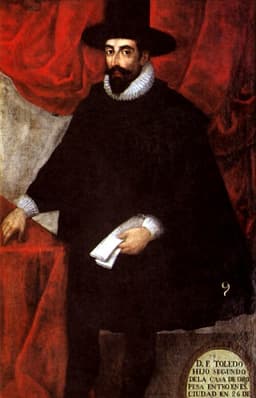
Francisco de Toledo
Politician · Modern
52.6Total

Ye Mingchen
Politician · Modern
44.2Total
Basic Information
Born
1515
1807
Died
1582
1859
Era
Modern
Modern
Nationality
Spain
China
Occupation
Politician
Politician
Civilization
Western
Eastern
Score Comparison
Military (10%)
21.2
36.6
Political (20%)
62.7
29.3
Influence (20%)
55.0
49.4
Legacy (20%)
52.0
40.8
Leadership (15%)
72.0
55.3
Strategy (15%)
35.7
53.3
TOTAL
52.6
44.2
Francisco de Toledo — Complete Timeline
1569 AD
Appointed Fifth Viceroy of PeruPolitical Action◆ Major
Francisco de Toledo was appointed by King Philip II as the fifth viceroy of Peru. He arrived in Lima with a mandate to reorganize the colony, consolidate Spanish control, and implement administrative reforms.
AppointmentColonial administration
Impact: regional
1570 AD
Implemented the Reducción SystemReform◆ Major
Toledo forced the resettlement of indigenous populations into planned towns called reducciones. This system aimed to facilitate Christianization, taxation, and labor control, but disrupted traditional Andean communities and led to population decline.
ReformIndigenous policy
Impact: regionaldestructive
1572 AD
Executed Túpac Amaru, Last Inca EmperorPolitical Action◆ Major
Toledo ordered the capture and execution of T
ExecutionInca Empire
Impact: regionaldestructive
1573 AD
Established the Mita Labor SystemReform◆ Major
Toledo formalized the mita system, requiring indigenous communities to provide labor for mines, public works, and agriculture. The system was particularly harsh in the Potos
LaborMining
Impact: regionaldestructive
Reorganized the Potosí Silver MinesReform◆ Major
Toledo visited Potos
MiningEconomy
Impact: global
1574 AD
Codified Laws of the IndiesReform◆ Major
Toledo compiled and systematized the laws governing the Viceroyalty of Peru into the Ordenanzas de Toledo. These ordinances regulated indigenous affairs, mining, trade, and administration, serving as a legal framework for Spanish colonial rule.
LawAdministration
Impact: regionalconstructive
Ye Mingchen — Complete Timeline
1852 AD
Appointed Viceroy of LiangguangPolitical Action◆ Major
Ye Mingchen was appointed Viceroy of Liangguang (Guangdong and Guangxi provinces), making him the highest Qing official in southern China. He was responsible for managing relations with foreign powers, particularly the British in Canton.
AppointmentGovernmentCanton
Impact: regional
1856 AD
Executed British PrisonersPolitical Action◆ Major
Ye Mingchen ordered the execution of British prisoners captured during the Arrow Incident, a dispute over a Chinese-owned ship flying the British flag. This act escalated tensions and contributed to the outbreak of the Second Opium War.
Arrow IncidentSecond Opium WarExecution
Impact: regionaldestructive
1858 AD
Captured by British ForcesWar◆ Major
During the Second Opium War, British forces captured Canton and took Ye Mingchen prisoner. He was held captive and later exiled to India, where he died in 1859. His capture symbolized Qing military weakness and the failure of his hardline anti-foreign policies.
Second Opium WarCaptureCanton
Impact: regionaltragic
This comparison has not been analyzed yet.
One-time AI generation (~1 minute). Scores and timeline are already available below.
Rankings
🥇
Francisco de ToledoLeader
Mil: 21.2Pol: 62.7Inf: 55.0
52.6
🥈
Ye Mingchen
Mil: 36.6Pol: 29.3Inf: 49.4
44.2
+8.4 behind
How This Comparison Works
Algorithm
Each figure is scored on 6 dimensions (0—100 scale) based on structured historical data: Military (10%), Political (20%), Influence (20%), Legacy (20%), Leadership (15%), Strategy (15%). The weighted total produces the final ranking.
Data Sources
Scores are computed from structured sub-indicators in the database. Scale factors adjust for era (Ancient ×0.85, Modern ×1.0) and civilization size (Eastern ×1.05, Other ×0.80) to account for differences in population and military scale.
Maximum 3 Figures
Comparisons are limited to 2—3 figures to ensure readability and statistical meaningfulness.
Error Margins
±5 points per dimension — Sub-scores are derived from historical records with inherent uncertainty. Two figures within 5 points on a dimension should be considered roughly equivalent in that area.
Total Score Accuracy
±3 points overall — The weighted combination of 6 dimensions produces a total score with approximately ±3 points of uncertainty. Differences of less than 3 points are not statistically significant— the figures are effectively tied.
Known Limitations
- Historical records are incomplete and uneven across civilizations
- Figures from oral-tradition societies may be underrepresented
- Occupation labels can misclassify multi-role figures
- Scores measure capability and impact, not moral character
- Quantitative scoring is a comparison tool, not absolute truth
Capability Radar
Military (10%) — Battles & Warfare
Battles
10
5
Win Rate
10
5
Expansion
40
5
Political (20%) — Governance & Reform
Reform
85
20
Diplomacy
70
15
Economy
80
20
Influence (20%) — Cultural & Global Reach
Cultural
60
15
Global
55
10
Legacy (20%) — Historical Impact
Historical
70
20
Longevity
65
15
Leadership (15%) — Power & Stability
Tenure
75
40
Stability
75
10
Strategy (15%) — Tactics & Innovation
Strategy
20
10
Tactics
15
10
Reform
55
5
Similar Comparisons
Comments & Discussion
No comments yet. Be the first to share your thoughts!