Loading...
Fidel Ramos vs Napoleon Bonaparte
Napoleon Bonaparte leads by 17.7 pts · 2 figures compared
…
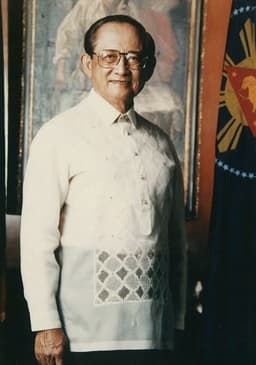
Fidel Ramos
General · Modern
53.2Total

Napoleon Bonaparte
General · Modern
70.9Total
Basic Information
Born
1928
1769
Died
—
1821
Era
Modern
Modern
Nationality
Philippines
France
Occupation
General
General
Civilization
Eastern
Western
Score Comparison
Military (10%)
55.0
94.0
Political (20%)
60.0
72.0
Influence (20%)
56.4
40.0
Legacy (20%)
48.3
80.0
Leadership (15%)
48.8
78.0
Strategy (15%)
52.5
90.0
TOTAL
53.2
70.9
Fidel Ramos — Complete Timeline
1989 AD
Suppressed the 1989 Coup AttemptPolitical Action◆ Major
As Chief of the Philippine Constabulary, Ramos played a key role in suppressing the 1989 coup attempt against President Corazon Aquino. He remained loyal to the government and helped stabilize the country.
Coup AttemptLoyaltyStability
Impact: nationalconstructive
1992 AD
Initiated Economic Liberalization ReformsReform◆ Major
Ramos implemented a series of economic liberalization policies, including deregulation, privatization of state-owned enterprises, and opening the economy to foreign investment. These reforms led to sustained economic growth.
Economic ReformLiberalizationGrowth
Impact: nationalconstructive
Elected President of the PhilippinesPolitical Action◆ Major
Ramos was elected as the 12th President of the Philippines, succeeding Corazon Aquino. He was the first Protestant president in a predominantly Catholic country and focused on economic reforms and peace negotiations.
ElectionPresidencyProtestant
Impact: nationalconstructive
1996 AD
Signed the Final Peace Agreement with the MNLFPolitical Action◆ Major
Ramos signed a final peace agreement with the Moro National Liberation Front (MNLF), ending decades of insurgency in Mindanao. The agreement established the Autonomous Region in Muslim Mindanao (ARMM).
Peace AgreementMNLFMindanao
Impact: regionalconstructive
Napoleon Bonaparte — Complete Timeline
1799 AD
Coup of 18 BrumaireOther◆ Major
Napoleon Bonaparte, with support from his brother Lucien and key political figures, overthrew the Directory in a bloodless coup. He established the Consulate with himself as First Consul, effectively becoming the ruler of France. This event ended the French Revolution's most unstable period.
French RevolutionCoupRise to Power
Impact: regional
1804 AD
Promulgation of the Napoleonic CodeOther◆ Major
Napoleon enacted the Civil Code of the French, known as the Napoleonic Code, a comprehensive set of laws that replaced the fragmented feudal legal systems. The code established legal equality, protected property rights, and secularized law. It became the basis for legal systems in many European and world countries.
Legal ReformNapoleonic CodeCivil Law
Impact: globalconstructive
1805 AD
Battle of AusterlitzWar◆ Major
Napoleon's Grande Arm
Napoleonic WarsBattleDecisive Victory
Impact: global
1812 AD
Invasion of RussiaWar◆ Major
Napoleon led the Grande Arm
Napoleonic WarsInvasionDisaster
Impact: globaldestructive
1815 AD
Battle of WaterlooWar◆ Major
Napoleon's French army was defeated by the combined forces of the Duke of Wellington's Anglo-Allied army and Gebhard Leberecht von Bl
Napoleonic WarsBattleFinal Defeat
Impact: globaldestructive
Expert Analysis
fidel-ramos-vs-napoleon-bonaparte
# The General and the Emperor: Two Paths to Power
On a misty morning in June 1815, Napoleon Bonaparte watched his Imperial Guard march toward the British lines at Waterloo, staking everything on one final, desperate gamble. The gamble failed. Across the centuries and half a world away, another general named Fidel Ramos sat in a Manila command center in December 1989, coordinating the suppression of a coup that threatened the fragile democracy he had helped restore. Napoleon fell from power in exile; Ramos rose to the presidency. Both men wore uniforms. Both wielded immense authority. But their journeys, their choices, and their legacies could not have diverged more sharply.
Origins
Napoleon was born in 1769 on the island of Corsica, a newly acquired French territory where his family belonged to the minor nobility. The Mediterranean world of his youth was one of ancient feuds, clan loyalties, and simmering resentment against French rule. He spoke Italian before French, and his accent would mark him as an outsider for life. The French Revolution, erupting when he was twenty, shattered the old order and created opportunities unimaginable under the Bourbon monarchy. A young artillery officer of modest birth could rise on talent alone—and Napoleon seized that chance with ferocious ambition.
Fidel Ramos was born in 1928 into a very different world: the American colonial Philippines, where his father was a journalist and diplomat. His family was Protestant in a predominantly Catholic nation, a religious minority status that would shape his career. He studied at the United States Military Academy at West Point, absorbing American ideals of civilian control over the military and constitutional governance. Where Napoleon’s France was convulsed by revolution, Ramos’s Philippines was shaped by colonial rule, war, and the slow struggle for democracy.
Rise to Power
Napoleon’s ascent was meteoric and bloody. In 1793, at age twenty-four, he drove British forces from the port of Toulon, earning promotion to brigadier general. By 1796, he commanded the French army in Italy, where his lightning campaigns humbled Austria and made him a national hero. The Directory, France’s corrupt ruling council, feared his popularity but needed his sword. In 1799, Napoleon staged a coup d’état, becoming First Consul, and by 1804, he crowned himself Emperor of the French. Each step was a gamble, each victory a foundation for the next.
Ramos’s rise was slower, more institutional. He served in the Philippine Constabulary, rose through the ranks, and became a key figure in the dictatorship of Ferdinand Marcos. But in 1986, when Marcos tried to steal a presidential election, Ramos made a fateful choice: he defected to the opposition. Standing beside Corazon Aquino, he helped topple a dictator through the peaceful People Power Revolution. That decision—to uphold the constitution rather than the regime—defined his career. In 1992, he was elected president, the first Protestant to hold the office, with a military score of only 22.4 but a political score of 77.5.
Leadership & Governance
Napoleon governed as a conqueror and reformer. His Napoleonic Code standardized French law, abolished feudal privileges, and enshrined merit over birth. He built roads, schools, and banks, centralized the state, and spread revolutionary ideals across Europe. But his governance was inseparable from war. With a military score of 94.0 and a strategy score of 93.0, he sought to dominate the continent through decisive battles: Austerlitz in 1805, Jena in 1806, Wagram in 1809. His leadership score of 80.0 reflected his ability to inspire soldiers, but also his growing arrogance and refusal to compromise.
Ramos governed as a stabilizer and modernizer. His military score of 22.4 was not a measure of incompetence, but of a different role: he suppressed coups, not launched them. As president, he initiated economic liberalization reforms in 1992, deregulating industries, privatizing state enterprises, and opening the Philippines to foreign investment. In 1996, he signed a final peace agreement with the Moro National Liberation Front, ending decades of insurgency in Mindanao. His political score of 77.5 and leadership score of 76.3 reflected a steady hand, not a brilliant one. He built institutions, not empires.
Triumph & Tragedy
Napoleon’s greatest triumph was Austerlitz, where he crushed the combined armies of Russia and Austria in a single day, dissolving the Holy Roman Empire and cementing his mastery of Europe. His greatest tragedy was the invasion of Russia in 1812. He marched with over 600,000 men; fewer than 100,000 returned. The Grand Army was destroyed, and the other powers of Europe united against him. Exiled to Elba in 1814, he escaped in 1815, only to meet final defeat at Waterloo. His legacy score of 78.0 reflects both his achievements and his catastrophic overreach.
Ramos’s triumph was the peaceful transition of power. He inherited a country scarred by dictatorship, coup attempts, and economic stagnation. He left it more stable, more prosperous, and more democratic. His tragedy was more subtle: the limits of reform. Corruption persisted, inequality deepened, and the peace with the MNLF, while historic, did not end all conflict. His legacy score of 68.0 and influence score of 72.9 reflect a competent but not transformative leader.
Character & Destiny
Napoleon was driven by an insatiable hunger for glory. “I am not a man, but a thing,” he once said. “I have no heart.” He believed his destiny was to reshape the world, and he nearly did. But his personality—brilliant, ruthless, impatient—led him to overreach. He could not stop conquering. He could not share power. He died in exile on Saint Helena in 1821, at age fifty-one, a prisoner of his own ambition.
Ramos was driven by duty. He was not a visionary but a manager, not a conqueror but a fixer. He believed in process, in institutions, in the slow work of building consensus. He died in 2022 at age ninety-four, having served his country in uniform and in office, remembered as the general who chose democracy over dictatorship.
Legacy
Napoleon’s legacy is vast and contradictory. He spread the ideals of the French Revolution—legal equality, secular governance, national citizenship—across Europe, but he did so through conquest and tyranny. His name is synonymous with military genius and tragic hubris. He is studied by generals and politicians, admired and reviled.
Ramos’s legacy is quieter but no less significant. He proved that a general could be a democrat, that a Protestant could lead a Catholic nation, that peace could be negotiated with enemies. He is remembered as the man who held the line when democracy trembled, who opened the economy when protectionism failed, who signed peace when war had become routine.
Conclusion
Two generals, two centuries, two worlds. Napoleon Bonaparte conquered a continent and lost everything. Fidel Ramos stabilized a nation and gained a legacy. The difference was not in talent—Napoleon was surely more brilliant—but in purpose. Napoleon sought to remake the world in his image; Ramos sought to repair the world he inherited. One burned bright and fast, the other burned steady and long. History remembers both, but it remembers them differently: the emperor who fell, and the general who stood.
Rankings
🥇
Napoleon BonaparteLeader
Mil: 94.0Pol: 72.0Inf: 40.0
70.9
🥈
Fidel Ramos
Mil: 55.0Pol: 60.0Inf: 56.4
53.2
+17.7 behind
How This Comparison Works
Algorithm
Each figure is scored on 6 dimensions (0—100 scale) based on structured historical data: Military (10%), Political (20%), Influence (20%), Legacy (20%), Leadership (15%), Strategy (15%). The weighted total produces the final ranking.
Data Sources
Scores are computed from structured sub-indicators in the database. Scale factors adjust for era (Ancient ×0.85, Modern ×1.0) and civilization size (Eastern ×1.05, Other ×0.80) to account for differences in population and military scale.
Maximum 3 Figures
Comparisons are limited to 2—3 figures to ensure readability and statistical meaningfulness.
Error Margins
±5 points per dimension — Sub-scores are derived from historical records with inherent uncertainty. Two figures within 5 points on a dimension should be considered roughly equivalent in that area.
Total Score Accuracy
±3 points overall — The weighted combination of 6 dimensions produces a total score with approximately ±3 points of uncertainty. Differences of less than 3 points are not statistically significant— the figures are effectively tied.
Known Limitations
- Historical records are incomplete and uneven across civilizations
- Figures from oral-tradition societies may be underrepresented
- Occupation labels can misclassify multi-role figures
- Scores measure capability and impact, not moral character
- Quantitative scoring is a comparison tool, not absolute truth
Capability Radar
Military (10%) — Battles & Warfare
Battles
35
95
Win Rate
40
90
Expansion
20
95
Political (20%) — Governance & Reform
Reform
65
95
Diplomacy
60
80
Economy
55
85
Influence (20%) — Cultural & Global Reach
Cultural
30
85
Global
40
90
Legacy (20%) — Historical Impact
Historical
45
95
Longevity
35
90
Leadership (15%) — Power & Stability
Tenure
55
85
Stability
50
70
Strategy (15%) — Tactics & Innovation
Strategy
50
95
Tactics
45
98
Reform
60
92
Similar Comparisons
Comments & Discussion
No comments yet. Be the first to share your thoughts!