Loading...
Analysis will be generated on first visit.
Scores and timeline are available below. The page will refresh automatically when ready.
Ferdinand I of Romania vs Julius Caesar
Julius Caesar leads by 16.6 pts · 2 figures compared
…
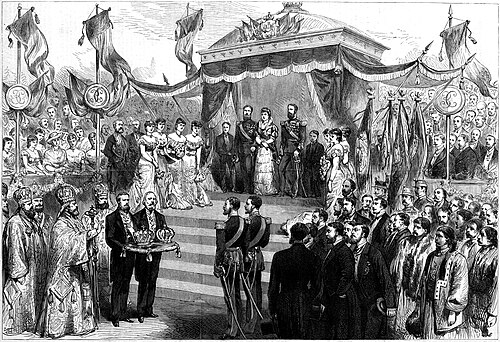
Ferdinand I of Romania
Emperor · Modern
66.7Total
Julius Caesar
General · Ancient
83.3Total
Basic Information
Born
1865
-100
Died
1927
-44
Era
Modern
Ancient
Nationality
Romania
Roman Republic
Occupation
Emperor
General
Civilization
Western
Western
Score Comparison
Military (10%)
42.0
88.0
Political (20%)
74.5
78.0
Influence (20%)
74.6
85.0
Legacy (20%)
63.0
82.0
Leadership (15%)
80.7
82.0
Strategy (15%)
52.9
88.0
TOTAL
66.7
83.3
Rankings
🥇
Julius CaesarLeader
Mil: 88.0Pol: 78.0Inf: 85.0
83.3
🥈
Ferdinand I of Romania
Mil: 42.0Pol: 74.5Inf: 74.6
66.7
+16.6 behind
How This Comparison Works
Algorithm
Each figure is scored on 6 dimensions (0—100 scale) based on structured historical data: Military (10%), Political (20%), Influence (20%), Legacy (20%), Leadership (15%), Strategy (15%). The weighted total produces the final ranking.
Data Sources
Scores are computed from structured sub-indicators in the database. Scale factors adjust for era (Ancient ×0.85, Modern ×1.0) and civilization size (Eastern ×1.05, Other ×0.80) to account for differences in population and military scale.
Maximum 3 Figures
Comparisons are limited to 2—3 figures to ensure readability and statistical meaningfulness.
Error Margins
±5 points per dimension — Sub-scores are derived from historical records with inherent uncertainty. Two figures within 5 points on a dimension should be considered roughly equivalent in that area.
Total Score Accuracy
±3 points overall — The weighted combination of 6 dimensions produces a total score with approximately ±3 points of uncertainty. Differences of less than 3 points are not statistically significant— the figures are effectively tied.
Known Limitations
- Historical records are incomplete and uneven across civilizations
- Figures from oral-tradition societies may be underrepresented
- Occupation labels can misclassify multi-role figures
- Scores measure capability and impact, not moral character
- Quantitative scoring is a comparison tool, not absolute truth
Capability Radar
Military (10%) — Battles & Warfare
Battles
20
95
Win Rate
25
92
Expansion
10
97
Political (20%) — Governance & Reform
Reform
55
90
Diplomacy
70
85
Economy
40
82
Influence (20%) — Cultural & Global Reach
Cultural
30
88
Global
40
94
Legacy (20%) — Historical Impact
Historical
50
95
Longevity
35
96
Leadership (15%) — Power & Stability
Tenure
60
75
Stability
45
60
Strategy (15%) — Tactics & Innovation
Strategy
30
94
Tactics
15
96
Reform
40
88
Analysis will be generated on first visit.
Scores and timeline are available below. The page will refresh automatically when ready.
Ferdinand I of Romania — Complete Timeline
1914 AD
Ascended to the Throne of RomaniaPolitical Action◆ Major
Ferdinand I became King of Romania on October 10, 1914, following the death of his uncle, King Carol I. He inherited a kingdom at a critical moment, as World War I had just begun, and Romania was initially neutral.
AccessionWorld War INeutrality
Impact: national
1916 AD
Led Romania into World War I on the Allied SideWar
Ferdinand I signed the Treaty of Bucharest with the Allies on August 17, 1916, committing Romania to enter World War I on their side. Romania declared war on Austria-Hungary on August 27, 1916, aiming to annex Transylvania.
World War IAllianceTransylvania
Impact: regional
1918 AD
Oversaw the Union of Transylvania with RomaniaPolitical Action
Following the collapse of Austria-Hungary, the Great National Assembly of Alba Iulia proclaimed the union of Transylvania with Romania on December 1, 1918. Ferdinand I ratified this union, fulfilling a key national goal and greatly expanding Romania's territory.
Great UnionTransylvaniaNational Unification
Impact: nationalconstructive
1921 AD
Implemented the Land Reform of 1921Reform◆ Major
Ferdinand I signed the Agrarian Reform Law of 1921, which expropriated large estates and redistributed land to peasants. This reform aimed to address rural poverty and create a stable class of small landowners, but it also weakened the traditional aristocracy.
Land ReformPeasantrySocial Change
Impact: nationalprogressive
1922 AD
Crowned King of Greater Romania at Alba IuliaPolitical Action◆ Major
Ferdinand I and Queen Marie were crowned in a grand ceremony at Alba Iulia on October 15, 1922, symbolizing the unification of all Romanian provinces. The coronation affirmed the creation of Greater Romania after World War I.
CoronationGreater RomaniaSymbolism
Impact: nationalconstructive
Similar Comparisons
Comments & Discussion
No comments yet. Be the first to share your thoughts!