Loading...
Fa Ngum vs Napoleon Bonaparte
Napoleon Bonaparte leads by 8.6 pts · 2 figures compared
…
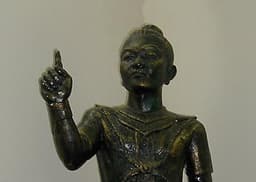
Fa Ngum
Emperor · Medieval
62.3Total

Napoleon Bonaparte
General · Modern
70.9Total
Basic Information
Born
1316
1769
Died
1393
1821
Era
Medieval
Modern
Nationality
Laos
France
Occupation
Emperor
General
Civilization
Eastern
Western
Score Comparison
Military (10%)
70.0
94.0
Political (20%)
68.0
72.0
Influence (20%)
61.0
40.0
Legacy (20%)
54.0
80.0
Leadership (15%)
74.0
78.0
Strategy (15%)
52.5
90.0
TOTAL
62.3
70.9
Fa Ngum — Complete Timeline
1353 AD
Founded the Kingdom of Lan XangPolitical Action
Fa Ngum unified the Lao principalities of Muang Sua and Vieng Chan under his rule, founding the Kingdom of Lan Xang (Million Elephants). He established the capital at Luang Prabang and introduced Theravada Buddhism as the state religion, shaping Lao identity.
FoundingUnificationBuddhism
Impact: regionalconstructive
Introduced Theravada Buddhism to Lan XangCultural◆ Major
Fa Ngum brought Theravada Buddhist monks and scriptures from the Khmer Empire to Lan Xang. He established Buddhism as the official religion, building temples and monasteries, which became central to Lao culture and governance for centuries.
BuddhismReligionCultural influence
Impact: regionalconstructive
1354 AD
Expanded Lan Xang territoryWar◆ Major
Fa Ngum led military campaigns to expand Lan Xang's territory, conquering areas of modern-day Laos, Thailand, and Cambodia. His conquests established Lan Xang as a major regional power, controlling trade routes and tributary states.
ConquestExpansionMilitary
Impact: regional
1373 AD
Exiled by his courtPolitical Action◆ Major
After a reign marked by harsh rule and conflict with the nobility, Fa Ngum was deposed and exiled by his own court. He died in exile in 1393, leaving his son Samsenethai to succeed him. His exile ended the founding era of Lan Xang.
ExileDepositionCourt conflict
Impact: regionaltragic
Napoleon Bonaparte — Complete Timeline
1799 AD
Coup of 18 BrumaireOther◆ Major
Napoleon Bonaparte, with support from his brother Lucien and key political figures, overthrew the Directory in a bloodless coup. He established the Consulate with himself as First Consul, effectively becoming the ruler of France. This event ended the French Revolution's most unstable period.
French RevolutionCoupRise to Power
Impact: regional
1804 AD
Promulgation of the Napoleonic CodeOther◆ Major
Napoleon enacted the Civil Code of the French, known as the Napoleonic Code, a comprehensive set of laws that replaced the fragmented feudal legal systems. The code established legal equality, protected property rights, and secularized law. It became the basis for legal systems in many European and world countries.
Legal ReformNapoleonic CodeCivil Law
Impact: globalconstructive
1805 AD
Battle of AusterlitzWar◆ Major
Napoleon's Grande Arm
Napoleonic WarsBattleDecisive Victory
Impact: global
1812 AD
Invasion of RussiaWar◆ Major
Napoleon led the Grande Arm
Napoleonic WarsInvasionDisaster
Impact: globaldestructive
1815 AD
Battle of WaterlooWar◆ Major
Napoleon's French army was defeated by the combined forces of the Duke of Wellington's Anglo-Allied army and Gebhard Leberecht von Bl
Napoleonic WarsBattleFinal Defeat
Impact: globaldestructive
Expert Analysis
fa-ngum-vs-napoleon-bonaparte
### The Emperor and the Exile: Napoleon and Fa Ngum, Two Paths to Power
In the winter of 1815, a man in a gray greatcoat stood on the deck of a British warship, watching the coast of France dissolve into the Atlantic fog. He was a titan of Europe, a man who had crowned himself emperor and redrawn the map of a continent. Half a millennium earlier, on a jungle path in Southeast Asia, another man—weary, betrayed, and stripped of his throne—trudged into exile, his kingdom of a million elephants fading behind him. Napoleon Bonaparte and Fa Ngum both rose from obscurity to forge empires, and both ended their days in bitter banishment. Yet their stories are not merely tales of triumph and fall; they are profound studies in how ambition, culture, and circumstance shape the very nature of power.
### Origins
Napoleon was born in 1769 on the island of Corsica, a rocky Mediterranean outpost that had only just become French. He grew up speaking Italian, a poor nobleman’s son in a world that looked down on him. The French Revolution, which erupted when he was twenty, shattered the old order and opened a chasm of opportunity. For a brilliant, hungry young artillery officer, it was a ladder. His era was one of chaos, nationalism, and the birth of modern warfare—a time when a man with a cannon and a constitution could remake the world.
Fa Ngum, born in 1316, came from a different universe. He was a prince of the Lao kingdom of Muang Sua, but his path was forged in exile. As a child, he was sent to the court of the Khmer Empire—a vast, Hindu-Buddhist civilization that dominated Southeast Asia. There, he absorbed the traditions of Theravada Buddhism, the art of Khmer statecraft, and the ambition to reclaim his homeland. His era was medieval, decentralized, and spiritual. Power came not from revolutionary ideas but from lineage, religion, and the loyalty of petty lords.
### Rise to Power
Napoleon’s ascent was a masterpiece of speed and audacity. By 1796, at just twenty-six, he was given command of the French army in Italy. He did not simply fight; he dazzled. His campaign of 1796–1797 was a whirlwind of rapid marches, decisive battles, and political cunning. He defeated the Austrians, made peace on his own terms, and returned to Paris a hero. In 1799, he seized power in a coup, becoming First Consul. Five years later, in 1804, he crowned himself Emperor of the French. Every step was calculated, every risk measured. He was a man who believed he could bend history to his will.
Fa Ngum’s rise was slower, more traditional, and yet no less dramatic. After years in the Khmer court, he gathered an army—with Khmer support—and marched north. In 1353, at the age of thirty-seven, he united the fractious Lao principalities of Muang Sua and Vieng Chan, founding the Kingdom of Lan Xang, the “Land of a Million Elephants.” His power was not built on revolutionary fervor but on marriage alliances, military conquest, and the sacred legitimacy of Buddhism. He brought monks and scriptures from the Khmer Empire, establishing Theravada Buddhism as the state religion—a move that would define Lao identity for centuries.
### Leadership & Governance
Napoleon governed like a storm. He centralized the French state, streamlined the bureaucracy, and created the Napoleonic Code—a legal system that enshrined equality before the law, property rights, and secular governance. It was a revolutionary document, exported across Europe. His military genius was unmatched: at Austerlitz in 1805, he crushed a Russo-Austrian army with a feigned retreat and a devastating flank attack. He was a master of logistics, morale, and deception. Yet his political wisdom was brittle. He appointed family members to thrones, alienated allies, and treated Europe as a chessboard. His reforms were brilliant, but his arrogance bred a coalition that would eventually destroy him.
Fa Ngum ruled as a medieval monarch, but his vision was no less transformative. He unified a fragmented land under a single crown, established a capital at Luang Prabang, and spread Buddhism as a unifying force. His political score of 85.5 reflects a ruler who understood that power in Southeast Asia required spiritual authority as much as military might. But his harshness—the “harsh rule” that led to his exile—was his undoing. He crushed dissent with a heavy hand, alienating the nobility who had once supported him. Unlike Napoleon, he did not create a lasting legal code or a bureaucratic machine. His kingdom survived, but his personal rule did not.
### Triumph & Tragedy
Napoleon’s greatest moment was perhaps the Battle of Austerlitz in 1805, where he achieved a victory so complete that it became a legend. His worst failure was the 1812 invasion of Russia, a catastrophic campaign that cost hundreds of thousands of lives and destroyed his Grand Army. He was exiled to Elba in 1814, returned for a hundred days in 1815, and was finally defeated at Waterloo. His tragedy was that he could not stop—could not consolidate what he had won.
Fa Ngum’s triumph was the founding of Lan Xang itself, a kingdom that would last for over three centuries. His tragedy came in 1373, when his own court deposed and exiled him. He died in 1393, alone, in a distant land. Where Napoleon’s fall was a spectacular blaze, Fa Ngum’s was a quiet extinguishing—a king rejected by those he had united.
### Character & Destiny
Napoleon was a man of relentless energy, supreme confidence, and a near-mystical belief in his own destiny. “Impossible is a word to be found only in the dictionary of fools,” he once said. That belief drove him to conquer, but also to overreach. He could not delegate, could not compromise, could not accept limits. His character was his fate.
Fa Ngum, by contrast, was a builder, not a conqueror. He sought to create a nation, not an empire. But his severity—perhaps born from years of exile and the need to impose order on fractious lords—made him enemies. He lacked Napoleon’s charisma and his genius for propaganda. His destiny was to be a founder, not a ruler.
### Legacy
Napoleon’s legacy is immense. The Napoleonic Code influences legal systems from France to Louisiana to Japan. His military innovations shaped modern warfare. He is remembered as a genius and a tyrant, a liberator and a despot. His name is synonymous with ambition.
Fa Ngum’s legacy is quieter but no less profound. He gave Laos its first unified identity, its state religion, and its cultural foundation. He is revered as the father of the Lao nation, a figure of national pride. Where Napoleon’s shadow falls across the world, Fa Ngum’s glows within the borders of one country.
### Conclusion
Standing at the rail of that British ship, Napoleon could still see the shores of Europe. Fa Ngum, walking into the jungle, saw only trees. One was a comet, burning across the sky; the other was a seed, buried in the earth. Both were exiles, but their different fates were written not just in their characters, but in the worlds they sought to shape. Napoleon tried to remake history in his own image; Fa Ngum tried to give his people a home. Which is the greater ambition? The answer, perhaps, depends on which shore you stand.
Rankings
🥇
Napoleon BonaparteLeader
Mil: 94.0Pol: 72.0Inf: 40.0
70.9
🥈
Fa Ngum
Mil: 70.0Pol: 68.0Inf: 61.0
62.3
+8.6 behind
How This Comparison Works
Algorithm
Each figure is scored on 6 dimensions (0—100 scale) based on structured historical data: Military (10%), Political (20%), Influence (20%), Legacy (20%), Leadership (15%), Strategy (15%). The weighted total produces the final ranking.
Data Sources
Scores are computed from structured sub-indicators in the database. Scale factors adjust for era (Ancient ×0.85, Modern ×1.0) and civilization size (Eastern ×1.05, Other ×0.80) to account for differences in population and military scale.
Maximum 3 Figures
Comparisons are limited to 2—3 figures to ensure readability and statistical meaningfulness.
Error Margins
±5 points per dimension — Sub-scores are derived from historical records with inherent uncertainty. Two figures within 5 points on a dimension should be considered roughly equivalent in that area.
Total Score Accuracy
±3 points overall — The weighted combination of 6 dimensions produces a total score with approximately ±3 points of uncertainty. Differences of less than 3 points are not statistically significant— the figures are effectively tied.
Known Limitations
- Historical records are incomplete and uneven across civilizations
- Figures from oral-tradition societies may be underrepresented
- Occupation labels can misclassify multi-role figures
- Scores measure capability and impact, not moral character
- Quantitative scoring is a comparison tool, not absolute truth
Capability Radar
Military (10%) — Battles & Warfare
Battles
55
95
Win Rate
60
90
Expansion
70
95
Political (20%) — Governance & Reform
Reform
55
95
Diplomacy
60
80
Economy
50
85
Influence (20%) — Cultural & Global Reach
Cultural
55
85
Global
40
90
Legacy (20%) — Historical Impact
Historical
60
95
Longevity
55
90
Leadership (15%) — Power & Stability
Tenure
60
85
Stability
45
70
Strategy (15%) — Tactics & Innovation
Strategy
65
95
Tactics
50
98
Reform
40
92
Similar Comparisons
Comments & Discussion
No comments yet. Be the first to share your thoughts!