Loading...
Eugenia Charles vs Nobusuke Kishi
Eugenia Charles leads by 4.3 pts · 2 figures compared
…
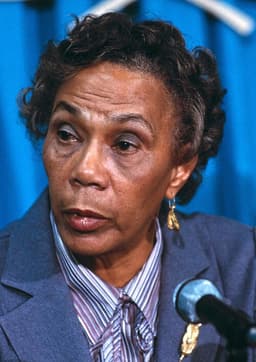
Eugenia Charles
Politician · Modern
55.7Total

Nobusuke Kishi
Politician · Modern
51.4Total
Basic Information
Born
1919
1896
Died
2005
1987
Era
Modern
Modern
Nationality
Dominica
Japan
Occupation
Politician
Politician
Civilization
Western
Eastern
Score Comparison
Military (10%)
49.7
17.4
Political (20%)
62.7
59.3
Influence (20%)
60.0
59.0
Legacy (20%)
48.3
50.0
Leadership (15%)
66.0
66.0
Strategy (15%)
43.3
36.0
TOTAL
55.7
51.4
Eugenia Charles — Complete Timeline
1980 AD
Implemented Economic ReformsReform◆ Major
Charles's government implemented free-market economic reforms, including privatization, tax cuts, and attracting foreign investment. These policies stabilized Dominica's economy but increased inequality.
Economic ReformFree MarketPrivatization
Impact: nationalconstructive
Became First Female Prime Minister of DominicaPolitical Action
Charles led the Dominica Freedom Party to victory in the 1980 general election, becoming the first female Prime Minister of Dominica and the first female head of government in the Caribbean.
First Female PMGender EqualityMilestone
Impact: regionalprogressive
1981 AD
Survived a Coup AttemptPolitical Action◆ Major
Charles's government survived a coup attempt by white supremacist mercenaries, who planned to overthrow her and install a white-led government. The plot was foiled by US and Dominican authorities.
Coup AttemptMercenariesPolitical Violence
Impact: nationaltragic
1983 AD
Led the US Invasion of GrenadaPolitical Action◆ Major
Charles was a key advocate for the US-led invasion of Grenada in 1983, following the execution of Maurice Bishop. She argued that the invasion was necessary to restore democracy and stability in the region.
US InvasionGrenadaForeign PolicyRegional Intervention
Impact: regionalconstructive
Nobusuke Kishi — Complete Timeline
1957 AD
Post-War Rehabilitation and Economic PoliciesReform
As prime minister, Kishi pursued policies to stimulate economic growth, including tax cuts, increased public works, and support for heavy industry. He also worked to normalize Japan's international standing, securing membership in the United Nations in 1956 and promoting trade with Southeast Asia.
Economic PolicyPost-WarJapan
Impact: nationalconstructive
1960 AD
Signing of the US-Japan Security Treaty (Anpo)Political Action
As prime minister, Nobusuke Kishi pushed through the revised US-Japan Security Treaty in January 1960, which strengthened the bilateral alliance and allowed US forces to remain in Japan. The treaty's ratification sparked massive protests and a political crisis, leading to Kishi's resignation shortly after its passage.
TreatyAllianceProtest
Impact: regional
Suppression of the 1960 Anpo ProtestsPolitical Action◆ Major
Kishi's government used police force to suppress the massive demonstrations against the Security Treaty, including the controversial decision to call in riot police to clear the Diet building. The crackdown deepened public anger and damaged Kishi's reputation, contributing to his decision to step down.
ProtestSuppressionPolitical Crisis
Impact: nationaldestructive
Expert Analysis
Origins
Eugenia Charles was born on May 15, 1919, in Pointe Michel, Dominica, to a wealthy mixed-race family. Her father was a planter and her mother a homemaker. She studied law in Canada and became one of the first female lawyers in Dominica. Her background in law and her family's prominence gave her a platform for political involvement.
Nobusuke Kishi was born on November 13, 1896, in Tabuse, Yamaguchi Prefecture, Japan, into a samurai family. He was adopted into the Kishi family. He studied at Tokyo Imperial University and entered the Ministry of Commerce and Industry. His early career was shaped by Japan's militaristic expansion, and he became a key figure in the wartime economy.
Rise to Power
Charles entered politics in the 1970s, founding the Dominica Freedom Party. She became the island's first female Prime Minister in July 1980 after a landslide election victory. Her rise was aided by the collapse of the previous Labour government amid economic turmoil and corruption.
Kishi's rise was more complex. He served as a minister in the wartime government of Hideki Tojo, overseeing industrial policy in Manchuria. After World War II, he was imprisoned as a Class A war suspect but never tried. He re-entered politics in the 1950s, becoming Prime Minister in February 1957. His rise was facilitated by his alliance with the Liberal Democratic Party's conservative faction.
Leadership & Governance
Charles governed with a free-market approach, privatizing state enterprises, cutting taxes, and encouraging foreign investment. She was a staunch anti-communist and aligned closely with the United States. Her leadership style was confrontational and decisive, earning her the nickname "Iron Lady of the Caribbean." For example, she pushed through unpopular economic reforms that stabilized Dominica's economy but increased inequality.
Kishi's governance was focused on revising the US-Japan Security Treaty (Anpo) to place Japan on a more equal footing with the US. He used strong-arm tactics to ram the treaty through the Diet, including calling police to remove opposition lawmakers. His economic policies continued the post-war growth, but his authoritarian methods sparked massive protests.
Triumph & Tragedy
Charles's greatest triumph was leading the US invasion of Grenada in 1983, which toppled a communist regime. She also survived a coup attempt by white supremacist mercenaries in 1981, demonstrating her resilience. Her tragedy was the long-term economic stagnation of Dominica despite her reforms, and her failure to diversify the economy away from bananas.
Kishi's triumph was the signing of the US-Japan Security Treaty in 1960, which solidified the alliance and set the stage for Japan's economic miracle. His tragedy was the violent suppression of the Anpo protests, which forced his resignation and left a legacy of distrust in the government. He also faced criticism for his wartime past.
Character & Destiny
Charles was known for her intelligence, stubbornness, and willingness to take risks. She often clashed with opponents and was unafraid to make enemies. Her character shaped her destiny as a polarizing figure who was revered by supporters and despised by critics. She scored 66.0 in leadership, reflecting her decisive style.
Kishi was a calculating pragmatist, willing to use any means to achieve his goals. His wartime experience made him adept at bureaucratic maneuvering but also left him with a tarnished reputation. His character led to his downfall after the Anpo protests, as his heavy-handed tactics backfired. He scored 66.0 in leadership as well, but his strategy score of 36.0 indicates poor long-term planning.
Legacy
Charles's legacy is mixed. She paved the way for women in Caribbean politics, but her economic policies are criticized for increasing inequality. Her role in the Grenada invasion remains controversial. She scored 48.3 in legacy, reflecting limited long-term impact beyond Dominica.
Kishi's legacy is more significant. The US-Japan Security Treaty remains the cornerstone of Japanese foreign policy. His economic policies contributed to Japan's post-war growth. However, his authoritarian methods and wartime past are enduring stains. He scored 50.0 in legacy, slightly higher than Charles.
Conclusion
While both leaders had notable achievements, Kishi's impact on international relations and Japan's trajectory is greater. The US-Japan Security Treaty he championed has shaped East Asian security for over six decades. Charles, despite her historic role as a female leader, had a narrower sphere of influence. Kishi's total score of 51.4 is slightly lower than Charles's 55.7, but his legacy in global affairs is more profound. Therefore, Kishi had greater impact.
Rankings
🥇
Eugenia CharlesLeader
Mil: 49.7Pol: 62.7Inf: 60.0
55.7
🥈
Nobusuke Kishi
Mil: 17.4Pol: 59.3Inf: 59.0
51.4
+4.3 behind
How This Comparison Works
Algorithm
Each figure is scored on 6 dimensions (0—100 scale) based on structured historical data: Military (10%), Political (20%), Influence (20%), Legacy (20%), Leadership (15%), Strategy (15%). The weighted total produces the final ranking.
Data Sources
Scores are computed from structured sub-indicators in the database. Scale factors adjust for era (Ancient ×0.85, Modern ×1.0) and civilization size (Eastern ×1.05, Other ×0.80) to account for differences in population and military scale.
Maximum 3 Figures
Comparisons are limited to 2—3 figures to ensure readability and statistical meaningfulness.
Error Margins
±5 points per dimension — Sub-scores are derived from historical records with inherent uncertainty. Two figures within 5 points on a dimension should be considered roughly equivalent in that area.
Total Score Accuracy
±3 points overall — The weighted combination of 6 dimensions produces a total score with approximately ±3 points of uncertainty. Differences of less than 3 points are not statistically significant— the figures are effectively tied.
Known Limitations
- Historical records are incomplete and uneven across civilizations
- Figures from oral-tradition societies may be underrepresented
- Occupation labels can misclassify multi-role figures
- Scores measure capability and impact, not moral character
- Quantitative scoring is a comparison tool, not absolute truth
Capability Radar
Military (10%) — Battles & Warfare
Battles
30
13
Win Rate
29
16
Expansion
37
18
Political (20%) — Governance & Reform
Reform
55
65
Diplomacy
65
70
Economy
50
60
Influence (20%) — Cultural & Global Reach
Cultural
45
30
Global
45
55
Legacy (20%) — Historical Impact
Historical
50
55
Longevity
40
40
Leadership (15%) — Power & Stability
Tenure
60
60
Stability
55
55
Strategy (15%) — Tactics & Innovation
Strategy
38
23
Tactics
43
24
Reform
43
29
Similar Comparisons
Comments & Discussion
No comments yet. Be the first to share your thoughts!