Loading...
Erich von Manstein vs Ri Myong-su
Erich von Manstein leads by 17.6 pts · 2 figures compared
…
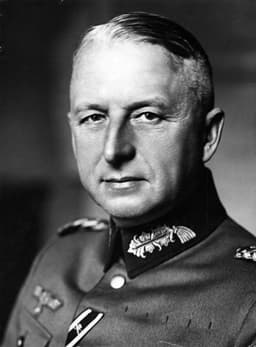
Erich von Manstein
General · Modern
56.2Total

Ri Myong-su
General · Modern
38.6Total
Basic Information
Born
1887
1934
Died
1973
—
Era
Modern
Modern
Nationality
Germany
North Korea
Occupation
General
General
Civilization
Western
Eastern
Score Comparison
Military (10%)
72.0
22.6
Political (20%)
35.1
25.0
Influence (20%)
65.0
50.2
Legacy (20%)
55.0
37.5
Leadership (15%)
43.8
50.7
Strategy (15%)
72.0
30.3
TOTAL
56.2
38.6
Erich von Manstein — Complete Timeline
1942 AD
Battle of SevastopolWar◆ Major
Manstein commanded the 11th Army in the assault on the Soviet fortress of Sevastopol in Crimea. After a prolonged siege, German forces captured the city in July 1942. For this victory, Manstein was promoted to field marshal.
World War IIEastern FrontSiege
Impact: regionaldestructive
1943 AD
Battle of KurskWar◆ Major
Manstein commanded Army Group South during the Battle of Kursk, the largest tank battle in history. His forces achieved tactical successes at Prokhorovka but failed to break through Soviet defenses. The German offensive was halted, marking a strategic defeat on the Eastern Front.
World War IIEastern FrontTank Battle
Impact: globaldestructive
1944 AD
Planning of the Ardennes OffensiveWar◆ Major
Manstein did not plan the Ardennes Offensive; that was Hitler's plan. Manstein was the primary planner of the 1940 Ardennes offensive through Belgium and France. His plan, known as the Manstein Plan, involved a surprise armored thrust through the Ardennes forest, leading to the rapid defeat of France.
World War IIBattle of FranceMilitary Strategy
Impact: global
Dismissal by HitlerPolitical Action◆ Major
After repeated disagreements with Hitler over military strategy, Manstein was dismissed from command of Army Group South in March 1944. He was replaced by Walter Model and never held another active command during the war.
World War IICommand ChangeHitler
Impact: national
1949 AD
Trial and ImprisonmentPolitical Action◆ Major
Manstein was tried by a British military court in Hamburg for war crimes, including the use of scorched earth tactics and mistreatment of prisoners. He was convicted on several counts and sentenced to 18 years imprisonment, but was released in 1953 due to health reasons.
War Crimes TrialPost-WarJustice
Impact: nationaltragic
Ri Myong-su — Complete Timeline
2009 AD
Appointed Chief of General Staff of KPAOther◆ Major
Ri Myong-su was appointed as Chief of the General Staff of the Korean People's Army (KPA). This position made him the top military commander under Supreme Leader Kim Jong-il, responsible for overseeing North Korea's military operations and strategic planning.
Military LeadershipNorth KoreaKPA
Impact: national
2011 AD
Oversaw Military During Kim Jong-il's SuccessionOther◆ Major
Ri Myong-su oversaw the Korean People's Army during the transition of power from Kim Jong-il to Kim Jong-un. He ensured military loyalty to the new leader and maintained stability during the succession period, a critical time for the North Korean regime.
SuccessionMilitary LoyaltyNorth Korea
Impact: national
2012 AD
Removed from Chief of General Staff PositionOther◆ Major
Ri Myong-su was removed from his position as Chief of the General Staff in 2012, reportedly as part of Kim Jong-un's military reshuffling. His removal was part of a broader purge of senior military officials associated with the previous leadership.
PurgeMilitary ReshuffleNorth Korea
Impact: nationaldestructive
2013 AD
Demoted to Lesser Military RolePolitical Action
Following his removal as Chief of Staff, Ri Myong-su was demoted to a lesser military position. This demotion reflected Kim Jong-un's consolidation of power and the replacement of older military leaders with younger officers loyal to the new leader.
DemotionLeadership ChangeNorth Korea
Impact: nationaldestructive
Expert Analysis
Origins
Erich von Manstein was born in 1887 in Berlin into a Prussian aristocratic family with a long military tradition. He joined the German Army in 1906 and served in World War I, where he was wounded. After the war, he remained in the Reichswehr, rising through staff positions. His early experiences in the trenches and his exposure to the new tactics of infiltration and combined arms shaped his strategic thinking. Ri Myong-su was born in 1934 in North Korea. Little is known about his early life, but he joined the Korean People's Army (KPA) and rose through the ranks during the Korean War and its aftermath. His formative experiences included serving in the elite units and participating in the consolidation of Kim Il-sung's regime. Unlike Manstein, Ri's career was deeply intertwined with the Kim dynasty and the political machinery of the Workers' Party of Korea.
Rise to Power
Manstein's rise began in the 1930s as a staff officer in the Wehrmacht. He played a key role in developing the plan for the 1940 invasion of France—the Ardennes offensive—which led to a decisive German victory. This success earned him command of the 11th Army, which he led in the capture of Sevastopol in 1942, for which he was promoted to field marshal. Ri Myong-su's rise was more political. He became a general in the KPA and was appointed Chief of the General Staff in 2009, during the final years of Kim Jong-il's rule. His position made him the top military commander under the supreme leader. His rise was facilitated by his loyalty to the Kim family and his role in managing the military during the succession from Kim Jong-il to Kim Jong-un in 2011.
Leadership & Governance
Manstein was a master of operational warfare, known for his ability to orchestrate large-scale mobile operations. He favored bold maneuvers and sought to encircle enemy forces. His leadership style was professional and based on delegation, but he often clashed with Hitler over strategy. For example, after the Battle of Stalingrad, Manstein argued for a flexible defense, while Hitler insisted on holding ground. His governance of occupied territories was harsh, including the implementation of scorched-earth tactics and tolerating the maltreatment of prisoners. Ri Myong-su's leadership was characterized by strict adherence to the party line. He oversaw the KPA during a period of political transition, ensuring the military did not challenge the succession. His governance was top-down and bureaucratic, with little room for independent initiative. The KPA under his leadership remained a tool of the regime rather than a professional fighting force capable of independent operations.
Triumph & Tragedy
Manstein's greatest triumph was the 1940 Ardennes offensive, which achieved a stunning victory over France in six weeks. His capture of Sevastopol in 1942 was another major success, demonstrating his skill in siege warfare. However, his tragedy was the failure at Kursk in 1943, where his tactical success at Prokhorovka did not lead to a strategic breakthrough. His dismissal by Hitler in 1944 marked the end of his active career. After the war, he was tried for war crimes and served four years in prison. Ri Myong-su's triumph was his successful management of the KPA during the transition from Kim Jong-il to Kim Jong-un, preventing any coup or instability. However, his tragedy came soon after: he was removed from his post in 2012 as part of Kim Jong-un's purge of older military leaders. He was demoted to a lesser role, reflecting the precarious nature of power in North Korea.
Character & Destiny
Manstein was a highly intelligent and ambitious officer, but his strict adherence to the Prussian military code sometimes blinded him to the political nature of the Nazi regime. His character—pride in his military professionalism—led him to believe he could serve Hitler without being tainted by the regime's crimes, a delusion that contributed to his post-war conviction. Ri Myong-su was a loyal functionary, whose survival depended on his ability to navigate the treacherous waters of North Korean politics. His destiny was tied to the Kim family; once his usefulness ended, he was discarded. Both men were shaped by their regimes, but Manstein had more agency in his decisions, while Ri was a product of a system that demanded absolute obedience.
Legacy
Manstein's legacy is complex. In military history, he is studied for his operational artistry, particularly the Manstein Plan and his command at Sevastopol. His scores show Military 72.0, Strategy 72.0, but his Political score is only 35.1, reflecting his failure to influence broader policy. His legacy is also marred by his involvement in war crimes. Ri Myong-su's legacy is minimal outside North Korea. His scores are uniformly low: Military 22.6, Strategy 30.3, Leadership 50.7. He is remembered primarily as a placeholder who ensured military loyalty during a succession. His influence score of 50.2 reflects his role in the transition, but his legacy score of 37.5 indicates that his impact did not endure.
Conclusion
Erich von Manstein had a greater impact on history than Ri Myong-su. Manstein's strategic innovations shaped the course of World War II, and his campaigns are still studied in military academies. His total score of 56.2 is significantly higher than Ri's 38.6, a gap of 17.6 points. While Manstein's legacy is tarnished by his association with the Nazi regime, his military achievements outweigh Ri's bureaucratic role. Ri Myong-su, despite his high rank, was a cog in a totalitarian machine, and his influence was fleeting. Therefore, Manstein is the more historically significant figure.
Rankings
🥇
Erich von MansteinLeader
Mil: 72.0Pol: 35.1Inf: 65.0
56.2
🥈
Ri Myong-su
Mil: 22.6Pol: 25.0Inf: 50.2
38.6
+17.6 behind
How This Comparison Works
Algorithm
Each figure is scored on 6 dimensions (0—100 scale) based on structured historical data: Military (10%), Political (20%), Influence (20%), Legacy (20%), Leadership (15%), Strategy (15%). The weighted total produces the final ranking.
Data Sources
Scores are computed from structured sub-indicators in the database. Scale factors adjust for era (Ancient ×0.85, Modern ×1.0) and civilization size (Eastern ×1.05, Other ×0.80) to account for differences in population and military scale.
Maximum 3 Figures
Comparisons are limited to 2—3 figures to ensure readability and statistical meaningfulness.
Error Margins
±5 points per dimension — Sub-scores are derived from historical records with inherent uncertainty. Two figures within 5 points on a dimension should be considered roughly equivalent in that area.
Total Score Accuracy
±3 points overall — The weighted combination of 6 dimensions produces a total score with approximately ±3 points of uncertainty. Differences of less than 3 points are not statistically significant— the figures are effectively tied.
Known Limitations
- Historical records are incomplete and uneven across civilizations
- Figures from oral-tradition societies may be underrepresented
- Occupation labels can misclassify multi-role figures
- Scores measure capability and impact, not moral character
- Quantitative scoring is a comparison tool, not absolute truth
Capability Radar
Military (10%) — Battles & Warfare
Battles
85
10
Win Rate
80
10
Expansion
75
5
Political (20%) — Governance & Reform
Reform
20
10
Diplomacy
25
10
Economy
15
5
Influence (20%) — Cultural & Global Reach
Cultural
55
5
Global
65
5
Legacy (20%) — Historical Impact
Historical
75
10
Longevity
60
5
Leadership (15%) — Power & Stability
Tenure
30
30
Stability
10
20
Strategy (15%) — Tactics & Innovation
Strategy
90
15
Tactics
95
15
Reform
70
10
Similar Comparisons
Comments & Discussion
No comments yet. Be the first to share your thoughts!