Loading...
Eon of Aksum vs Napoleon Bonaparte
Napoleon Bonaparte leads by 31.8 pts · 2 figures compared
…
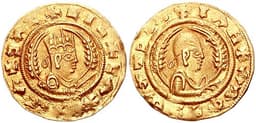
Eon of Aksum
Emperor · Ancient
39.1Total

Napoleon Bonaparte
General · Modern
70.9Total
Basic Information
Born
390
1769
Died
410
1821
Era
Ancient
Modern
Nationality
Ethiopia
France
Occupation
Emperor
General
Civilization
Other
Western
Score Comparison
Military (10%)
25.9
94.0
Political (20%)
29.3
72.0
Influence (20%)
45.5
40.0
Legacy (20%)
35.0
80.0
Leadership (15%)
55.3
78.0
Strategy (15%)
36.8
90.0
TOTAL
39.1
70.9
Eon of Aksum — Complete Timeline
395 AD
Issued gold coins with royal portraitCultural
Eon of Aksum minted gold coins featuring his crowned portrait, continuing the tradition of royal coinage. These coins were used in long-distance trade and demonstrated Aksumite sovereignty.
CoinageRoyal PortraitureTrade
Impact: regional
400 AD
Maintained diplomatic relations with ByzantiumPolitical Action
Eon likely maintained contact with the Byzantine Empire, as suggested by the style of his coinage. This relationship helped secure Aksum's position in the Red Sea trade network.
DiplomacyByzantine EmpireTrade
Impact: regional
Napoleon Bonaparte — Complete Timeline
1799 AD
Coup of 18 BrumaireOther◆ Major
Napoleon Bonaparte, with support from his brother Lucien and key political figures, overthrew the Directory in a bloodless coup. He established the Consulate with himself as First Consul, effectively becoming the ruler of France. This event ended the French Revolution's most unstable period.
French RevolutionCoupRise to Power
Impact: regional
1804 AD
Promulgation of the Napoleonic CodeOther◆ Major
Napoleon enacted the Civil Code of the French, known as the Napoleonic Code, a comprehensive set of laws that replaced the fragmented feudal legal systems. The code established legal equality, protected property rights, and secularized law. It became the basis for legal systems in many European and world countries.
Legal ReformNapoleonic CodeCivil Law
Impact: globalconstructive
1805 AD
Battle of AusterlitzWar◆ Major
Napoleon's Grande Arm
Napoleonic WarsBattleDecisive Victory
Impact: global
1812 AD
Invasion of RussiaWar◆ Major
Napoleon led the Grande Arm
Napoleonic WarsInvasionDisaster
Impact: globaldestructive
1815 AD
Battle of WaterlooWar◆ Major
Napoleon's French army was defeated by the combined forces of the Duke of Wellington's Anglo-Allied army and Gebhard Leberecht von Bl
Napoleonic WarsBattleFinal Defeat
Impact: globaldestructive
Expert Analysis
eon-of-aksum-vs-napoleon-bonaparte
# The Emperor and the King of Gold
In the year 395, as the Roman Empire trembled under barbarian pressure and the first whispers of the Migration Age began, two rulers sat on thrones separated by more than mere geography. On one side of the Mediterranean, a French general named Napoleon would one day thunder across Europe with armies that changed the world. On the other, in the highlands of Ethiopia, a king named Eon stamped his image onto gold coins, leaving behind little more than metal and mystery. How can two figures—both called emperor, both wielding power—stand so far apart in history's judgment?
Origins
Napoleon Bonaparte was born in 1769 on the island of Corsica, a place that had only recently become French. His family was minor nobility, but his world was one of revolution and radical change. The French Revolution of 1789 shattered the old order, and Napoleon, educated in military academies, emerged as a child of chaos. He was ambitious, brilliant, and hungry—a man forged in the fire of an era that demanded new leaders.
Eon of Aksum, by contrast, ruled in the ancient kingdom of Aksum, located in what is now Ethiopia, from roughly 390 to 410. His world was stable, ancient, and deeply rooted in traditions stretching back centuries. Aksum was a major trading empire, connecting Africa, Arabia, and the Roman world. But Eon appears to have been a caretaker king, not a revolutionary. His origins are obscure; we know him only through the coins he minted, which show a crowned portrait in the Roman style. He inherited a throne, not a revolution.
Rise to Power
Napoleon’s rise was meteoric. By 1795, at just 26, he had crushed a royalist uprising in Paris. By 1796, he led the Italian campaign, defeating Austrian armies with stunning speed. His political genius matched his military skill: in 1799, he staged a coup and became First Consul, then Emperor in 1804. Each step was a gamble, each victory a stepping stone. He did not wait for opportunity—he seized it.
Eon’s rise, as far as we can tell, was hereditary. Aksumite kingship passed through bloodlines, and Eon likely assumed the throne after his father or a relative. There is no record of a dramatic ascent, no battlefield triumph that launched him into power. He simply became king, and his reign was marked not by conquest but by continuity. The key event of his rule—the issuance of gold coins in 395—was a traditional act, not a revolutionary one.
Leadership & Governance
Napoleon governed with the energy of a storm. He reformed French law with the Napoleonic Code, which standardized legal systems across Europe. He centralized administration, built schools, and negotiated the Concordat with the Pope. His military genius—scored at 94.0—was legendary: he won battles at Austerlitz, Jena, and Friedland, and his strategy reshaped warfare. But his political score of 75.0 reflects the costs: he imposed his will, suppressed dissent, and eventually overreached.
Eon governed quietly. His political score of 39.0 suggests limited ambition or limited evidence. He maintained diplomatic relations with Byzantium, as the style of his coinage indicates, and his reign likely saw peace and trade. But there is no record of legal reform, military expansion, or grand construction. His leadership score of 37.6 reflects a ruler who managed, not transformed.
Triumph & Tragedy
Napoleon’s greatest triumph was Austerlitz in 1805, where he crushed the Russian and Austrian armies, cementing his dominion over Europe. His tragedy came in 1812, when he invaded Russia, losing hundreds of thousands of men to winter and attrition. His final defeat at Waterloo in 1815 ended his empire, and he died in exile on Saint Helena in 1821, a prisoner of his own ambition.
Eon’s triumphs are modest: his gold coins, which bear his portrait, survived the centuries, providing the main evidence for his reign. His tragedy is one of obscurity. He left no great battles, no lasting reforms, no epic story. He ruled, he minted coins, and then he vanished from history, remembered only by numismatists and scholars.
Character & Destiny
Napoleon’s character was one of relentless drive. He once said, “Impossible is a word to be found only in the dictionary of fools.” His destiny was shaped by his own will—he believed he could bend history to his desires. And for a time, he did. But his hubris, his inability to stop, led to his downfall. His personality was both his greatest asset and his fatal flaw.
Eon’s character is unknowable. We have no speeches, no letters, no accounts of his personality. He appears as a silhouette, a figure defined by absence. His destiny was to be a link in a chain, not a shatterer of worlds. He ruled in an era when kings were expected to maintain, not revolutionize.
Legacy
Napoleon’s legacy is immense. The Napoleonic Code still influences legal systems worldwide. His military tactics are studied in academies. His name is synonymous with ambition, genius, and tragedy. His scores—Influence 82.0, Legacy 78.0—reflect a figure who reshaped the modern world.
Eon’s legacy is fragile. His coins are prized by collectors, but his name is unknown to most. His scores—Influence 60.7, Legacy 46.3—show a ruler who contributed to a tradition but did not transcend it. He is a footnote, a small piece in the mosaic of African history.
Conclusion
Napoleon and Eon stand as opposites: the titan who shook the world and the king who merely minted gold. Their differences are not just of scale but of kind. Napoleon emerged from revolution, driven by hunger and genius, while Eon inherited a stable kingdom and maintained it. One reshaped history; the other was shaped by it. And yet, both were emperors. Both ruled. Both left traces. Perhaps the lesson is this: history remembers not just what we do, but how loudly we do it. Napoleon’s roar echoes across centuries; Eon’s whisper survives only in the gleam of ancient coins.
Rankings
🥇
Napoleon BonaparteLeader
Mil: 94.0Pol: 72.0Inf: 40.0
70.9
🥈
Eon of Aksum
Mil: 25.9Pol: 29.3Inf: 45.5
39.1
+31.8 behind
How This Comparison Works
Algorithm
Each figure is scored on 6 dimensions (0—100 scale) based on structured historical data: Military (10%), Political (20%), Influence (20%), Legacy (20%), Leadership (15%), Strategy (15%). The weighted total produces the final ranking.
Data Sources
Scores are computed from structured sub-indicators in the database. Scale factors adjust for era (Ancient ×0.85, Modern ×1.0) and civilization size (Eastern ×1.05, Other ×0.80) to account for differences in population and military scale.
Maximum 3 Figures
Comparisons are limited to 2—3 figures to ensure readability and statistical meaningfulness.
Error Margins
±5 points per dimension — Sub-scores are derived from historical records with inherent uncertainty. Two figures within 5 points on a dimension should be considered roughly equivalent in that area.
Total Score Accuracy
±3 points overall — The weighted combination of 6 dimensions produces a total score with approximately ±3 points of uncertainty. Differences of less than 3 points are not statistically significant— the figures are effectively tied.
Known Limitations
- Historical records are incomplete and uneven across civilizations
- Figures from oral-tradition societies may be underrepresented
- Occupation labels can misclassify multi-role figures
- Scores measure capability and impact, not moral character
- Quantitative scoring is a comparison tool, not absolute truth
Capability Radar
Military (10%) — Battles & Warfare
Battles
10
95
Win Rate
10
90
Expansion
10
95
Political (20%) — Governance & Reform
Reform
20
95
Diplomacy
20
80
Economy
30
85
Influence (20%) — Cultural & Global Reach
Cultural
20
85
Global
10
90
Legacy (20%) — Historical Impact
Historical
20
95
Longevity
10
90
Leadership (15%) — Power & Stability
Tenure
40
85
Stability
30
70
Strategy (15%) — Tactics & Innovation
Strategy
10
95
Tactics
10
98
Reform
10
92
Similar Comparisons
Comments & Discussion
NapoleonWrecker6/17/2026
Comparing Napoleon to Eon is like comparing a nuclear reactor to a candle. Sure, Eon stamped coins, but Napoleon reshaped the entire concept of modern warfare with his corps system and speed of maneuver. Eon's Aksum was a trading hub, not a world-shaking empire. Napoleon fought 60+ battles across Europe; Eon's biggest legacy is a few gold coins that historians can barely agree on. One built an empire that still echoes in law codes and military doctrine; the other is a footnote. That's not a comp
黄金小丑6/17/2026
拿破仑是硬通货,阿克苏姆的伊恩只是贵金属的虚影。伊恩的硬币上刻着他戴着王冠的形象,但历史上他连哪年死的都没人记得。拿破仑却凭民法典和军事改革锻造了现代欧洲,他打过的战役数量可能超过伊恩统治的整年数。把俩人放一起,就像拿卢浮宫和撒哈拉里的沙粒比。历史法官判得清楚:拿破仑是传奇,伊恩只是博物馆的标签。
AksumApologist6/17/2026
Don't be so quick to dismiss the old king. Eon ruled at a time when Aksum was a global power—its coins have been found in India and Rome, proving its reach. Napoleon's Europe was a tempest in a teacup; his fame is borrowed from guns and guillotines. Eon's gold coins minted in 395 show a king who could control the Red Sea trade routes, a strategic advantage Napoleon never dreamed of. History's judgment is biased toward the loud and violent, but Eon's quiet reign built wealth, not just war.
经典迷思6/17/2026
你们这些拿破仑崇拜者总拿军功当尺子,但历史不是战场胜负的计数游戏。伊恩的阿克苏姆王国在公元400年左右是非洲之角的霸主,控制着红海和尼罗河之间的商路,它发行的金银币是古代全球化的证据。拿破仑的荣誉靠的是枪炮和征兵制,而伊恩的繁荣靠的是可持续的经济体系。别用欧洲中心论的杆子丈量全世界。真正的帝国,像阿克苏姆,是财富的流水线,不是战争的爆竹。