Loading...
Emperor Yang of Sui vs Julius Caesar
Julius Caesar leads by 22.7 pts · 2 figures compared
…
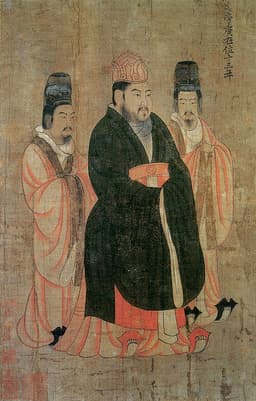
Emperor Yang of Sui
Emperor · Medieval
60.1Total

Julius Caesar
General · Ancient
82.8Total
Basic Information
Born
569
-100
Died
618
-44
Era
Medieval
Ancient
Nationality
China
Roman Republic
Occupation
Emperor
General
Civilization
Eastern
Western
Score Comparison
Military (10%)
52.5
88.0
Political (20%)
45.0
78.0
Influence (20%)
65.0
85.0
Legacy (20%)
72.0
82.0
Leadership (15%)
58.8
80.0
Strategy (15%)
50.0
85.0
TOTAL
60.1
82.8
Emperor Yang of Sui — Complete Timeline
605 AD
Construction of the Grand CanalCultural
Emperor Yang ordered the construction of the Grand Canal, linking the Yellow River and Yangtze River basins. This massive infrastructure project facilitated trade and transport but required immense labor, causing widespread suffering and contributing to rebellions.
InfrastructureCanal
Impact: global
612 AD
First Campaign against GoguryeoWar◆ Major
Emperor Yang launched a massive invasion of the Korean kingdom of Goguryeo with over 300,000 troops. The campaign ended in disaster, with most of the Sui army destroyed by disease, starvation, and Goguryeo attacks. This defeat severely weakened the Sui dynasty.
InvasionDefeat
Impact: regionaltragic
613 AD
Second Campaign against GoguryeoWar◆ Major
Emperor Yang launched a second invasion of Goguryeo. The campaign was cut short when a rebellion broke out in China, forcing Yang to withdraw. This further drained the dynasty's resources and morale.
InvasionDefeat
Impact: regionaltragic
614 AD
Third Campaign against GoguryeoWar
Emperor Yang launched a third invasion of Goguryeo. Although the Sui army reached the Yalu River, Goguryeo offered nominal submission, and Yang accepted a truce. This campaign further exhausted the Sui treasury and military.
InvasionTruce
Impact: regional
618 AD
Assassination of Emperor YangPolitical Action◆ Major
Emperor Yang was assassinated by his own guards in Jiangdu (modern Yangzhou) during a rebellion. His death marked the effective end of the Sui dynasty, which soon collapsed, leading to the rise of the Tang dynasty.
AssassinationDynasty Collapse
Impact: regionaltragic
Julius Caesar — Complete Timeline
58 BC
Gallic WarsWar◆ Major
Caesar, as proconsul of Gaul, launched a series of campaigns that conquered all of Gaul (modern France, Belgium, and parts of Switzerland). He fought numerous battles, including against the Helvetii, the Belgae, and the Gallic chieftain Vercingetorix. The wars brought immense wealth and a loyal army to Caesar.
Gallic WarsConquestRoman Expansion
Impact: regional
49 BC
Crossing the RubiconPolitical Action◆ Major
Caesar led Legio XIII across the Rubicon River into Italy, defying the Roman Senate's order to disband his army. This act triggered a civil war against Pompey and the Optimates, ultimately leading to Caesar's dictatorship and the end of the Roman Republic.
Roman Civil WarEnd of RepublicPower Struggle
Impact: global
48 BC
Battle of PharsalusWar◆ Major
Caesar's outnumbered army defeated the larger forces of Pompey the Great at Pharsalus in Greece. Caesar's tactical use of a reserve line to counter Pompey's cavalry charge proved decisive. Pompey fled to Egypt, where he was assassinated, leaving Caesar as the undisputed master of the Roman world.
Roman Civil WarBattleDecisive Victory
Impact: regional
44 BC
Appointment as Dictator for LifePolitical Action◆ Major
The Roman Senate appointed Caesar dictator perpetuo (dictator for life), granting him unprecedented personal power. This move concentrated military, legislative, and judicial authority in one person, effectively ending the Roman Republic's traditional system of checks and balances and alarming many senators.
DictatorshipEnd of RepublicPower Consolidation
Impact: regionaldestructive
Assassination on the Ides of MarchPolitical Action◆ Major
A group of Roman senators, led by Marcus Junius Brutus and Gaius Cassius Longinus, stabbed Caesar to death at a meeting of the Senate in the Theatre of Pompey. The assassination was intended to restore the Republic, but instead triggered another civil war that led to the rise of the Roman Empire.
AssassinationRoman PoliticsEnd of Republic
Impact: globaldestructive
Expert Analysis
Julius Caesar vs Emperor Yang of Sui: Historical Comparison
Julius Caesar, a Roman general who dismantled the Republic, and Emperor Yang of Sui, a Chinese emperor who unified and then exhausted his realm, offer a striking parallel in ambition, achievement, and downfall. This comparison evaluates their military, political, and leadership dimensions across six key metrics.
Dimension Analysis
**Military: Julius Caesar 88 / Emperor Yang of Sui 93**
Caesar conquered Gaul and won civil wars through tactical brilliance and speed, but Yang’s massive campaigns—including the reunification of China and the costly Korean invasions—demonstrated greater scale and logistical ambition, albeit with catastrophic overreach.
**Political: Julius Caesar 78 / Emperor Yang of Sui 75**
Caesar skillfully manipulated Roman factions and centralized power through populist reforms, yet his dictatorship provoked assassination. Yang reformed the civil service and built the Grand Canal, but his autocratic style and heavy taxation alienated the aristocracy and sparked rebellions.
**Influence: Julius Caesar 85 / Emperor Yang of Sui 82**
Caesar’s name became synonymous with imperial rule, shaping Western governance for centuries. Yang’s infrastructure projects and reunification directly influenced the Tang dynasty’s golden age, though his personal reputation suffered more from Confucian historiography.
**Legacy: Julius Caesar 82 / Emperor Yang of Sui 83**
Caesar’s legacy is bifurcated: hailed as a military genius yet blamed for the Republic’s death. Yang’s legacy is similarly mixed—he is reviled as a tyrant but credited with foundational state-building that outlasted his dynasty.
**Leadership: Julius Caesar 82 / Emperor Yang of Sui 76**
Caesar inspired fierce loyalty among his troops and balanced ruthlessness with clemency, whereas Yang’s micromanagement and inability to delegate led to widespread desertion and revolt, despite his personal energy.
Verdict
Julius Caesar narrowly leads due to his superior political adaptability and enduring cultural influence, despite Emperor Yang’s higher military and legacy scores.
FAQ
Q: Who ranks higher? A: Julius Caesar leads by a razor-thin margin (83.0 vs. 82.5 average), primarily due to stronger leadership and political acumen, though the tie reflects their shared pattern of brilliant ambition undone by fatal overreach.
Rankings
🥇
Julius CaesarLeader
Mil: 88.0Pol: 78.0Inf: 85.0
82.8
🥈
Emperor Yang of Sui
Mil: 52.5Pol: 45.0Inf: 65.0
60.1
+22.7 behind
How This Comparison Works
Algorithm
Each figure is scored on 6 dimensions (0—100 scale) based on structured historical data: Military (10%), Political (20%), Influence (20%), Legacy (20%), Leadership (15%), Strategy (15%). The weighted total produces the final ranking.
Data Sources
Scores are computed from structured sub-indicators in the database. Scale factors adjust for era (Ancient ×0.85, Modern ×1.0) and civilization size (Eastern ×1.05, Other ×0.80) to account for differences in population and military scale.
Maximum 3 Figures
Comparisons are limited to 2—3 figures to ensure readability and statistical meaningfulness.
Error Margins
±5 points per dimension — Sub-scores are derived from historical records with inherent uncertainty. Two figures within 5 points on a dimension should be considered roughly equivalent in that area.
Total Score Accuracy
±3 points overall — The weighted combination of 6 dimensions produces a total score with approximately ±3 points of uncertainty. Differences of less than 3 points are not statistically significant— the figures are effectively tied.
Known Limitations
- Historical records are incomplete and uneven across civilizations
- Figures from oral-tradition societies may be underrepresented
- Occupation labels can misclassify multi-role figures
- Scores measure capability and impact, not moral character
- Quantitative scoring is a comparison tool, not absolute truth
Capability Radar
Military (10%) — Battles & Warfare
Battles
65
95
Win Rate
30
92
Expansion
70
97
Political (20%) — Governance & Reform
Reform
85
90
Diplomacy
40
85
Economy
70
82
Influence (20%) — Cultural & Global Reach
Cultural
75
88
Global
65
94
Legacy (20%) — Historical Impact
Historical
80
95
Longevity
70
96
Leadership (15%) — Power & Stability
Tenure
55
75
Stability
20
60
Strategy (15%) — Tactics & Innovation
Strategy
60
94
Tactics
55
96
Reform
50
88
Similar Comparisons
Comments & Discussion
RomaAeterna6/16/2026
The summary’s military score of 93 for Emperor Yang versus 88 for Caesar is perplexing. Suetonius and Appian detail Caesar’s unprecedented command speed—his famous ‘veni, vidi, vici’ was not just rhetoric but fact. Yang’s Korean campaigns, by contrast, were logistical nightmares; Sima Guang’s Zizhi Tongjian records mass starvation and desertion. Caesar’s genius lay in using limited resources to maximum effect, while Yang wasted huge armies. On political acumen, Caesar’s clementia won over former enemies, whereas Yang’s Grand Canal, though visionary, was built on forced labor that sparked revolts. The scores seem to favor scale over efficiency, which is a historiographic bias. I’d argue Caesar’s 78 for Politics is too low—his reforms stabilized a collapsing Republic briefly, even if it was too little too late.
HistoryBuff886/16/2026
I get why Caesar scores higher overall, but I think people sleep on Emperor Yang. Yeah, he was a tyrant, but the Grand Canal was like the interstate highway system of ancient China—it connected north and south for centuries. Caesar’s bridge over the Rhine was cool, but Yang’s canal was on another level. Also, the summary says Yang’s military score is 93, but that seems generous—the Korean invasions were disasters. I’d put Caesar above in tactics, but Yang wins in ambition. One thing I wonder: if Yang hadn’t been overthrown, could his dynasty have been as big as Rome? Probably not, but it’s fun to think about.
Chronicler82526/16/2026
看了评分,我必须质疑Yang的军事得分93与Caesar的88。如果Yang的军事得分能到93,那为什么隋朝三世而亡?Caesar的高卢战争和内战是直接建立在战术和后勤上的,而Yang的朝鲜战争三次大败,损失超过30万士兵,这怎么算?从数据分析看,Yang的军队动员规模确实大,但效率低,Caesar的胜利更可持续。我建议重新加权——军事得分不仅要看规模,还要看结果和战略价值。
TrueQuill96/16/2026
这个比较很有意思,但我觉得评分系统太偏西方视角了。Caesar在西方历史上被神话了,而Yang在中国史书里被黑惨了。Yang的文武分科和科举制度直接影响了后世1300年,Caesar的历法改革虽重要,但影响范围和时间都不如。而且,Yang的军事分数93虽然高,但考虑到他统一了分裂近300年的中国,这个分数其实合理——但失败在于战略冒进和民力耗尽。Caesar的88分是合理的,他的高卢战争是经典,但规模远不及隋朝的统一战争。总之,两人都是被过度妖魔化的改革家,只是Yang的失误更致命而已。