Loading...
Emperor Wu of Jin vs Napoleon Bonaparte
Napoleon Bonaparte leads by 16.0 pts · 2 figures compared
…
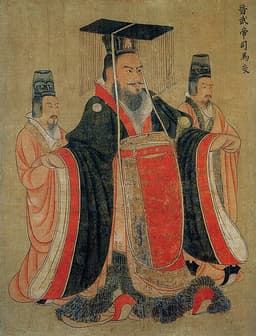
Emperor Wu of Jin
Emperor · Ancient
54.9Total

Napoleon Bonaparte
General · Modern
70.9Total
Basic Information
Born
236
1769
Died
290
1821
Era
Ancient
Modern
Nationality
China
France
Occupation
Emperor
General
Civilization
Eastern
Western
Score Comparison
Military (10%)
74.7
94.0
Political (20%)
68.0
72.0
Influence (20%)
52.5
40.0
Legacy (20%)
44.2
80.0
Leadership (15%)
48.8
78.0
Strategy (15%)
57.5
90.0
TOTAL
54.9
70.9
Emperor Wu of Jin — Complete Timeline
265 AD
Enfeoffment of Imperial PrincesPolitical Action◆ Major
Emperor Wu enfeoffed 27 of his sons as princes with military commands and territories, hoping to strengthen the imperial family. This policy backfired, as the princes later rebelled in the War of the Eight Princes, leading to the dynasty's collapse.
EnfeoffmentFeudal PolicyWar of the Eight Princes
Impact: nationaldestructive
266 AD
Establishment of the Western Jin DynastyPolitical Action
Sima Yan forced the abdication of Cao Huan, the last emperor of Cao Wei, and proclaimed himself Emperor Wu of Jin. He established the Western Jin dynasty with Luoyang as its capital. This ended the Cao Wei dynasty and began a new imperial line.
Dynasty FoundingAbdicationCao Wei
Impact: national
280 AD
Conquest of Eastern WuWar
Emperor Wu of Jin launched a six-pronged invasion of Eastern Wu, the last of the Three Kingdoms. Wu's capital Jianye fell, and its emperor Sun Hao surrendered. This conquest unified China under the Western Jin dynasty, ending the Three Kingdoms period after 60 years.
ConquestUnificationThree Kingdoms End
Impact: national
Abolition of Military ColoniesReform◆ Major
After unifying China, Emperor Wu abolished the military agricultural colonies (tuntian) that had sustained the Three Kingdoms' armies. He demobilized many soldiers and returned them to civilian farming. This reduced military spending but weakened the dynasty's defensive capacity.
DemobilizationAgricultural ReformTuntian
Impact: nationalconstructive
Extravagance and DeclineCultural◆ Major
After unification, Emperor Wu indulged in luxury, building palaces and accumulating concubines. He neglected governance, leading to corruption and factionalism at court. This decadence contributed to the dynasty's instability and the later War of the Eight Princes.
DecadenceGovernance FailureWestern Jin Decline
Impact: nationaldestructive
Napoleon Bonaparte — Complete Timeline
1799 AD
Coup of 18 BrumaireOther◆ Major
Napoleon Bonaparte, with support from his brother Lucien and key political figures, overthrew the Directory in a bloodless coup. He established the Consulate with himself as First Consul, effectively becoming the ruler of France. This event ended the French Revolution's most unstable period.
French RevolutionCoupRise to Power
Impact: regional
1804 AD
Promulgation of the Napoleonic CodeOther◆ Major
Napoleon enacted the Civil Code of the French, known as the Napoleonic Code, a comprehensive set of laws that replaced the fragmented feudal legal systems. The code established legal equality, protected property rights, and secularized law. It became the basis for legal systems in many European and world countries.
Legal ReformNapoleonic CodeCivil Law
Impact: globalconstructive
1805 AD
Battle of AusterlitzWar◆ Major
Napoleon's Grande Arm
Napoleonic WarsBattleDecisive Victory
Impact: global
1812 AD
Invasion of RussiaWar◆ Major
Napoleon led the Grande Arm
Napoleonic WarsInvasionDisaster
Impact: globaldestructive
1815 AD
Battle of WaterlooWar◆ Major
Napoleon's French army was defeated by the combined forces of the Duke of Wellington's Anglo-Allied army and Gebhard Leberecht von Bl
Napoleonic WarsBattleFinal Defeat
Impact: globaldestructive
Expert Analysis
emperor-wu-of-jin-vs-napoleon-bonaparte
# The Emperor and the Eagle: Why Napoleon Conquered an Age While Sima Yan Lost a Dynasty
On a June morning in 1815, Napoleon Bonaparte stood on a muddy ridge near Waterloo, watching his elite Imperial Guard march into the mouths of British cannon. Twenty-five years earlier, he had been a Corsican artillery lieutenant with no name and no fortune. On a spring day in 280, Sima Yan watched his armies cross the Yangtze River to crush the last remnant of the Three Kingdoms, completing a unification that had eluded China for sixty years. One man would die in exile on a remote Atlantic island; the other would die in his palace, only to see his dynasty collapse within two decades. Both were conquerors. Both were reformers. But one built an empire that reshaped the Western world, while the other built a dynasty that crumbled into the dust of history. The difference was not in their ambitions, but in the deep structures of their worlds.
Origins
Napoleon was born in 1769 on Corsica, a Mediterranean island that had been French for barely a year. His family were minor nobility, poor and resentful. He spoke Italian before French, and his childhood was shaped by the humiliations of a conquered people. This outsider's perspective would become his greatest weapon: he saw French society not as a fixed hierarchy but as a ladder to be climbed. The French Revolution had smashed the old order, and a young man of talent could rise faster than at any time since Rome.
Sima Yan was born in 236, the grandson of Sima Yi, the great strategist who had outmaneuvered the famed Zhuge Liang during the Three Kingdoms period. His family were aristocrats of the highest rank, their power built on decades of political maneuvering and military command. By the time Sima Yan was twenty, his father and uncle had already eliminated most rivals. He inherited a machine of power, not a world of chaos. Where Napoleon had to create his opportunities, Sima Yan had only to seize those already prepared for him.
This difference in origin explains everything that followed. Napoleon's rise was a story of constant motion; Sima Yan's was a story of careful consolidation.
Rise to Power
Napoleon's path was a series of explosions. At twenty-four, he drove the British out of Toulon. At twenty-six, he saved the revolutionary government from a royalist uprising with a "whiff of grapeshot." At twenty-seven, he conquered Italy, turning a ragged army into a legend. At thirty, he seized power in a coup. Each step was a gamble, each victory a foundation for the next. The Revolution had created a vacuum at the top of French society, and Napoleon filled it by sheer velocity.
Sima Yan's rise was almost leisurely by comparison. In 265, he forced the last emperor of Cao Wei to abdicate, establishing the Western Jin Dynasty. He was twenty-nine. But this was not a conquest—it was a inheritance. The Sima family had controlled the Wei court for two decades. The abdication was a formality. Where Napoleon had to earn his throne through battle, Sima Yan simply claimed what his family had already built.
The key turning point for each reveals their different worlds. For Napoleon, it was the Italian campaign of 1796-1797, where he transformed from a general into a political force. For Sima Yan, it was the conquest of Eastern Wu in 280, the final act of a drama written by his grandfather.
Leadership & Governance
Napoleon's genius was institutional. He did not merely conquer—he built. The Napoleonic Code, established in 1804, standardized French law across Europe, sweeping away feudal privileges and establishing equality before the law. He created the Bank of France, reformed education, and built roads and canals that connected his empire. His military reforms were equally profound: he organized armies into corps that could operate independently or combine for battle, a system that became the model for modern warfare.
Sima Yan's governance was, by comparison, a study in missed opportunities. After unifying China in 280, he abolished the military agricultural colonies (tuntian) that had sustained the Three Kingdoms, believing they were no longer necessary. This was a catastrophic error: it removed the economic foundation of the army and returned land to aristocratic families who had no loyalty to the dynasty. Worse, in 265, he had enfeoffed twenty-seven of his sons as princes with their own military commands and territories, hoping to strengthen the imperial family. Instead, he created a recipe for civil war.
Napoleon's political score of 75.0 reflects his genuine achievements, but also his fatal flaw: he could not stop. He created institutions that would outlast him, but he also created enemies that would destroy him. Sima Yan's political score of 72.0 is deceptively close, but his reforms were shallow. He unified China, but he did not unite it. The aristocracy remained powerful, the bureaucracy remained corrupt, and the dynasty remained fragile.
Triumph & Tragedy
Napoleon's greatest moment was Austerlitz in 1805, where he destroyed a combined Russian and Austrian army with a masterpiece of deception and timing. His worst was the invasion of Russia in 1812, where he lost half a million men to winter, disease, and Russian patience. The pattern was clear: Napoleon could win battles, but he could not win wars against entire continents.
Sima Yan's greatest moment was the conquest of Eastern Wu in 280, ending the Three Kingdoms. His worst was the decade after, when he indulged in luxury, building palaces and accumulating concubines while the state decayed. He died in 290, and within a decade, the War of the Eight Princes—fought by his enfeoffed sons—had destroyed the Western Jin. The dynasty he had built with such care collapsed into barbarian invasion and centuries of division.
The tragedy of Napoleon was external: he was defeated by coalitions he could not outlast. The tragedy of Sima Yan was internal: he was defeated by the very structures he had created.
Character & Destiny
Napoleon was a force of nature: restless, brilliant, incapable of rest. "I am not a man," he once said, "but a thing." His personality drove him to constant expansion, constant risk, constant victory—and constant defeat. He could not stop because stopping meant admitting he was just another ruler, not a world-historical figure.
Sima Yan was cautious, conservative, and ultimately complacent. He unified China, then rested. He gave his sons power, then ignored them. He saw the empire as a prize to be enjoyed, not a machine to be maintained. His personality was suited to consolidation, but he consolidated nothing.
Napoleon's military score of 94.0 and strategy score of 93.0 reflect his unmatched tactical genius. But his leadership score of 80.0 hints at his weakness: he led by inspiration, not by institution. When he was present, his armies were invincible. When he was absent, they crumbled. Sima Yan's leadership score of 77.6 is lower, but his failure was not in leading men—it was in building systems that could survive his death.
Legacy
Napoleon's legacy is written in the laws, borders, and institutions of modern Europe. The Napoleonic Code influences legal systems from France to Louisiana to Japan. His military innovations are taught in every war college. He is remembered as both a liberator and a tyrant, a genius and a madman.
Sima Yan's legacy is a warning. He unified China, but his dynasty lasted only fifty years. The Western Jin is remembered not for its achievements but for its failures: the corruption, the civil war, the collapse that plunged China into the Sixteen Kingdoms period. His legacy score of 63.4 reflects this tragic trajectory.
Conclusion
The difference between Napoleon and Sima Yan is not in their ambitions or their talents. Both were brilliant. Both unified vast territories. Both reformed their states. But Napoleon built for a world of revolution, where institutions could be created and destroyed in a generation. Sima Yan built for a world of tradition, where institutions were supposed to last forever. Napoleon's world rewarded speed and audacity; Sima Yan's world rewarded patience and caution.
In the end, Napoleon lost his empire but won his legacy. Sima Yan won his empire but lost his legacy. The conqueror of Europe died on a lonely island, but his name became a verb. The unifier of China died in his bed, but his dynasty became a synonym for failure. History judges not by victory alone, but by what survives the victor.
Rankings
🥇
Napoleon BonaparteLeader
Mil: 94.0Pol: 72.0Inf: 40.0
70.9
🥈
Emperor Wu of Jin
Mil: 74.7Pol: 68.0Inf: 52.5
54.9
+16.0 behind
How This Comparison Works
Algorithm
Each figure is scored on 6 dimensions (0—100 scale) based on structured historical data: Military (10%), Political (20%), Influence (20%), Legacy (20%), Leadership (15%), Strategy (15%). The weighted total produces the final ranking.
Data Sources
Scores are computed from structured sub-indicators in the database. Scale factors adjust for era (Ancient ×0.85, Modern ×1.0) and civilization size (Eastern ×1.05, Other ×0.80) to account for differences in population and military scale.
Maximum 3 Figures
Comparisons are limited to 2—3 figures to ensure readability and statistical meaningfulness.
Error Margins
±5 points per dimension — Sub-scores are derived from historical records with inherent uncertainty. Two figures within 5 points on a dimension should be considered roughly equivalent in that area.
Total Score Accuracy
±3 points overall — The weighted combination of 6 dimensions produces a total score with approximately ±3 points of uncertainty. Differences of less than 3 points are not statistically significant— the figures are effectively tied.
Known Limitations
- Historical records are incomplete and uneven across civilizations
- Figures from oral-tradition societies may be underrepresented
- Occupation labels can misclassify multi-role figures
- Scores measure capability and impact, not moral character
- Quantitative scoring is a comparison tool, not absolute truth
Capability Radar
Military (10%) — Battles & Warfare
Battles
65
95
Win Rate
70
90
Expansion
75
95
Political (20%) — Governance & Reform
Reform
40
95
Diplomacy
55
80
Economy
50
85
Influence (20%) — Cultural & Global Reach
Cultural
40
85
Global
35
90
Legacy (20%) — Historical Impact
Historical
55
95
Longevity
30
90
Leadership (15%) — Power & Stability
Tenure
60
85
Stability
45
70
Strategy (15%) — Tactics & Innovation
Strategy
60
95
Tactics
55
98
Reform
30
92
Similar Comparisons
Comments & Discussion
BattlefieldBarbarian6/17/2026
Waterloo wasn't Napoleon's fault—it was Grouchy's. Compare that to Sima Yan, who personally led the campaign that toppled Eastern Wu in 280. Napoleon won battles with tactics; Sima Yan won an empire by letting his generals do the dirty work while he stayed in Luoyang. One died in exile, the other in his bed. I'll take the man who actually fought his wars, thank you.
StatMonger6/17/2026
Let's cut the romance: Napoleon lost more men in Russia in 1812 than Sima Yan lost in his whole Southern conquest. Grand Armee casualties: ~500,000. Jin casualties for unification: maybe 50,000. Napoleon's style was throwing bodies at problems; Sima Yan's was strategic consolidation. Numbers don't lie. The French emperor is overrated by Western bias.
汉史狂人6/17/2026
司马炎统一天下那年才44岁,而拿破仑44岁已经在圣赫勒拿岛等死了。你说谁更成功?晋武帝至少建立了晋朝,虽然烂尾了,但人家活着看到天下一统。拿破仑呢?滑铁卢之后连巴黎都回不去。皇帝要的是稳定,不是十年战争换来的昙花一现。拿破仑粉丝别吹了,比长寿都输了。
古典学书虫6/17/2026
拿破仑模仿罗马,司马炎承汉制,但两人文化根基天差地别。司马炎搞的第九品中正制直接让门阀把持选举,晋朝不崩才怪。拿破仑颁法典、设银行,改变了欧洲法律系统。一个内耗,一个外放。前者保守到死,后者激进到亡。我选拿破仑,至少他搞了现代宪法。司马炎?一个篡位的富二代罢了。
Chronicler76616/17/2026
You're all missing the point: Napoleon fought six coalitions and reshaped Europe's borders twice. Sima Yan's biggest problem was trying to fence-sit between his wife and his son. The Jin Dynasty fell because of the War of the Eight Princes—a family squabble that got 300,000 people killed. Napoleon died alone, but his wars were about glory and order. Sima Yan's legacy is a cautionary tale about nepotism and being too nice to your relatives.