Loading...
Emperor Wu of Jin vs Julius Caesar
Julius Caesar leads by 27.9 pts · 2 figures compared
…
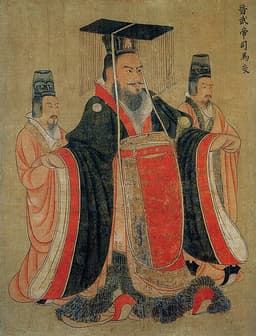
Emperor Wu of Jin
Emperor · Ancient
54.9Total

Julius Caesar
General · Ancient
82.8Total
Basic Information
Born
236
-100
Died
290
-44
Era
Ancient
Ancient
Nationality
China
Roman Republic
Occupation
Emperor
General
Civilization
Eastern
Western
Score Comparison
Military (10%)
74.7
88.0
Political (20%)
68.0
78.0
Influence (20%)
52.5
85.0
Legacy (20%)
44.2
82.0
Leadership (15%)
48.8
80.0
Strategy (15%)
57.5
85.0
TOTAL
54.9
82.8
Emperor Wu of Jin — Complete Timeline
265 AD
Enfeoffment of Imperial PrincesPolitical Action◆ Major
Emperor Wu enfeoffed 27 of his sons as princes with military commands and territories, hoping to strengthen the imperial family. This policy backfired, as the princes later rebelled in the War of the Eight Princes, leading to the dynasty's collapse.
EnfeoffmentFeudal PolicyWar of the Eight Princes
Impact: nationaldestructive
266 AD
Establishment of the Western Jin DynastyPolitical Action
Sima Yan forced the abdication of Cao Huan, the last emperor of Cao Wei, and proclaimed himself Emperor Wu of Jin. He established the Western Jin dynasty with Luoyang as its capital. This ended the Cao Wei dynasty and began a new imperial line.
Dynasty FoundingAbdicationCao Wei
Impact: national
280 AD
Conquest of Eastern WuWar
Emperor Wu of Jin launched a six-pronged invasion of Eastern Wu, the last of the Three Kingdoms. Wu's capital Jianye fell, and its emperor Sun Hao surrendered. This conquest unified China under the Western Jin dynasty, ending the Three Kingdoms period after 60 years.
ConquestUnificationThree Kingdoms End
Impact: national
Abolition of Military ColoniesReform◆ Major
After unifying China, Emperor Wu abolished the military agricultural colonies (tuntian) that had sustained the Three Kingdoms' armies. He demobilized many soldiers and returned them to civilian farming. This reduced military spending but weakened the dynasty's defensive capacity.
DemobilizationAgricultural ReformTuntian
Impact: nationalconstructive
Extravagance and DeclineCultural◆ Major
After unification, Emperor Wu indulged in luxury, building palaces and accumulating concubines. He neglected governance, leading to corruption and factionalism at court. This decadence contributed to the dynasty's instability and the later War of the Eight Princes.
DecadenceGovernance FailureWestern Jin Decline
Impact: nationaldestructive
Julius Caesar — Complete Timeline
58 BC
Gallic WarsWar◆ Major
Caesar, as proconsul of Gaul, launched a series of campaigns that conquered all of Gaul (modern France, Belgium, and parts of Switzerland). He fought numerous battles, including against the Helvetii, the Belgae, and the Gallic chieftain Vercingetorix. The wars brought immense wealth and a loyal army to Caesar.
Gallic WarsConquestRoman Expansion
Impact: regional
49 BC
Crossing the RubiconPolitical Action◆ Major
Caesar led Legio XIII across the Rubicon River into Italy, defying the Roman Senate's order to disband his army. This act triggered a civil war against Pompey and the Optimates, ultimately leading to Caesar's dictatorship and the end of the Roman Republic.
Roman Civil WarEnd of RepublicPower Struggle
Impact: global
48 BC
Battle of PharsalusWar◆ Major
Caesar's outnumbered army defeated the larger forces of Pompey the Great at Pharsalus in Greece. Caesar's tactical use of a reserve line to counter Pompey's cavalry charge proved decisive. Pompey fled to Egypt, where he was assassinated, leaving Caesar as the undisputed master of the Roman world.
Roman Civil WarBattleDecisive Victory
Impact: regional
44 BC
Appointment as Dictator for LifePolitical Action◆ Major
The Roman Senate appointed Caesar dictator perpetuo (dictator for life), granting him unprecedented personal power. This move concentrated military, legislative, and judicial authority in one person, effectively ending the Roman Republic's traditional system of checks and balances and alarming many senators.
DictatorshipEnd of RepublicPower Consolidation
Impact: regionaldestructive
Assassination on the Ides of MarchPolitical Action◆ Major
A group of Roman senators, led by Marcus Junius Brutus and Gaius Cassius Longinus, stabbed Caesar to death at a meeting of the Senate in the Theatre of Pompey. The assassination was intended to restore the Republic, but instead triggered another civil war that led to the rise of the Roman Empire.
AssassinationRoman PoliticsEnd of Republic
Impact: globaldestructive
Expert Analysis
emperor-wu-of-jin-vs-julius-caesar
### The Ides of March and the Fall of a Dynasty
In the year 280 CE, a Chinese emperor stood triumphant. Sima Yan, known to history as Emperor Wu of Jin, had just conquered the last of the Three Kingdoms, ending a century of civil war and reuniting the ancient land. He was the master of all he surveyed. Twenty-four years earlier and half a world away, another general had crossed a small river in Italy, defied his own republic, and set in motion events that would end with his assassination on the floor of the Roman Senate. Both men were conquerors. Both men were reformers. But one left a legacy that shaped the Western world for two millennia; the other left a dynasty that crumbled within a generation. Why? The answer lies not in the stars, but in the very different soils of their ambition.
### Origins
Gaius Julius Caesar was born into the twilight of the Roman Republic, a world of fierce aristocratic competition, senatorial privilege, and a restless army. His family, the Julii, were patrician but not wealthy. From his youth, Caesar was acutely aware that in Rome, power was not inherited—it was seized. He cut his teeth on the political knife-fight of the Forum, learning to charm, bribe, and outmaneuver. His uncle by marriage was Gaius Marius, a populist general who had reformed the army and turned it into a personal instrument of power. Caesar absorbed the lesson: the future belonged to the man who could command legions, not just votes.
Sima Yan, by contrast, was a scion of the Sima clan, the de facto rulers of the Kingdom of Wei. His grandfather, Sima Yi, had been a master strategist who outlived and outmaneuvered his rivals. His father and uncle had served as regents, consolidating power behind a puppet emperor. Sima Yan was born into a system where power was already baked into the family name. He was not a revolutionary; he was an heir. In 266 CE, with the machinery of state already in his hands, he forced the abdication of the last Wei emperor and declared himself the first emperor of the Jin Dynasty. His path was paved not by his own genius, but by the careful, ruthless work of his forebears.
### Rise to Power
Caesar’s ascent was a masterpiece of calculated risk. He climbed the *cursus honorum*—the ladder of Roman offices—with audacity. He borrowed fortunes to throw games that dazzled the public. He secured the governorship of a province where he could win military glory. Then came Gaul. Between 58 and 50 BCE, Caesar conquered an entire region, wrote about it in crisp, third-person Latin, and built an army that was loyal to him, not to the Senate. When ordered to disband, he did the unthinkable: he crossed the Rubicon River into Italy, declaring war on the Republic itself. In a single act, he traded the legitimacy of law for the naked authority of the sword.
Sima Yan’s rise was almost the opposite—a quiet, bureaucratic coup. In 265 CE, he inherited the regency of Wei from his father. The puppet emperor, Cao Huan, was a boy. Sima Yan simply waited. He built no great army from scratch. He fought no legendary campaigns. Instead, he manipulated the court, secured the loyalty of the generals, and then, in a bloodless ceremony, accepted the abdication. He did not conquer the throne; he was handed it. The difference is crucial: Caesar seized power in defiance of the state; Sima Yan inherited it as the culmination of a family’s long, patient subversion.
### Leadership & Governance
As dictator of Rome, Caesar was a whirlwind of reform. He standardized the calendar, giving us the Julian calendar we still use today. He granted citizenship to provincials, diluted the power of the old aristocracy, and initiated massive public works. His governance was personal, direct, and often reckless. He pardoned his enemies, which was generous but also naive. He centralized power in himself, which was efficient but also intolerable to the senatorial class. His military genius was matched only by his political blindness: he understood how to win a war, but not how to secure a peace.
Emperor Wu of Jin, after his conquest of Eastern Wu in 280 CE, faced a different challenge: how to govern a unified China after decades of division. His solution was disastrous. He enfeoffed twenty-seven of his sons as princes, granting them military commands and territories. His intention was to prevent the rise of rival warlords by putting his own family in charge. In practice, he created a powder keg of ambitious princelings. Worse, he abolished the military agricultural colonies (*tuntian*) that had sustained the Wei state, believing that peace made them unnecessary. Then he retired to his palace, accumulating thousands of concubines and neglecting governance. His reign became a byword for extravagance and decline. Where Caesar reformed, Emperor Wu indulged.
### Triumph & Tragedy
Caesar’s greatest triumph was the conquest of Gaul, a feat of logistics, tactics, and sheer will that doubled Rome’s territory and filled its treasury. His greatest tragedy was his assassination on the Ides of March, 44 BCE, stabbed by senators he had pardoned. It was a death that proved his point: the Republic could no longer contain a man of his ambition. He died not as a tyrant, but as a symptom of a system that had broken.
Emperor Wu’s greatest triumph was the conquest of Eastern Wu in 280 CE, a six-pronged invasion that ended the Three Kingdoms era. It was a genuine military achievement, though it relied on overwhelming force rather than strategic brilliance. His greatest tragedy was his own complacency. He lived to see his dynasty’s seeds of destruction planted. Within a decade of his death, the War of the Eight Princes tore the Jin apart, leading to the barbarian invasions and the collapse of northern China. Emperor Wu did not die a violent death, but his legacy was a slow, agonizing unraveling.
### Character & Destiny
Caesar was driven by an insatiable need for glory. He was charismatic, calculating, and supremely confident. He took risks because he believed his luck would hold. It did—until it didn’t. His personality shaped his decisions: he pardoned enemies because he saw himself as magnanimous, but that magnanimity was a blind spot. He crossed the Rubicon because he could not imagine defeat. His destiny was to be both the destroyer and the creator of the Roman world.
Emperor Wu, by contrast, was cautious and complacent. He did not have Caesar’s hunger. He unified China and then stopped. He built no lasting institutions, no legal reforms, no cultural renaissance. His personality—indulgent, short-sighted, and trusting of his family—led him to make decisions that prioritized personal comfort over state stability. His destiny was to be a footnote: the man who ended the Three Kingdoms but failed to build a lasting peace.
### Legacy
Caesar’s legacy is monumental. His name became a title—*Kaiser*, *Tsar*—for emperors for two thousand years. His writings are still studied in military academies. His reforms outlived him. The Roman Empire, which he inadvertently founded, shaped Western law, language, and governance. He is remembered as a genius, a tyrant, and a martyr.
Emperor Wu’s legacy is a cautionary tale. The Western Jin Dynasty he founded collapsed within thirty years of his death, plunging China into the Sixteen Kingdoms period, an era of chaos and division. He is remembered, if at all, as the emperor who had too many concubines and not enough foresight. His scores in history are modest, his name obscure outside of China. He unified a land, but he did not unify a people.
### Conclusion
Caesar and Sima Yan both stood at the pinnacle of their worlds. Both conquered, both reformed, both died. But Caesar’s ambition was a fire that burned through the old order and forged a new one. Sima Yan’s ambition was a candle that illuminated his own reign and then guttered out. The difference is not in their achievements, but in their hunger. Caesar wanted to remake the world. Sima Yan only wanted to hold it. And history, as always, rewards the one who dares to break the mold—even if it breaks him in the process.
Rankings
🥇
Julius CaesarLeader
Mil: 88.0Pol: 78.0Inf: 85.0
82.8
🥈
Emperor Wu of Jin
Mil: 74.7Pol: 68.0Inf: 52.5
54.9
+27.9 behind
How This Comparison Works
Algorithm
Each figure is scored on 6 dimensions (0—100 scale) based on structured historical data: Military (10%), Political (20%), Influence (20%), Legacy (20%), Leadership (15%), Strategy (15%). The weighted total produces the final ranking.
Data Sources
Scores are computed from structured sub-indicators in the database. Scale factors adjust for era (Ancient ×0.85, Modern ×1.0) and civilization size (Eastern ×1.05, Other ×0.80) to account for differences in population and military scale.
Maximum 3 Figures
Comparisons are limited to 2—3 figures to ensure readability and statistical meaningfulness.
Error Margins
±5 points per dimension — Sub-scores are derived from historical records with inherent uncertainty. Two figures within 5 points on a dimension should be considered roughly equivalent in that area.
Total Score Accuracy
±3 points overall — The weighted combination of 6 dimensions produces a total score with approximately ±3 points of uncertainty. Differences of less than 3 points are not statistically significant— the figures are effectively tied.
Known Limitations
- Historical records are incomplete and uneven across civilizations
- Figures from oral-tradition societies may be underrepresented
- Occupation labels can misclassify multi-role figures
- Scores measure capability and impact, not moral character
- Quantitative scoring is a comparison tool, not absolute truth
Capability Radar
Military (10%) — Battles & Warfare
Battles
65
95
Win Rate
70
92
Expansion
75
97
Political (20%) — Governance & Reform
Reform
40
90
Diplomacy
55
85
Economy
50
82
Influence (20%) — Cultural & Global Reach
Cultural
40
88
Global
35
94
Legacy (20%) — Historical Impact
Historical
55
95
Longevity
30
96
Leadership (15%) — Power & Stability
Tenure
60
75
Stability
45
60
Strategy (15%) — Tactics & Innovation
Strategy
60
94
Tactics
55
96
Reform
30
88
Similar Comparisons
Comments & Discussion
Spartan Sima6/17/2026
Sima Yan was a conqueror, sure, but he won on easy mode—the Three Kingdoms were already exhausted by the time he mopped up Wu. Caesar crossed the Rubicon against a still-vibrant Republic with armed rivals like Pompey. One took the throne by inheritance (a Cao-Wei regent’s son), the other by genius-level gambles in Gaul. No contest: Caesar earned his crown with blood and betrayal; Sima Yan just walked through the door his father left open.
典午狂徒6/17/2026
把司马炎和凯撒放一起比?别逗了。凯撒是让元老院跪着称他为神的人,司马炎呢?统一后忙着分封傻儿子、养着八王之乱的火药桶。凯撒至少活到了被刺,司马炎死后十年西晋就烂透了。论原创性,凯撒是玩法重塑者,司马炎只是曹魏体制的继承者。高下立判,别拿复制品和原版比。
Rubicon vs Yangtze6/17/2026
Let's talk logistics—Caesar’s most famous victory, Alesia, involved a 40-mile siege wall against a Gallic relief army nearly 250,000 strong. Sima Yan’s conquest of Wu required a six-pronged river crossing and some bribes—a naval operation, sure, but not a tactical miracle. Caesar built his empire on campaign ingenuity; Sima Yan mostly let his generals do the work. The Jin Dynasty’s collapse within a generation proves who had a lasting military doctrine.
晋武议郎6/17/2026
数据上司马炎更“成功”:他控制人口超1600万,统一后疆域约400万平方公里,凯撒死前罗马疆域还没这么大呢。但凯撒留的是制度遗产——他推动了独裁官、历法改革、公民权扩展,这些活了两千年。司马炎留了啥?占田制?九品中正制?不到百年就被五胡踩碎了。短命不等于失败,但凯撒重塑了地中海,司马炎只重组了中原。
Praetorian Peasant6/17/2026
Final jab: Caesar’s murderers had principles—Brutus called it tyranny, they killed for the Republic. Sima Yan’s successors were murdered by family members in palace coups over a harem policy (remember Jia Nanfeng?). That’s the difference: one death sparked civil war for ideology; the other sparked civil wars because incompetence and inbreeding. Caesar’s fall saved Rome for Augustus; Sima Yan’s fall just saved the history books for tragedy.