Loading...
Emperor Taizong of Tang vs Ruhollah Khomeini
Emperor Taizong of Tang leads by 3.8 pts · 2 figures compared
…
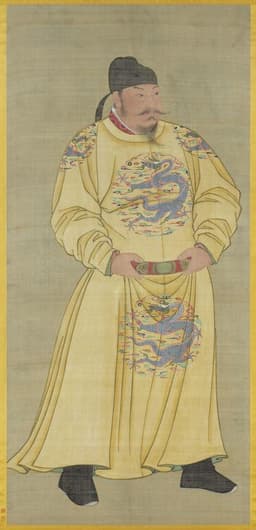
Emperor Taizong of Tang
Emperor · Medieval
78.9Total

Ruhollah Khomeini
Politician · Modern
75.1Total
Basic Information
Born
598
1902
Died
649
1989
Era
Medieval
Modern
Nationality
China
Iran
Occupation
Emperor
Politician
Civilization
Eastern
Middle Eastern
Score Comparison
Military (10%)
77.5
41.6
Political (20%)
82.0
65.0
Influence (20%)
85.0
85.0
Legacy (20%)
71.4
90.0
Leadership (15%)
78.0
80.0
Strategy (15%)
80.6
54.3
TOTAL
78.9
75.1
Emperor Taizong of Tang — Complete Timeline
626 AD
Reign of ZhenguanReform
Emperor Taizong initiated the Zhenguan era, characterized by efficient governance, legal codification, and economic recovery. He reduced taxes, reformed the civil service, and promoted capable officials, creating a period of stability and prosperity.
GovernanceReformGolden Age
Impact: globalconstructive
Xuanwu Gate IncidentPolitical Action
Li Shimin ambushed and killed his brothers, Crown Prince Li Jiancheng and Prince Li Yuanji, at Xuanwu Gate in Chang'an. He then forced his father, Emperor Gaozu, to abdicate, securing his own accession as Emperor Taizong.
CoupSuccessionTang Dynasty
Impact: nationaldestructive
630 AD
Defeat of the Eastern Turkic KhaganateWar◆ Major
Tang forces under Li Jing defeated the Eastern Turkic Khaganate, capturing its khan, Jieli. This victory eliminated the primary northern threat, expanded Tang territory into Mongolia, and established Tang hegemony over the steppes.
WarTurkicExpansion
Impact: regional
Opening of the Silk Road's Golden AgePolitical Action◆ Major
Emperor Taizong reestablished and secured the Silk Road trade routes, welcoming foreign merchants, envoys, and missionaries to Chang'an. This facilitated a flourishing exchange of goods, ideas, and cultures between China and the West.
Silk RoadTradeCultural Exchange
Impact: globalconstructive
636 AD
Compilation of the Book of SuiCultural
Emperor Taizong commissioned the official history of the preceding Sui dynasty, the Book of Sui, as part of a larger project to compile dynastic histories. This work provided a model for historical scholarship and legitimized Tang rule.
HistoriographyCultureLegitimacy
Impact: nationalconstructive
Ruhollah Khomeini — Complete Timeline
1964 AD
Exile to Iraq and FrancePolitical Action◆ Major
Khomeini was exiled from Iran after criticizing the Shah's White Revolution and granting of diplomatic immunity to US personnel. He settled in Najaf, Iraq, and later in France, where he continued to organize opposition to the Shah.
ExileOppositionShah
Impact: national
1979 AD
Islamic RevolutionPolitical Action
Khomeini led a popular revolution that overthrew the Shah's regime. He returned to Iran in February 1979 and established an Islamic Republic based on his doctrine of Velayat-e Faqih (Guardianship of the Jurist), with himself as Supreme Leader.
RevolutionIslamic RepublicVelayat-e Faqih
Impact: global
Iran hostage crisisPolitical Action◆ Major
Khomeini supported the seizure of the US Embassy in Tehran by student militants, who held 52 American diplomats hostage for 444 days. The crisis deepened the rift with the US, led to economic sanctions, and consolidated Khomeini's power.
Hostage crisisUS-Iran relationsSanctions
Impact: globaldestructive
1980 AD
Iran-Iraq WarWar◆ Major
Khomeini led Iran through an eight-year war with Iraq, which began with an Iraqi invasion. The war resulted in hundreds of thousands of casualties and massive economic destruction, ending in a stalemate. Khomeini accepted a UN ceasefire in 1988.
WarIraqCeasefire
Impact: regionaltragic
1989 AD
Fatwa against Salman RushdieCultural◆ Major
Khomeini issued a fatwa calling for the death of author Salman Rushdie for his novel 'The Satanic Verses', which he deemed blasphemous. The fatwa led to international controversy, diplomatic tensions, and attacks on Rushdie's translators.
FatwaBlasphemyInternational controversy
Impact: globaldestructive
Expert Analysis
Origins
Emperor Taizong of Tang (Li Shimin) was born in 598 CE into the powerful Li family, which played a central role in overthrowing the Sui dynasty. His father, Li Yuan, founded the Tang dynasty, and Taizong grew up in a militaristic environment, honing his skills as a commander. In contrast, Ruhollah Khomeini was born in 1902 in Khomeyn, Iran, into a religious family of Shiite scholars. His father was murdered when he was young, and he was raised by his mother and aunt, steeped in Islamic theology and jurisprudence. Both men emerged from backgrounds that combined political ambition with ideological conviction, but Taizong's path was rooted in secular statecraft, while Khomeini's was deeply intertwined with religious authority.
Rise to Power
Taizong's rise was marked by ruthless pragmatism. He orchestrated the Xuanwu Gate Incident in 626 CE, where he ambushed and killed his brothers, the crown prince and another brother, then forced his father to abdicate. This bloody coup secured his rule but stained his legitimacy. Conversely, Khomeini's ascent was gradual and ideological. He opposed the Shah's Westernization policies, leading to his exile in 1964 to Iraq and later France. From exile, he mobilized a network of clerics and activists, using cassette tapes to spread his message. The 1979 Islamic Revolution capitalized on widespread discontent, and Khomeini returned to Iran as the Supreme Leader, a position he held until his death. Both seized power through upheaval, but Taizong's was a palace coup, while Khomeini's was a popular revolution.
Leadership & Governance
Taizong is celebrated for the "Reign of Zhenguan" (627-649), a model of effective governance. He reformed the bureaucracy, implemented fair taxation, and promoted meritocracy through civil service exams. He also expanded the empire, defeating the Eastern Turkic Khaganate and securing the Silk Road, ushering in a golden age of trade and cultural exchange. He compiled historical texts like the Book of Sui to legitimize his rule. Khomeini, as Supreme Leader, established a theocratic system where clerics held ultimate authority. His governance was marked by the Iran hostage crisis (1979-1981), the Iran-Iraq War (1980-1988), and the suppression of dissent. He enforced Islamic law, curtailed women's rights, and issued the fatwa against Salman Rushdie. While Taizong's rule fostered prosperity and stability, Khomeini's was revolutionary but divisive, prioritizing ideological purity over economic development.
Triumph & Tragedy
Taizong's triumphs include military victories that expanded Tang territory, the establishment of the Silk Road's golden age, and the creation of a stable, prosperous empire. His tragedy lies in the violent means of his ascension, which haunted his legacy. He also faced rebellions late in his reign and struggled with succession issues. Khomeini's triumph was the successful Islamic Revolution, which overthrew a monarchy and created a state based on his vision of Velayat-e Faqih (Guardianship of the Jurist). His tragedy was the immense human cost of the Iran-Iraq War (hundreds of thousands dead) and the international isolation of Iran. The hostage crisis damaged Iran's global standing, and his fatwa against Rushdie provoked diplomatic crises. Both leaders achieved their core goals but at significant moral and material costs.
Character & Destiny
Taizong was pragmatic, strategic, and willing to compromise, but also ruthless. He admired Confucian ideals yet used violence to achieve power. His destiny was to be remembered as one of China's greatest emperors, a model of enlightened despotism. Khomeini was ascetic, uncompromising, and charismatic, driven by a religious mission. He saw himself as a defender of Islam against Western imperialism. His destiny was to create a lasting theocratic state, but his legacy is contested: revered by supporters as a visionary leader, criticized by opponents for authoritarianism and human rights abuses. Taizong's scores (M=78, P=82, I=85, L=71, D=78, S=81, T=79) reflect a balanced, effective ruler, while Khomeini's (M=42, P=65, I=85, L=90, D=80, S=54, T=75) show lower military power but high legacy and determination.
Legacy
Taizong's legacy is the Tang dynasty's golden age, which influenced East Asia for centuries. His governance model, the Zhenguan era, is still studied in China. The Silk Road's flourishing under his rule had global economic and cultural impacts. Khomeini's legacy is the Islamic Republic of Iran, which remains a major geopolitical actor. His ideas of clerical rule have inspired Shia movements worldwide, but his regime's human rights record and support for militias have drawn criticism. Both leaders left indelible marks, but Taizong's is associated with prosperity and cultural exchange, while Khomeini's is tied to revolution and religious governance.
Conclusion
Emperor Taizong of Tang scores higher overall (with a score gap of 3.8) due to his superior military and political achievements, which created a lasting era of peace and prosperity. His pragmatic governance and expansion of trade networks had a positive global impact. Khomeini, while influential, led a revolution that resulted in prolonged conflict and isolation. Taizong's model of effective statecraft, despite its violent origins, stands as a more successful example of leadership. Thus, Emperor Taizong of Tang is the superior historical figure in terms of net positive impact and legacy.
Rankings
🥇
Emperor Taizong of TangLeader
Mil: 77.5Pol: 82.0Inf: 85.0
78.9
🥈
Ruhollah Khomeini
Mil: 41.6Pol: 65.0Inf: 85.0
75.1
+3.8 behind
How This Comparison Works
Algorithm
Each figure is scored on 6 dimensions (0—100 scale) based on structured historical data: Military (10%), Political (20%), Influence (20%), Legacy (20%), Leadership (15%), Strategy (15%). The weighted total produces the final ranking.
Data Sources
Scores are computed from structured sub-indicators in the database. Scale factors adjust for era (Ancient ×0.85, Modern ×1.0) and civilization size (Eastern ×1.05, Other ×0.80) to account for differences in population and military scale.
Maximum 3 Figures
Comparisons are limited to 2—3 figures to ensure readability and statistical meaningfulness.
Error Margins
±5 points per dimension — Sub-scores are derived from historical records with inherent uncertainty. Two figures within 5 points on a dimension should be considered roughly equivalent in that area.
Total Score Accuracy
±3 points overall — The weighted combination of 6 dimensions produces a total score with approximately ±3 points of uncertainty. Differences of less than 3 points are not statistically significant— the figures are effectively tied.
Known Limitations
- Historical records are incomplete and uneven across civilizations
- Figures from oral-tradition societies may be underrepresented
- Occupation labels can misclassify multi-role figures
- Scores measure capability and impact, not moral character
- Quantitative scoring is a comparison tool, not absolute truth
Capability Radar
Military (10%) — Battles & Warfare
Battles
95
10
Win Rate
95
10
Expansion
90
10
Political (20%) — Governance & Reform
Reform
95
90
Diplomacy
95
75
Economy
95
40
Influence (20%) — Cultural & Global Reach
Cultural
90
85
Global
90
85
Legacy (20%) — Historical Impact
Historical
95
90
Longevity
95
80
Leadership (15%) — Power & Stability
Tenure
85
85
Stability
95
50
Strategy (15%) — Tactics & Innovation
Strategy
95
15
Tactics
95
10
Reform
90
20
Similar Comparisons
Comments & Discussion
No comments yet. Be the first to share your thoughts!