Loading...
Emperor Kogen vs Napoleon Bonaparte
Napoleon Bonaparte leads by 32.4 pts · 2 figures compared
…
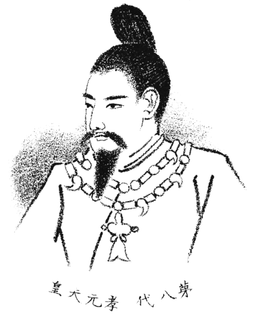
Emperor Kogen
Emperor · Ancient
38.5Total

Napoleon Bonaparte
General · Modern
70.9Total
Basic Information
Born
-273
1769
Died
-158
1821
Era
Ancient
Modern
Nationality
Japan
France
Occupation
Emperor
General
Civilization
Eastern
Western
Score Comparison
Military (10%)
20.5
94.0
Political (20%)
27.9
72.0
Influence (20%)
46.3
40.0
Legacy (20%)
36.7
80.0
Leadership (15%)
36.9
78.0
Strategy (15%)
60.0
90.0
TOTAL
38.5
70.9
Napoleon Bonaparte — Complete Timeline
1799 AD
Coup of 18 BrumaireOther◆ Major
Napoleon Bonaparte, with support from his brother Lucien and key political figures, overthrew the Directory in a bloodless coup. He established the Consulate with himself as First Consul, effectively becoming the ruler of France. This event ended the French Revolution's most unstable period.
French RevolutionCoupRise to Power
Impact: regional
1804 AD
Promulgation of the Napoleonic CodeOther◆ Major
Napoleon enacted the Civil Code of the French, known as the Napoleonic Code, a comprehensive set of laws that replaced the fragmented feudal legal systems. The code established legal equality, protected property rights, and secularized law. It became the basis for legal systems in many European and world countries.
Legal ReformNapoleonic CodeCivil Law
Impact: globalconstructive
1805 AD
Battle of AusterlitzWar◆ Major
Napoleon's Grande Arm
Napoleonic WarsBattleDecisive Victory
Impact: global
1812 AD
Invasion of RussiaWar◆ Major
Napoleon led the Grande Arm
Napoleonic WarsInvasionDisaster
Impact: globaldestructive
1815 AD
Battle of WaterlooWar◆ Major
Napoleon's French army was defeated by the combined forces of the Duke of Wellington's Anglo-Allied army and Gebhard Leberecht von Bl
Napoleonic WarsBattleFinal Defeat
Impact: globaldestructive
Expert Analysis
emperor-kogen-vs-napoleon-bonaparte
# The Conqueror and the Keeper
On a June morning in 1815, Napoleon Bonaparte watched his Imperial Guard march into the muddy fields of Waterloo, their blue coats crisp against the grey sky. He was forty-six years old, already a legend who had reshaped Europe. Nearly two thousand years earlier, on the other side of the world, a very different kind of ruler—Emperor Kogen of Japan—sat in his palace in Yamato, his reign so quiet that history would remember him mostly as a name on a list. Between these two men lies a chasm not merely of time, but of ambition, opportunity, and the very meaning of power.
Origins
Napoleon was born in 1769 on the Mediterranean island of Corsica, a place that had only recently become French. His family was minor nobility, but poor enough that young Napoleone Buonaparte—as he was then called—attended military school on scholarship. The France of his youth was a powder keg: the old monarchy crumbling, the Enlightenment fermenting new ideas, and revolution just over the horizon. He grew up speaking Italian-accented French, an outsider who would come to embody his adopted nation’s glory.
Emperor Kogen, by contrast, was born in 273 BC into the imperial house of Japan, a lineage that claimed descent from the sun goddess Amaterasu. Ancient Japan was a world of rice paddies, clan warfare, and shamanistic rituals. The Yamato court was consolidating its power, but it was still a fragile, decentralized realm where an emperor’s authority depended more on ritual and kinship than on armies. Kogen was the eighth emperor, a position that carried immense symbolic weight but limited practical control.
The difference in their eras is stark: Napoleon lived in an age of mass mobilization, nationalism, and rapid change; Kogen presided over a pre-literate, agrarian society where the wheel of history turned slowly. One man was forged by revolution, the other by tradition.
Rise to Power
Napoleon’s ascent was a masterpiece of opportunism. A young artillery officer during the French Revolution, he first distinguished himself at the Siege of Toulon in 1793, where he was just twenty-four. By 1796, he was commanding the Army of Italy, turning a ragtag force into a victorious machine. His Italian campaign was not just a military triumph—it was a political launchpad. He returned to France a hero, and in 1799, with the Directory in chaos, he staged a coup d’état, becoming First Consul. Within five years, he crowned himself Emperor.
Kogen’s path was the opposite: he was born into power, not seized it. According to the *Nihon Shoki*, Japan’s ancient chronicle, he became emperor upon the death of his father, Emperor Korei, likely in his twenties. There was no coup, no battlefield glory—just the quiet succession of a sacred line. His reign, spanning from roughly 214 to 158 BC, is recorded as uneventful. He was a keeper of the flame, not a firestarter.
What drove this difference? Napoleon rose in a society that rewarded talent and audacity; Kogen ruled in one that prized continuity and ritual. The French Revolution had shattered old hierarchies; ancient Japan had barely begun to build them.
Leadership & Governance
As a leader, Napoleon was a force of nature. He reorganized France’s legal system with the Napoleonic Code (1804), centralizing laws that had been a patchwork of feudal customs. He created the Bank of France, reformed education, and promoted merit over birth—at least in principle. His military genius was unmatched: at Austerlitz in 1805, he crushed the combined armies of Austria and Russia, a victory so complete it became a synonym for tactical brilliance. His political score of 75.0 reflects a ruler who understood power but also its limits—he could conquer but not consolidate.
Emperor Kogen’s governance is far harder to assess, because so little is known. His political score of 57.9 and leadership score of 74.6 suggest a competent, perhaps beloved figure, but one who left no great reforms or conquests. The *Nihon Shoki* records that he moved the capital to a new location and that his son, Sujin, later became a major reformer. Kogen’s role was likely that of a stabilizer, preserving the Yamato state through a long, peaceful reign. In a world where emperors were more priests than politicians, that was no small achievement.
Napoleon governed through action; Kogen through presence. One changed laws, the other maintained traditions.
Triumph & Tragedy
Napoleon’s greatest moment was Austerlitz—the sun of Austerlitz, as he called it. His worst was the invasion of Russia in 1812. He marched with 600,000 men; fewer than 100,000 returned. The disaster broke his aura of invincibility. Exiled to Elba in 1814, he escaped in 1815, only to meet final defeat at Waterloo. He died in 1821 on the remote island of Saint Helena, a prisoner of the British.
Kogen’s life holds no such drama. His triumph was simply surviving and passing on the imperial line. His tragedy—if it can be called that—is that history forgot him. He reigned for fifty-six years, yet we know almost nothing of his joys or sorrows. He was a placeholder in a story that would not reach its climax for centuries.
Character & Destiny
Napoleon was restless, brilliant, and insatiable. “I am not a man, but a thing,” he once said. “My life is made up of events.” He believed in destiny—his own—and drove himself and his armies to exhaustion. His arrogance was his undoing: he could not stop, could not compromise.
Kogen, by contrast, was likely patient and dutiful. Ancient Japanese emperors were expected to be serene, to embody the harmony of heaven and earth. His personality was subsumed into his role. He did not shape history; history flowed through him.
Their characters reflect their civilizations: Napoleon, the individualist of the West, who believed a man could remake the world; Kogen, the collectivist of the East, who saw himself as a link in an eternal chain.
Legacy
Napoleon’s legacy is immense. The Napoleonic Code influences legal systems from France to Louisiana to Japan itself. He redrew the map of Europe, sparked nationalism, and inspired both admiration and fear. His military tactics are still studied. His legacy score of 78.0 and influence score of 82.0 are deserved.
Kogen’s legacy is quieter but no less real. He is one of the earliest emperors in Japan’s unbroken imperial line, a lineage that continues to this day. His son Sujin is credited with major reforms, but Kogen made that possible. In Japan, he is revered as an ancestor, not a hero. His legacy score of 52.3 reflects his obscurity, but also the endurance of the institution he served.
Conclusion
To compare Napoleon and Kogen is to compare a storm with a stone. One changed everything he touched; the other held steady so that change could come later. Napoleon’s story is a tragedy of overreach; Kogen’s is a mystery of stillness. Perhaps the deepest difference is this: Napoleon wanted to be remembered, and he is. Kogen likely never imagined being forgotten, yet he almost is. And that, in itself, tells us something profound about the nature of power—and the price of ambition.
Rankings
🥇
Napoleon BonaparteLeader
Mil: 94.0Pol: 72.0Inf: 40.0
70.9
🥈
Emperor Kogen
Mil: 20.5Pol: 27.9Inf: 46.3
38.5
+32.4 behind
How This Comparison Works
Algorithm
Each figure is scored on 6 dimensions (0—100 scale) based on structured historical data: Military (10%), Political (20%), Influence (20%), Legacy (20%), Leadership (15%), Strategy (15%). The weighted total produces the final ranking.
Data Sources
Scores are computed from structured sub-indicators in the database. Scale factors adjust for era (Ancient ×0.85, Modern ×1.0) and civilization size (Eastern ×1.05, Other ×0.80) to account for differences in population and military scale.
Maximum 3 Figures
Comparisons are limited to 2—3 figures to ensure readability and statistical meaningfulness.
Error Margins
±5 points per dimension — Sub-scores are derived from historical records with inherent uncertainty. Two figures within 5 points on a dimension should be considered roughly equivalent in that area.
Total Score Accuracy
±3 points overall — The weighted combination of 6 dimensions produces a total score with approximately ±3 points of uncertainty. Differences of less than 3 points are not statistically significant— the figures are effectively tied.
Known Limitations
- Historical records are incomplete and uneven across civilizations
- Figures from oral-tradition societies may be underrepresented
- Occupation labels can misclassify multi-role figures
- Scores measure capability and impact, not moral character
- Quantitative scoring is a comparison tool, not absolute truth
Capability Radar
Military (10%) — Battles & Warfare
Battles
30
95
Win Rate
37
90
Expansion
40
95
Political (20%) — Governance & Reform
Reform
10
95
Diplomacy
10
80
Economy
10
85
Influence (20%) — Cultural & Global Reach
Cultural
10
85
Global
5
90
Legacy (20%) — Historical Impact
Historical
20
95
Longevity
10
90
Leadership (15%) — Power & Stability
Tenure
10
85
Stability
20
70
Strategy (15%) — Tactics & Innovation
Strategy
41
95
Tactics
43
98
Reform
48
92
Similar Comparisons
Comments & Discussion
No comments yet. Be the first to share your thoughts!