Loading...
Emperor Kogen vs Julius Caesar
Julius Caesar leads by 44.3 pts · 2 figures compared
…
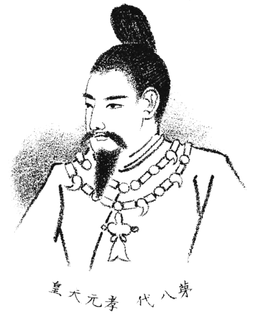
Emperor Kogen
Emperor · Ancient
38.5Total

Julius Caesar
General · Ancient
82.8Total
Basic Information
Born
-273
-100
Died
-158
-44
Era
Ancient
Ancient
Nationality
Japan
Roman Republic
Occupation
Emperor
General
Civilization
Eastern
Western
Score Comparison
Military (10%)
20.5
88.0
Political (20%)
27.9
78.0
Influence (20%)
46.3
85.0
Legacy (20%)
36.7
82.0
Leadership (15%)
36.9
80.0
Strategy (15%)
60.0
85.0
TOTAL
38.5
82.8
Julius Caesar — Complete Timeline
58 BC
Gallic WarsWar◆ Major
Caesar, as proconsul of Gaul, launched a series of campaigns that conquered all of Gaul (modern France, Belgium, and parts of Switzerland). He fought numerous battles, including against the Helvetii, the Belgae, and the Gallic chieftain Vercingetorix. The wars brought immense wealth and a loyal army to Caesar.
Gallic WarsConquestRoman Expansion
Impact: regional
49 BC
Crossing the RubiconPolitical Action◆ Major
Caesar led Legio XIII across the Rubicon River into Italy, defying the Roman Senate's order to disband his army. This act triggered a civil war against Pompey and the Optimates, ultimately leading to Caesar's dictatorship and the end of the Roman Republic.
Roman Civil WarEnd of RepublicPower Struggle
Impact: global
48 BC
Battle of PharsalusWar◆ Major
Caesar's outnumbered army defeated the larger forces of Pompey the Great at Pharsalus in Greece. Caesar's tactical use of a reserve line to counter Pompey's cavalry charge proved decisive. Pompey fled to Egypt, where he was assassinated, leaving Caesar as the undisputed master of the Roman world.
Roman Civil WarBattleDecisive Victory
Impact: regional
44 BC
Appointment as Dictator for LifePolitical Action◆ Major
The Roman Senate appointed Caesar dictator perpetuo (dictator for life), granting him unprecedented personal power. This move concentrated military, legislative, and judicial authority in one person, effectively ending the Roman Republic's traditional system of checks and balances and alarming many senators.
DictatorshipEnd of RepublicPower Consolidation
Impact: regionaldestructive
Assassination on the Ides of MarchPolitical Action◆ Major
A group of Roman senators, led by Marcus Junius Brutus and Gaius Cassius Longinus, stabbed Caesar to death at a meeting of the Senate in the Theatre of Pompey. The assassination was intended to restore the Republic, but instead triggered another civil war that led to the rise of the Roman Empire.
AssassinationRoman PoliticsEnd of Republic
Impact: globaldestructive
Expert Analysis
emperor-kogen-vs-julius-caesar
# The Emperor Who Never Fought and the General Who Conquered an Empire
On the Ides of March in 44 BCE, blood pooled around the body of Gaius Julius Caesar at the foot of Pompey’s Theatre in Rome. Sixty senators had plunged their daggers into the man who had made himself dictator for life. Half a world away and more than a century earlier, Emperor Kogen of Japan died peacefully at the age of 115, having ruled for nearly six decades from his palace in Yamato. One man’s death reshaped the Western world; the other’s passing barely rippled beyond his own court. Why did these two ancient rulers—both born into eras of political transformation—leave such profoundly different marks on history?
Origins
Julius Caesar was born into the chaos of the late Roman Republic, a world of civil wars, senatorial intrigue, and expanding frontiers. His family, the Julii, claimed descent from the goddess Venus, but they were politically modest. Caesar’s childhood unfolded against the backdrop of the Social War and the dictatorship of Sulla, who nearly executed the young patrician for refusing to divorce his wife. Survival required cunning, and Caesar learned early that in Rome, reputation was currency and boldness was the only path to power.
Emperor Kogen, by contrast, was born into the relative stability of ancient Japan’s Yamato period, around 273 BCE. He was the eighth emperor in a lineage that claimed direct descent from the sun goddess Amaterasu. His world was one of rice paddies, clan alliances, and Shinto rituals—a land where emperors ruled more as priest-kings than as conquerors. Kogen inherited a throne that demanded reverence, not revolution. Where Caesar grew up surrounded by the clatter of swords and the rhetoric of the Forum, Kogen’s youth was steeped in the quiet authority of tradition and the slow rhythms of agricultural cycles.
Rise to Power
Caesar’s path to dominance was a masterclass in calculated risk. He climbed the Roman political ladder—quaestor, aedile, praetor—but his true ascent began in 58 BCE when he secured command of Gaul. Over eight years, he conquered a territory larger than Italy itself, crossed the Rhine into Germany, and launched two invasions of Britain. His Commentaries on the Gallic Wars turned military reports into political propaganda, making Caesar a legend while he still lived. When the Senate ordered him to disband his army, he instead crossed the Rubicon River in 49 BCE, igniting a civil war that would end the Republic.
Kogen’s rise was not a rise at all—it was an inheritance. He became emperor upon his father’s death, likely in his twenties, and his power was circumscribed by the great clans that surrounded the throne. The Kojiki and Nihon Shoki, Japan’s earliest chronicles, record that Kogen reigned for fifty-seven years from a palace called Sakurai, but they mention no wars, no conquests, no dramatic reforms. His authority was spiritual and ceremonial; he was the living bridge between the gods and the Japanese people, but he did not command armies or rewrite laws.
Leadership & Governance
Caesar governed as a revolutionary. As dictator, he reformed the calendar (creating the Julian calendar, still used in modified form today), granted citizenship to provincials, initiated public works projects, and centralized power in his own hands. His military leadership was legendary—he fought alongside his men, shared their hardships, and made decisions with blinding speed. At the Battle of Alesia in 52 BCE, he surrounded an entire Gallic army while simultaneously fending off a massive relief force, a feat of logistics and nerve that still stuns military historians.
Kogen governed as a custodian. The chronicles describe him as a wise ruler who maintained peace and prosperity, but they offer no specific achievements. His leadership score of 74.6 reflects a stable, if unremarkable, reign. He likely presided over rituals, mediated disputes between clans, and ensured the rice harvests were sufficient. His greatest contribution was fathering Emperor Sujin, who would later be remembered as a reformer—a son who accomplished what the father had not. In this sense, Kogen’s governance was that of a placeholder, a necessary link in a chain of tradition.
Triumph & Tragedy
Caesar’s greatest triumph was not any single battle but the transformation of the Roman world. He brought Gaul into the orbit of Mediterranean civilization, ended the corrupt rule of the optimates, and laid the foundations for the empire that would endure for five centuries. His tragedy was that he could not complete his work. The assassination of 44 BCE, born from the fear that he would crown himself king, plunged Rome into another round of civil wars from which his adopted heir, Octavian, would eventually emerge as Augustus.
Kogen’s triumphs are invisible to history. No dramatic victories, no famous speeches, no monumental buildings bear his name. His tragedy is that he is almost forgotten—a name in a list, a shadow in a chronicle. Where Caesar’s death became the subject of Shakespeare’s greatest play, Kogen’s passing is recorded only in a few lines of ancient text. The quiet emperor was eclipsed by the very tradition he preserved.
Character & Destiny
Caesar was driven by an insatiable ambition that he disguised as duty. He was ruthless, calculating, and charismatic—a man who could weep for his enemies and then order their execution. His personality demanded that he be first in everything, and this hunger ultimately sealed his fate. He could not stop climbing, and when he reached the summit, he found only daggers.
Kogen was defined by patience and acceptance. He ruled within the boundaries of his era, content to be a steward rather than a shaper. His destiny was not to conquer but to endure, to pass the sacred lineage intact to the next generation. In a world that measured success by stability, he succeeded entirely. But in the judgment of history, which prizes change over continuity, he remains a footnote.
Legacy
Caesar’s legacy is monumental. His name became a title for rulers—Kaiser, Tsar, Caesar—and his military tactics are still studied at war colleges. The Western political tradition, from the Roman Empire to the Renaissance to modern republics, bears his fingerprints. He is both hero and warning, the man who destroyed a republic and built an empire.
Kogen’s legacy is the Japanese imperial line itself. He is one of the pillars of the world’s oldest continuous monarchy, a tradition that would survive shoguns, civil wars, and modernization. Without Kogen and his obscure reign, there would be no Emperor Sujin, no later Meiji Restoration, no symbolic continuity through centuries of change. His legacy is not in what he did, but in what he made possible.
Conclusion
The contrast between Caesar and Kogen is ultimately a contrast between two visions of leadership. Caesar saw history as a stage for individual action; Kogen saw it as a river to be preserved. One man’s life was a storm that reshaped the landscape; the other’s was a quiet current that kept the river flowing. Both were necessary—the conqueror who breaks the old world and the caretaker who holds the new one together. But in the end, history remembers the thunder, not the silence.
Rankings
🥇
Julius CaesarLeader
Mil: 88.0Pol: 78.0Inf: 85.0
82.8
🥈
Emperor Kogen
Mil: 20.5Pol: 27.9Inf: 46.3
38.5
+44.3 behind
How This Comparison Works
Algorithm
Each figure is scored on 6 dimensions (0—100 scale) based on structured historical data: Military (10%), Political (20%), Influence (20%), Legacy (20%), Leadership (15%), Strategy (15%). The weighted total produces the final ranking.
Data Sources
Scores are computed from structured sub-indicators in the database. Scale factors adjust for era (Ancient ×0.85, Modern ×1.0) and civilization size (Eastern ×1.05, Other ×0.80) to account for differences in population and military scale.
Maximum 3 Figures
Comparisons are limited to 2—3 figures to ensure readability and statistical meaningfulness.
Error Margins
±5 points per dimension — Sub-scores are derived from historical records with inherent uncertainty. Two figures within 5 points on a dimension should be considered roughly equivalent in that area.
Total Score Accuracy
±3 points overall — The weighted combination of 6 dimensions produces a total score with approximately ±3 points of uncertainty. Differences of less than 3 points are not statistically significant— the figures are effectively tied.
Known Limitations
- Historical records are incomplete and uneven across civilizations
- Figures from oral-tradition societies may be underrepresented
- Occupation labels can misclassify multi-role figures
- Scores measure capability and impact, not moral character
- Quantitative scoring is a comparison tool, not absolute truth
Capability Radar
Military (10%) — Battles & Warfare
Battles
30
95
Win Rate
37
92
Expansion
40
97
Political (20%) — Governance & Reform
Reform
10
90
Diplomacy
10
85
Economy
10
82
Influence (20%) — Cultural & Global Reach
Cultural
10
88
Global
5
94
Legacy (20%) — Historical Impact
Historical
20
95
Longevity
10
96
Leadership (15%) — Power & Stability
Tenure
10
75
Stability
20
60
Strategy (15%) — Tactics & Innovation
Strategy
41
94
Tactics
43
96
Reform
48
88
Similar Comparisons
Comments & Discussion
No comments yet. Be the first to share your thoughts!