Loading...
Emperor Kanmu vs Napoleon Bonaparte
Napoleon Bonaparte leads by 9.2 pts · 2 figures compared
…
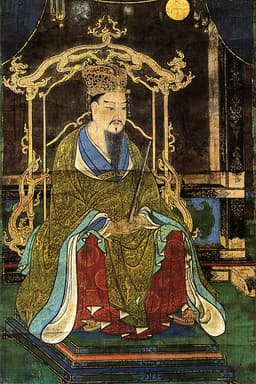
Emperor Kanmu
Emperor · Medieval
61.7Total

Napoleon Bonaparte
General · Modern
70.9Total
Basic Information
Born
737
1769
Died
806
1821
Era
Medieval
Modern
Nationality
Japan
France
Occupation
Emperor
General
Civilization
Eastern
Western
Score Comparison
Military (10%)
22.6
94.0
Political (20%)
72.0
72.0
Influence (20%)
72.0
40.0
Legacy (20%)
65.0
80.0
Leadership (15%)
72.0
78.0
Strategy (15%)
35.7
90.0
TOTAL
61.7
70.9
Emperor Kanmu — Complete Timeline
784 AD
Abandonment of Nagaoka-kyoPolitical Action
Emperor Kanmu abandoned the new capital at Nagaoka-kyo after only ten years, following a series of disasters and political intrigues, including the assassination of the chief architect. The move to Heian-kyo was motivated by a desire for a fresh start.
Nagaoka-kyoAbandonmentCapital
Impact: national
789 AD
Campaigns Against the EmishiWar◆ Major
Emperor Kanmu launched military campaigns to subdue the Emishi tribes in northern Honshu. Led by generals like Sakanoue no Tamuramaro, the campaigns expanded Japanese control into the Tohoku region. The Emishi were eventually defeated or assimilated.
EmishiNorthern ExpansionTohoku
Impact: national
794 AD
Transfer of the Capital to Heian-kyoPolitical Action◆ Major
Emperor Kanmu moved the imperial capital from Nagaoka-kyo to Heian-kyo (modern Kyoto). The new city was laid out on a grid pattern modeled after Chang'an. This move established Kyoto as the imperial capital for over a thousand years.
CapitalHeian-kyoKyoto
Impact: nationalconstructive
Napoleon Bonaparte — Complete Timeline
1799 AD
Coup of 18 BrumaireOther◆ Major
Napoleon Bonaparte, with support from his brother Lucien and key political figures, overthrew the Directory in a bloodless coup. He established the Consulate with himself as First Consul, effectively becoming the ruler of France. This event ended the French Revolution's most unstable period.
French RevolutionCoupRise to Power
Impact: regional
1804 AD
Promulgation of the Napoleonic CodeOther◆ Major
Napoleon enacted the Civil Code of the French, known as the Napoleonic Code, a comprehensive set of laws that replaced the fragmented feudal legal systems. The code established legal equality, protected property rights, and secularized law. It became the basis for legal systems in many European and world countries.
Legal ReformNapoleonic CodeCivil Law
Impact: globalconstructive
1805 AD
Battle of AusterlitzWar◆ Major
Napoleon's Grande Arm
Napoleonic WarsBattleDecisive Victory
Impact: global
1812 AD
Invasion of RussiaWar◆ Major
Napoleon led the Grande Arm
Napoleonic WarsInvasionDisaster
Impact: globaldestructive
1815 AD
Battle of WaterlooWar◆ Major
Napoleon's French army was defeated by the combined forces of the Duke of Wellington's Anglo-Allied army and Gebhard Leberecht von Bl
Napoleonic WarsBattleFinal Defeat
Impact: globaldestructive
Expert Analysis
Origins
Emperor Kanmu (737-806) was born as Yamabe, a prince of the Japanese imperial family. His father was Emperor Konin, and his mother was of Korean descent from the Baekje kingdom. Kanmu's early life was marked by political instability and factional struggles at the Nara court. He ascended the throne in 781 after his father's death, inheriting a realm plagued by Buddhist clerical influence and regional unrest. Kanmu's education emphasized Confucian governance, Chinese literature, and legal codes, shaping his vision for a centralized state.
Napoleon Bonaparte (1769-1821) was born on Corsica to a minor noble family of Italian ancestry. His father Carlo was a lawyer who secured a scholarship for Napoleon to attend military school in mainland France. Napoleon graduated from the École Militaire in Paris in 1785 as an artillery officer. His early years were shaped by the French Revolution, which opened opportunities for ambitious officers. He read widely in military history, engineering, and Enlightenment philosophy, developing a strategic mind and a drive for personal glory.
Rise to Power
Kanmu's rise was gradual and institutional. After becoming emperor, he faced opposition from Buddhist monasteries and the powerful Nara clergy. To break their influence, he moved the capital from Nara to Nagaoka-kyo in 784, then to Heian-kyo (modern Kyoto) in 794. This bold relocation stripped the old capital's temples of political power and established a new administrative center. Kanmu also appointed capable officials like Wake no Kiyomaro and generals like Sakanoue no Tamuramaro, consolidating his authority.
Napoleon's rise was meteoric and revolutionary. He first gained fame during the Siege of Toulon in 1793, where his artillery tactics drove out British forces. Promoted to brigadier general, he later suppressed a royalist uprising in Paris with a 'whiff of grapeshot' in 1795. His Italian campaign of 1796-97 showcased his strategic genius, winning a series of battles against Austria. The Coup of 18 Brumaire (November 9, 1799) overthrew the Directory, and Napoleon became First Consul, effectively dictator of France. His political score was 72.0, matching Kanmu's.
Leadership & Governance
Kanmu governed through traditional imperial bureaucracy, emphasizing Confucian principles of merit and order. He issued edicts to regulate land distribution, reduce tax burdens, and standardize weights and measures. His most enduring act was the construction of Heian-kyo, a planned city modeled on the Tang capital Chang'an. The city's grid layout and administrative divisions facilitated efficient rule. Kanmu also sent envoys to Tang China to study governance and culture, but he maintained Japan's independence.
Napoleon's governance was transformative and centralized. He enacted the Napoleonic Code in 1804, which unified French law and influenced civil codes worldwide. He established the Bank of France, reformed education through lycées, and reorganized the state bureaucracy on rational principles. His leadership style was autocratic but efficient, blending meritocracy with personal loyalty. Napoleon's strategic score of 90.0 reflects his military planning, while his leadership score of 78.0 indicates his ability to inspire and command.
Triumph & Tragedy
Kanmu's greatest triumph was the successful transfer of the capital to Heian-kyo, which became the heart of Japanese civilization for over a millennium. His campaigns against the Emishi (northern tribes) expanded imperial control, with general Sakanoue no Tamuramaro conquering territories that would later become the Tohoku region. However, Kanmu's reign also saw failures: the Nagaoka-kyo capital was abandoned after only ten years due to floods, curses, and political intrigue. His military campaigns were costly and achieved limited assimilation of the Emishi.
Napoleon's triumphs include the Battle of Austerlitz (1805), where he defeated the combined Russian and Austrian armies, and the Napoleonic Code, which reshaped European law. His empire stretched from Spain to Poland. Yet his greatest tragedy was the Invasion of Russia in 1812: the Grande Armée of over 600,000 men was reduced to fewer than 100,000 due to cold, hunger, and Russian scorched-earth tactics. His final defeat at Waterloo (1815) ended his rule. Napoleon's military score of 94.0 is among the highest in history, but his influence score of 40.0 is relatively low, reflecting the transience of his empire.
Character & Destiny
Kanmu was a cautious, methodical ruler who prioritized stability over expansion. He was deeply influenced by Chinese political thought, believing in the emperor's role as a moral exemplar. His decision to move the capital twice shows pragmatism but also indecision. Kanmu's character was shaped by the need to balance aristocratic factions and Buddhist institutions, leading to a reign of consolidation rather than glory. He died of illness in 806, having secured the imperial line but not fully subduing the north.
Napoleon was ambitious, restless, and supremely confident. His character drove him to conquer Europe, but also to overreach. He centralized power but alienated allies through arrogance. His strategic mind was matched by a relentless drive for personal glory, which led to catastrophic miscalculations like the Russian campaign. Historians assess Napoleon as a military genius whose flaws—hubris and impatience—ultimately undid him. His score total of 70.9 reflects a volatile mix of brilliance and failure.
Legacy
Kanmu's legacy is foundational for Japan. Heian-kyo (Kyoto) remained the imperial capital until 1868, and its layout influenced Japanese urban planning. The shift away from Nara reduced Buddhist political power, allowing a distinct Japanese culture to flourish during the Heian period. Kanmu's military campaigns set the stage for the eventual subjugation of the Emishi, though this took centuries. His reign is seen as a turning point toward a more centralized, Sinified state. His legacy score of 65.0 reflects enduring but indirect impact.
Napoleon's legacy is vast and contested. The Napoleonic Code influenced legal systems in Europe, Latin America, and beyond. His military innovations—like the corps system and mass conscription—became standard. He redrew the map of Europe, ending the Holy Roman Empire and spreading nationalism. However, his conquests caused immense suffering, and his dynasty fell. Napoleon's legacy score of 80.0 is high, but his influence score of 40.0 suggests that his direct impact faded quickly after his defeat.
Conclusion
Napoleon had greater impact in terms of immediate, global change, scoring 70.9 vs Kanmu's 61.7. Napoleon's military and strategic scores (94.0 and 90.0) dwarf Kanmu's (22.6 and 35.7). While Kanmu shaped Japan's trajectory for centuries, Napoleon reshaped Europe and the world in a single generation. Napoleon's reforms and warfare accelerated modernity, whereas Kanmu's achievements were conservative and localized. Therefore, Napoleon Bonaparte is the more historically significant figure, despite his eventual downfall.
Rankings
🥇
Napoleon BonaparteLeader
Mil: 94.0Pol: 72.0Inf: 40.0
70.9
🥈
Emperor Kanmu
Mil: 22.6Pol: 72.0Inf: 72.0
61.7
+9.2 behind
How This Comparison Works
Algorithm
Each figure is scored on 6 dimensions (0—100 scale) based on structured historical data: Military (10%), Political (20%), Influence (20%), Legacy (20%), Leadership (15%), Strategy (15%). The weighted total produces the final ranking.
Data Sources
Scores are computed from structured sub-indicators in the database. Scale factors adjust for era (Ancient ×0.85, Modern ×1.0) and civilization size (Eastern ×1.05, Other ×0.80) to account for differences in population and military scale.
Maximum 3 Figures
Comparisons are limited to 2—3 figures to ensure readability and statistical meaningfulness.
Error Margins
±5 points per dimension — Sub-scores are derived from historical records with inherent uncertainty. Two figures within 5 points on a dimension should be considered roughly equivalent in that area.
Total Score Accuracy
±3 points overall — The weighted combination of 6 dimensions produces a total score with approximately ±3 points of uncertainty. Differences of less than 3 points are not statistically significant— the figures are effectively tied.
Known Limitations
- Historical records are incomplete and uneven across civilizations
- Figures from oral-tradition societies may be underrepresented
- Occupation labels can misclassify multi-role figures
- Scores measure capability and impact, not moral character
- Quantitative scoring is a comparison tool, not absolute truth
Capability Radar
Military (10%) — Battles & Warfare
Battles
10
95
Win Rate
10
90
Expansion
15
95
Political (20%) — Governance & Reform
Reform
75
95
Diplomacy
60
80
Economy
65
85
Influence (20%) — Cultural & Global Reach
Cultural
75
85
Global
60
90
Legacy (20%) — Historical Impact
Historical
80
95
Longevity
85
90
Leadership (15%) — Power & Stability
Tenure
70
85
Stability
70
70
Strategy (15%) — Tactics & Innovation
Strategy
15
95
Tactics
10
98
Reform
20
92
Similar Comparisons
Comments & Discussion
No comments yet. Be the first to share your thoughts!