Loading...
Emperor Gaozu of Han vs Napoleon Bonaparte
Napoleon Bonaparte leads by 1.2 pts · 2 figures compared
…
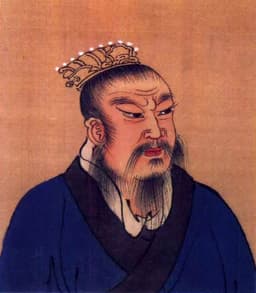
Emperor Gaozu of Han
Emperor · Ancient
69.7Total

Napoleon Bonaparte
General · Modern
70.9Total
Basic Information
Born
-256
1769
Died
-195
1821
Era
Ancient
Modern
Nationality
China
France
Occupation
Emperor
General
Civilization
Eastern
Western
Score Comparison
Military (10%)
78.0
94.0
Political (20%)
72.0
72.0
Influence (20%)
65.0
40.0
Legacy (20%)
65.0
80.0
Leadership (15%)
79.8
78.0
Strategy (15%)
66.3
90.0
TOTAL
69.7
70.9
Emperor Gaozu of Han — Complete Timeline
209 BC
Rebellion Against the Qin DynastyWar◆ Major
Liu Bang, a minor Qin official, led a revolt after a group of convicts he was escorting escaped. He gathered followers and joined the broader rebellion against the Qin dynasty, eventually becoming a key rebel leader.
Qin RebellionPeasant RevoltCivil War
Impact: national
202 BC
Battle of GaixiaWar
Liu Bang's Han forces, commanded by Han Xin, defeated Xiang Yu's Chu army at Gaixia. Xiang Yu committed suicide after the battle. This victory ended the Chu-Han Contention and allowed Liu Bang to proclaim himself emperor.
Chu-Han ContentionDecisive BattleHan Dynasty Founding
Impact: national
Abolition of Harsh Qin LawsReform◆ Major
Emperor Gaozu repealed the severe legal codes of the Qin dynasty, including collective punishment and harsh corporal penalties. He replaced them with a simplified legal system that reduced punishments, aiming to win popular support and stabilize the realm.
Legal ReformQin LegacyPopular Support
Impact: nationalprogressive
Proclamation of the Han DynastyPolitical Action
After defeating Xiang Yu, Liu Bang declared himself Emperor Gaozu of Han, founding the Han dynasty. He established the capital at Chang'an and began consolidating power, marking the start of one of China's longest-lasting dynasties.
Dynasty FoundingImperial ChinaChang'an
Impact: globalconstructive
Enfeoffment of Vassal KingsPolitical Action
To secure loyalty, Gaozu granted large territories to allied generals and relatives, creating semi-autonomous kingdoms. This policy initially stabilized the empire but later led to rebellions, forcing his successors to centralize power more firmly.
Feudal SystemVassalagePolitical Strategy
Impact: national
Napoleon Bonaparte — Complete Timeline
1799 AD
Coup of 18 BrumaireOther◆ Major
Napoleon Bonaparte, with support from his brother Lucien and key political figures, overthrew the Directory in a bloodless coup. He established the Consulate with himself as First Consul, effectively becoming the ruler of France. This event ended the French Revolution's most unstable period.
French RevolutionCoupRise to Power
Impact: regional
1804 AD
Promulgation of the Napoleonic CodeOther◆ Major
Napoleon enacted the Civil Code of the French, known as the Napoleonic Code, a comprehensive set of laws that replaced the fragmented feudal legal systems. The code established legal equality, protected property rights, and secularized law. It became the basis for legal systems in many European and world countries.
Legal ReformNapoleonic CodeCivil Law
Impact: globalconstructive
1805 AD
Battle of AusterlitzWar◆ Major
Napoleon's Grande Arm
Napoleonic WarsBattleDecisive Victory
Impact: global
1812 AD
Invasion of RussiaWar◆ Major
Napoleon led the Grande Arm
Napoleonic WarsInvasionDisaster
Impact: globaldestructive
1815 AD
Battle of WaterlooWar◆ Major
Napoleon's French army was defeated by the combined forces of the Duke of Wellington's Anglo-Allied army and Gebhard Leberecht von Bl
Napoleonic WarsBattleFinal Defeat
Impact: globaldestructive
Expert Analysis
emperor-gaozu-of-han-vs-napoleon-bonaparte
# The Peasant Emperor and the Corsican Corporal
On a winter morning in 1805, Napoleon Bonaparte stood before his Grande Armée at Austerlitz, the rising sun glinting off the eagles atop their battle standards. He was thirty-six years old, already master of Europe, about to crush the combined armies of Russia and Austria in what would be his greatest victory. Two thousand years earlier and half a world away, another man had risen from even humbler beginnings. Liu Bang, a minor Qin official who had once been a peasant, watched his own sun rise over the plains of Gaixia in 202 BCE—a sun that would set on his rival Xiang Yu and dawn on a dynasty that would rule China for four centuries. Both men seized history by the throat. But one built an empire that crumbled within a generation; the other laid foundations that outlasted Rome itself.
Origins
Napoleon was born in 1769 on the island of Corsica, a place recently annexed by France, into a minor noble family with more pride than money. He spoke Italian before French, and throughout his life carried the suspicion of being an outsider. The French Revolution, which erupted when he was twenty, shattered the old order and created opportunities unimaginable under the Bourbon monarchy. A gifted artillery officer could become emperor—if he had the nerve and the genius.
Liu Bang’s origins were even more obscure. Born in 256 BCE, during the chaotic Warring States period, he grew up in a peasant household in the state of Chu. He was known as a roisterer, fond of wine and women, with little interest in the Confucian scholarship that marked the elite. His only official post was as a local constable, responsible for escorting convicts. When his prisoners escaped, he chose rebellion over punishment. The difference in their starting points is stark: Napoleon began with a noble name and a military education; Liu Bang began with nothing but his wits and the loyalty of men who had nothing to lose.
Rise to Power
Napoleon’s ascent was meteoric, a trajectory of pure military brilliance. At twenty-four, he drove the British out of Toulon. At twenty-six, he crushed a royalist uprising in Paris with a "whiff of grapeshot." By thirty, he had conquered Italy and Egypt. Each victory was a stepping stone, each campaign a masterpiece of speed and deception. The coup of 18 Brumaire in 1799 made him First Consul; by 1804, he crowned himself Emperor. His path was one of relentless, upward momentum.
Liu Bang’s rise was slower, messier, and more political. He did not win battles through genius; he won them through patience and the ability to attract better men. His greatest general, Han Xin, had once been a petty officer under his rival. His strategist, Zhang Liang, was a former assassin. Liu Bang’s genius lay not in strategy—his score of 58.8 in that category is notably low—but in leadership, scoring a formidable 78.8. He knew how to listen, how to delegate, and, crucially, when to share credit. While Napoleon dazzled with his own brilliance, Liu Bang built a coalition.
Leadership & Governance
As ruler, Napoleon was a whirlwind. He reformed French law into the Napoleonic Code, a rational, secular system that influenced legal codes across Europe and beyond. He centralized administration, established the Bank of France, and created a system of lycées to educate the next generation. His political score of 75.0 reflects genuine achievement. Yet his governance was autocratic. He tolerated no opposition, suppressed dissent, and placed family members on thrones across the continent. His military score of 94.0 is world-class, but his political wisdom was brittle—it depended entirely on his own presence.
Emperor Gaozu took a different approach. He abolished the harsh Qin laws that had punished entire families for one man’s crime, replacing them with simpler, more humane codes. He reduced taxes and corvée labor, allowing a war-torn land to heal. But his most significant decision was political: he enfeoffed vassal kings, granting territory to allies and relatives to secure loyalty. This was a pragmatic compromise, not an ideal solution—it would lead to rebellions later—but it bought time for the dynasty to consolidate. His political score of 65.3 is lower than Napoleon’s, but his legacy score of 76.9 is nearly equal, because his system endured.
Triumph & Tragedy
Napoleon’s greatest moment was Austerlitz in 1805, where he destroyed the Third Coalition in a single day. His worst was the invasion of Russia in 1812—a catastrophic miscalculation that cost half a million men. He never recovered. Exiled to Elba, he returned for a final, desperate gamble at Waterloo in 1815, and lost. His tragedy was that his ambition outran his judgment.
Liu Bang’s greatest triumph was the Battle of Gaixia in 202 BCE, where his forces finally cornered Xiang Yu. The Chu king, surrounded and outnumbered, committed suicide. But Liu Bang’s tragedy was quieter: he spent his final years suspicious of the very men who had won him his empire. He purged Han Xin and other generals, fearing their power. He died in 195 BCE, a lonely old man, but one who had built something that would outlast him.
Character & Destiny
Napoleon was a man of immense will, restless energy, and towering ego. He once said, "Impossible is a word to be found only in the dictionary of fools." This confidence made him unstoppable—and ultimately, blind to his limits. He could not share power, could not compromise, could not stop. His character drove him to conquer, and to fall.
Liu Bang was cunning, pragmatic, and self-aware. He famously said, "In planning strategies within a tent, I am not as good as Zhang Liang; in governing the state, I am not as good as Xiao He; in leading troops, I am not as good as Han Xin. But I could use them." That humility—or at least, that realism—was his greatest strength. He built a dynasty not by being the smartest man in the room, but by being the one who could keep the smartest men in the room.
Legacy
Napoleon’s legacy is immense but ambiguous. He reshaped Europe, spread nationalism and legal reform, and inspired both admiration and horror. His total score of 82.4 reflects a figure of extraordinary impact. Yet his empire vanished within fifteen years of his death. He is remembered as a genius and a tyrant, a liberator and a conqueror.
Liu Bang’s legacy is quieter but deeper. The Han Dynasty lasted over four hundred years, and the name "Han" became synonymous with Chinese identity itself. The legal and administrative systems he established—centralized government, merit-based bureaucracy, reduced harshness—became the model for all subsequent Chinese dynasties. His total score of 70.1 is lower, but his influence on billions of lives is incalculable.
Conclusion
Two men, two worlds. Napoleon Bonaparte, the Corsican outsider who conquered Europe through sheer force of genius, built an empire of glass that shattered when he fell. Liu Bang, the peasant from Chu, built an empire of oak that weathered storms for centuries. The difference was not in ambition—both had it in abundance. It was in wisdom: the wisdom to know that power, to last, must be shared, and that the greatest leader is not the one who wins every battle, but the one who builds a system that outlives him. Napoleon left a legend. Liu Bang left a civilization.
Rankings
🥇
Napoleon BonaparteLeader
Mil: 94.0Pol: 72.0Inf: 40.0
70.9
🥈
Emperor Gaozu of Han
Mil: 78.0Pol: 72.0Inf: 65.0
69.7
+1.2 behind
How This Comparison Works
Algorithm
Each figure is scored on 6 dimensions (0—100 scale) based on structured historical data: Military (10%), Political (20%), Influence (20%), Legacy (20%), Leadership (15%), Strategy (15%). The weighted total produces the final ranking.
Data Sources
Scores are computed from structured sub-indicators in the database. Scale factors adjust for era (Ancient ×0.85, Modern ×1.0) and civilization size (Eastern ×1.05, Other ×0.80) to account for differences in population and military scale.
Maximum 3 Figures
Comparisons are limited to 2—3 figures to ensure readability and statistical meaningfulness.
Error Margins
±5 points per dimension — Sub-scores are derived from historical records with inherent uncertainty. Two figures within 5 points on a dimension should be considered roughly equivalent in that area.
Total Score Accuracy
±3 points overall — The weighted combination of 6 dimensions produces a total score with approximately ±3 points of uncertainty. Differences of less than 3 points are not statistically significant— the figures are effectively tied.
Known Limitations
- Historical records are incomplete and uneven across civilizations
- Figures from oral-tradition societies may be underrepresented
- Occupation labels can misclassify multi-role figures
- Scores measure capability and impact, not moral character
- Quantitative scoring is a comparison tool, not absolute truth
Capability Radar
Military (10%) — Battles & Warfare
Battles
75
95
Win Rate
70
90
Expansion
80
95
Political (20%) — Governance & Reform
Reform
85
95
Diplomacy
80
80
Economy
75
85
Influence (20%) — Cultural & Global Reach
Cultural
85
85
Global
85
90
Legacy (20%) — Historical Impact
Historical
90
95
Longevity
95
90
Leadership (15%) — Power & Stability
Tenure
70
85
Stability
72
70
Strategy (15%) — Tactics & Innovation
Strategy
78
95
Tactics
72
98
Reform
65
92
Similar Comparisons
Comments & Discussion
LiuBangsLancaster6/17/2026
Napoleon’s brilliance was ultimately wasted on short-term glory—he conquered Europe but couldn’t hold it past Waterloo. Liu Bang, the peasant emperor, knew something Bonaparte never learned: slow, steady institutional control beats flashy battles. The Han Dynasty lasted four centuries because Liu built a civil service, not just a cult of personality. Napoleon’s empire? A bonfire. Liu’s? A torch that burned generations. Name one Napoleonic institution that outlasted his exile.
历史簿记员6/17/2026
数据不会撒谎:拿破仑指挥过约60场战役,胜率高达85%,但他统治的帝国仅存十年。反观刘邦,军事胜率不到50%,却开创了持续四百年的汉朝。为什么?因为刘邦懂得治理的算术:减赋税、放兵权、用文官。拿破仑只懂征服的几何:加领土、增盟友、树敌人。胜利的度量从来不是战场数,而是子孙碗里的粮。
GallicGambler6/17/2026
Let’s be real—Napoleon bet on the Corsican card and the French Revolution’s chaos to leap from artillery officer to emperor. It was a brilliant hustle, but a fragile one. Liu Bang played the long game: he used his peasant roots to bond with soldiers, then outlasted the brilliant but brutal Xiang Yu with patience and propaganda. One was a tactical magician, the other a dynastic gardener. Which would you rather bet on for the next four centuries?
竹简考据家6/17/2026
仔细看身份:刘邦出身农家,早年连官职都是乡里小吏,却懂民间疾苦,施行黄老之术休养生息。拿破仑却是贵族次子,炮兵军校毕业,一路靠军功和政变上台。他的法典虽进步,但连年战争让法国人口锐减。刘邦“约法三章”能收买关中民心,拿破仑的《维也纳条约》却让欧洲联合反他。权力基础不同,结局自然分岔。
TacticalTerraformer6/17/2026
Napoleon was a genius of the battlefield, no doubt—but his real legacy was military reorganization, not empire-building. The Grande Armée’s corps system was revolutionary, and his Civil Code still lives. Liu Bang couldn’t match that tactical flair, but he created a ruling philosophy—Confucian bureaucracy mixed with Legalist control—that shaped China for millennia. Napoleon shaped armies; Liu Bang shaped civilizations. The scale is just different: one war, one world.