Loading...
Edward VII vs William of Julich-Cleves-Berg
Edward VII leads by 5.9 pts · 2 figures compared
…
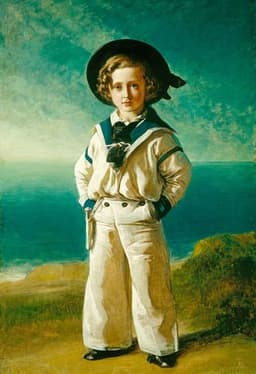
Edward VII
Emperor · Modern
56.1Total

William of Julich-Cleves-Berg
Emperor · Modern
50.2Total
Basic Information
Born
1841
1516
Died
1910
1592
Era
Modern
Modern
Nationality
United Kingdom
Cleves
Occupation
Emperor
Emperor
Civilization
Western
Western
Score Comparison
Military (10%)
45.0
55.0
Political (20%)
60.0
54.7
Influence (20%)
62.0
50.2
Legacy (20%)
46.7
40.0
Leadership (15%)
79.8
67.0
Strategy (15%)
35.0
38.6
TOTAL
56.1
50.2
Edward VII — Complete Timeline
1901 AD
Accession to the ThronePolitical Action◆ Major
Edward VII became king upon the death of his mother Queen Victoria. He was the first monarch of the House of Saxe-Coburg and Gotha. His accession marked the beginning of the Edwardian era, a period of social and cultural change.
AccessionEdwardian EraSuccession
Impact: national
1903 AD
State Visit to FrancePolitical Action
Edward VII made a state visit to France, which improved Anglo-French relations. He was warmly received by the French public and government. This visit helped pave the way for the Entente Cordiale and strengthened diplomatic ties.
State VisitDiplomacyFrance
Impact: regionalconstructive
1904 AD
Entente CordialePolitical Action◆ Major
Edward VII played a key role in the Entente Cordiale, a series of agreements between Britain and France. This resolved colonial disputes and established a diplomatic alliance. It laid the groundwork for the Triple Entente and shaped pre-WWI alliances.
Entente CordialeDiplomacyAlliance
Impact: globalconstructive
1910 AD
Death from BronchitisOther◆ Major
Edward VII died of bronchitis at Buckingham Palace at age 68. He was buried in St George's Chapel. His death ended the Edwardian era and passed the throne to his son George V. His reign saw the rise of the Labour Party and social reforms.
DeathEdwardian EraSuccession
Impact: nationaltragic
William of Julich-Cleves-Berg — Complete Timeline
1539 AD
Inherited the United Duchies of Jülich-Cleves-BergPolitical Action◆ Major
William inherited the combined territories of J
SuccessionTerritorial Inheritance
Impact: regional
1543 AD
Battle of SittardWar◆ Major
William's forces were defeated by the army of Emperor Charles V at Sittard. This battle was part of the Gelderland Wars and resulted in William being forced to cede the Duchy of Gelderland to the Habsburgs, ending his expansionist ambitions.
BattleDefeatGelderland Wars
Impact: regionaldestructive
Treaty of VenloPolitical Action
Following his defeat at Sittard, William signed the Treaty of Venlo with Emperor Charles V. The treaty forced him to surrender Gelderland and Zutphen to the Habsburgs and accept the Catholic Church's authority, significantly reducing his power.
TreatyTerritorial LossHabsburg
Impact: regionaldestructive
1555 AD
Founded the University of DuisburgCultural◆ Major
William founded the University of Duisburg as a Protestant institution. The university served as a center for learning and religious education in his territories, contributing to the intellectual and cultural development of the region.
UniversityEducationCultural Development
Impact: regionalconstructive
Expert Analysis
Origins
Edward VII was born on 9 November 1841 at Buckingham Palace, the second child and eldest son of Queen Victoria and Prince Albert. As Prince of Wales, he was excluded from state affairs by his mother for decades, spending his youth in a gilded but frustrating limbo. He received a rigorous education but was more interested in socializing and foreign travel than statecraft.
William of Jülich-Cleves-Berg was born on 28 July 1516 in Düsseldorf, the son of John III, Duke of Jülich-Cleves-Berg, and Maria von Geldern. He inherited the United Duchies of Jülich, Cleves, and Berg upon his father's death in 1539, making him ruler of the largest contiguous territory in northwestern Germany. His upbringing was shaped by the Protestant Reformation and the complex politics of the Holy Roman Empire.
Rise to Power
Edward VII waited until age 59 to become king upon Victoria's death on 22 January 1901. His long apprenticeship taught him diplomacy and charm, which he used to foster better relations with France and Russia. His accession marked a shift from Victoria's isolation to active personal diplomacy.
William ascended to power at 23, inheriting a vast territory. He sought to expand his influence by claiming Gelderland, a duchy his mother had a claim to. This ambition brought him into conflict with Emperor Charles V, who also claimed Gelderland. William's early reign was marked by aggressive expansion, but he lacked the military and political resources to match the Habsburgs.
Leadership & Governance
Edward VII's leadership was defined by his role as a constitutional monarch. He had no formal political power but used his social skills to influence foreign policy. His state visit to France in 1903 charmed the French public and paved the way for the Entente Cordiale signed on 8 April 1904. This agreement resolved colonial disputes and established a basis for cooperation against Germany. Edward scored 79.8 in leadership, reflecting his ability to shape events through personal magnetism.
William governed as a Renaissance prince, centralizing authority and promoting Protestantism. He founded the University of Duisburg in 1555 as a Protestant institution, fostering education and religious reform. However, his governance was hampered by constant military conflicts. He scored 67.0 in leadership, indicating competent but overshadowed rule. His political score of 54.7 was hampered by his failure to secure Gelderland.
Triumph & Tragedy
Edward VII's greatest triumph was the Entente Cordiale, which realigned European alliances and isolated Germany. He also successfully modernized the monarchy, making it more visible and popular. His greatest failure was his inability to prevent the arms race with Germany, which contributed to tensions leading to World War I. His military score of 45.0 reflects his lack of direct military involvement.
William's triumph was the foundation of the University of Duisburg, which lasted until 1818. He also maintained the unity of his territories despite external pressures. His tragedy was the loss of Gelderland and Zutphen after the Battle of Sittard in 1543, forced by the Treaty of Venlo. This defeat reduced his power and influence. His military score of 55.0 is modest, reflecting his inability to win key battles.
Character & Destiny
Edward VII was affable, shrewd, and pleasure-loving. His charm opened diplomatic doors but his lifestyle also drew criticism. His character shaped his fate as a peacemaker, but his lack of involvement in military matters left him unprepared for the war that followed his death. He scored 62.0 in influence, reflecting his impact on foreign relations.
William was ambitious but impulsive. His overreach in claiming Gelderland led to his defeat, and his later years were spent consolidating his remaining lands. He scored 50.2 in influence, lower than Edward. His character led to a more tragic destiny, as his ambitions exceeded his capabilities.
Legacy
Edward VII's legacy is the Edwardian era, a period of peace and prosperity before World War I. The Entente Cordiale set the stage for the Triple Entente, which would shape the war. He is remembered as a diplomat king. His total score of 56.1 reflects moderate impact across all categories.
William's legacy is more regional. He is remembered as a founder of a university and a ruler who held his territories together. The United Duchies persisted under his son, but his defeat limited his dynasty's power. His total score of 50.2 shows lower overall impact.
Conclusion
Edward VII had greater impact than William of Jülich-Cleves-Berg, with a total score of 56.1 versus 50.2. Edward's influence on international relations through the Entente Cordiale reshaped European alliances and set the course for the 20th century. William's ambitions were thwarted by his military defeat, and his legacy is confined to German regional history. While both were competent rulers, Edward's diplomatic achievements had far-reaching consequences that William's could not match.
Rankings
🥇
Edward VIILeader
Mil: 45.0Pol: 60.0Inf: 62.0
56.1
🥈
William of Julich-Cleves-Berg
Mil: 55.0Pol: 54.7Inf: 50.2
50.2
+5.9 behind
How This Comparison Works
Algorithm
Each figure is scored on 6 dimensions (0—100 scale) based on structured historical data: Military (10%), Political (20%), Influence (20%), Legacy (20%), Leadership (15%), Strategy (15%). The weighted total produces the final ranking.
Data Sources
Scores are computed from structured sub-indicators in the database. Scale factors adjust for era (Ancient ×0.85, Modern ×1.0) and civilization size (Eastern ×1.05, Other ×0.80) to account for differences in population and military scale.
Maximum 3 Figures
Comparisons are limited to 2—3 figures to ensure readability and statistical meaningfulness.
Error Margins
±5 points per dimension — Sub-scores are derived from historical records with inherent uncertainty. Two figures within 5 points on a dimension should be considered roughly equivalent in that area.
Total Score Accuracy
±3 points overall — The weighted combination of 6 dimensions produces a total score with approximately ±3 points of uncertainty. Differences of less than 3 points are not statistically significant— the figures are effectively tied.
Known Limitations
- Historical records are incomplete and uneven across civilizations
- Figures from oral-tradition societies may be underrepresented
- Occupation labels can misclassify multi-role figures
- Scores measure capability and impact, not moral character
- Quantitative scoring is a comparison tool, not absolute truth
Capability Radar
Military (10%) — Battles & Warfare
Battles
0
30
Win Rate
0
25
Expansion
0
35
Political (20%) — Governance & Reform
Reform
55
30
Diplomacy
75
35
Economy
65
45
Influence (20%) — Cultural & Global Reach
Cultural
55
20
Global
55
10
Legacy (20%) — Historical Impact
Historical
50
25
Longevity
40
15
Leadership (15%) — Power & Stability
Tenure
60
40
Stability
70
30
Strategy (15%) — Tactics & Innovation
Strategy
0
25
Tactics
0
20
Reform
15
15
Similar Comparisons
Comments & Discussion
No comments yet. Be the first to share your thoughts!