Loading...
Edward V of England vs Qasim Khan of Astrakhan
Edward V of England leads by 8.6 pts · 2 figures compared
…
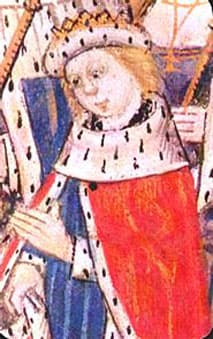
Edward V of England
Emperor · Medieval
47.5Total

Qasim Khan of Astrakhan
Emperor · Medieval
38.9Total
Basic Information
Born
1470
1480
Died
1483
1532
Era
Medieval
Medieval
Nationality
England
Astrakhan Khanate
Occupation
Emperor
Emperor
Civilization
Western
Eastern
Score Comparison
Military (10%)
16.6
21.2
Political (20%)
68.0
29.3
Influence (20%)
45.5
47.1
Legacy (20%)
37.5
35.8
Leadership (15%)
70.4
41.5
Strategy (15%)
43.0
54.8
TOTAL
47.5
38.9
Edward V of England — Complete Timeline
1483 AD
Accession to the ThronePolitical Action◆ Major
Edward V became king of England at age 12 after the death of his father, Edward IV. His reign was brief and dominated by his uncle Richard, Duke of Gloucester, who acted as Lord Protector.
SuccessionMinor KingYorkist
Impact: national
Deposition by Richard IIIPolitical Action
Edward V was declared illegitimate by Parliament under the Titulus Regius, and his uncle Richard was crowned as Richard III. Edward and his brother Richard were placed in the Tower of London, where they disappeared.
DepositionPrinces in the TowerUsurpation
Impact: nationaltragic
Disappearance of the Princes in the TowerOther◆ Major
Edward V and his brother Richard, Duke of York, vanished from the Tower of London after being declared illegitimate. Their fate remains unknown, but they are widely believed to have been murdered, likely on orders of Richard III.
MysteryMurderPrinces in the Tower
Impact: nationaltragic
Qasim Khan of Astrakhan — Complete Timeline
1520 AD
Alliance with the Crimean KhanatePolitical Action◆ Major
Qasim Khan formed an alliance with the Crimean Khanate, recognizing Crimean suzerainty in exchange for military support. This alliance shaped Astrakhan's foreign policy, aligning it with Crimea against Muscovy and the Nogai Horde.
AllianceCrimean KhanateForeign Policy
Impact: regional
1521 AD
Raid on MoscowWar◆ Major
Qasim Khan of Astrakhan joined the Crimean khan Mehmed I Giray in a raid on Moscow. The allied forces reached the outskirts of the city, forcing Grand Prince Vasily III to pay tribute and recognize Crimean suzerainty.
RaidMoscowCrimean Khanate
Impact: regional
1525 AD
Conflict with the Nogai HordeWar
Qasim Khan fought against the Nogai Horde, which was encroaching on Astrakhan's territory. The conflict ended in a stalemate, with both sides suffering heavy losses and the border remaining unchanged.
ConflictNogai HordeBorder Dispute
Expert Analysis
Origins
Edward V of England was born in 1470 to Edward IV and Elizabeth Woodville in Westminster. His childhood was marked by the instability of the Wars of the Roses; his father briefly lost the throne in 1470-71. Edward received a humanist education under scholars like John Alcock, but his formative years were dominated by court intrigues. His mother's Woodville family sought power, creating friction with the nobility.
Qasim Khan of Astrakhan was born around 1500, likely in Astrakhan, into the Aq Koyunlu dynasty. Little is known of his early life, but he was raised in a volatile region where the Astrakhan Khanate struggled to maintain independence against the Crimean Khanate, Nogai Horde, and Russia. He likely received military training and exposure to diplomacy from a young age.
Rise to Power
Edward V ascended to the throne on April 9, 1483, at age 12, following his father's sudden death. He was in Ludlow when news arrived, and his uncle Richard, Duke of Gloucester, intercepted him en route to London. Richard detained Edward's Woodville allies and placed him in the Tower of London for 'protection.' On June 22, 1483, Richard claimed Edward was illegitimate due to a precontract between Edward IV and Eleanor Butler. Parliament passed Titulus Regius, and Richard was crowned Richard III on July 6. Edward's reign lasted only 78 days.
Qasim Khan rose to power in the early 1530s, likely after the death of his predecessor. He inherited a khanate caught between the expanding Crimean Khanate and the growing power of Russia under Vasili III. To secure his position, Qasim allied with Crimea, recognizing its suzerainty by 1533. This alliance gave him military support but reduced his autonomy. His major turning point came in 1533 when he joined the Crimean khan Mehmed I Giray in a raid on Moscow, reaching the city's outskirts and forcing Grand Prince Vasili III to pay tribute.
Leadership & Governance
Edward V never truly governed. His uncle Richard controlled the regency council and the young king's person. Edward's only recorded act as king was to appoint his uncle as Protector. His leadership score of 70.4 reflects his potential rather than actual rule, based on his education and the orderly administration his father left. In contrast, Qasim Khan actively led his khanate, scoring 41.5 in leadership. He made strategic alliances, balancing between Crimea, Nogai, and Russia. He maintained Astrakhan's independence for a decade despite external pressures. However, his reliance on Crimea limited his power; he was often a junior partner in Crimean campaigns.
Triumph & Tragedy
Edward V's greatest triumph was his peaceful accession, which briefly ended dynastic conflict. His tragedy was his deposition and likely murder. He and his brother Richard vanished from the Tower in 1483, their fate unknown. The disappearance weakened the Yorkist cause and allowed Henry Tudor to seize the throne in 1485. Edward's score of 16.6 in military reflects his inability to command armies; his political score of 68.0 reflects the legitimacy he held, which Richard had to override.
Qasim Khan's triumph was the 1533 raid on Moscow, which forced tribute and demonstrated Astrakhan's military capability. His tragedy was the erosion of his khanate's independence. By 1535, internal strife and Nogai attacks weakened him. He was killed in battle against the Nogai Horde around 1536. His death ended his dynasty's rule, and Astrakhan was eventually annexed by Russia in 1556. Qasim's military score of 21.2 reflects his limited success in battle, while his strategy score of 54.8 shows his diplomatic maneuvering.
Character & Destiny
Edward V was described by contemporaries as intelligent and well-educated, but his youth and the machinations of his uncle sealed his fate. His character—passive and trusting—led him to rely on Richard, who betrayed him. Historical assessments, like those of Sir Thomas More, portray him as a victim. His destiny was shaped by the power vacuum after Edward IV's death.
Qasim Khan was pragmatic, willing to submit to Crimea to preserve his rule. His character was cautious but ultimately unable to prevent his downfall. He faced impossible choices between larger powers. His destiny was determined by geography; Astrakhan's location made it a pawn. He scored 29.3 in political acumen, reflecting his limited success in navigating these pressures.
Legacy
Edward V's legacy is tied to the mystery of the Princes in the Tower. His disappearance inspired literature and historical debate, influencing the reputation of Richard III. He scored 37.5 in legacy. His brief reign is a cautionary tale about the vulnerability of child rulers. No institutions or reforms survived him.
Qasim Khan's legacy is that of a minor ruler in a collapsing khanate. He scored 35.8 in legacy, slightly lower than Edward's. His reign is remembered in regional chronicles, but his khanate was soon absorbed by Russia. His alliance with Crimea failed to secure lasting independence. However, his resistance to the Nogai Horde delayed their expansion.
Conclusion
Edward V of England, with a total score of 47.5, had a greater impact than Qasim Khan's 38.9. Though Edward never ruled, the mystery of his disappearance shaped English history, contributing to the end of the Plantagenet dynasty and the rise of the Tudors. Qasim Khan's influence was local and temporary; his khanate vanished within two decades. Edward's higher political and leadership scores reflect his symbolic power, while Qasim's strategic score could not compensate for his weak position. Thus, Edward V's brief, tragic reign left a more enduring mark on history.
Rankings
🥇
Edward V of EnglandLeader
Mil: 16.6Pol: 68.0Inf: 45.5
47.5
🥈
Qasim Khan of Astrakhan
Mil: 21.2Pol: 29.3Inf: 47.1
38.9
+8.6 behind
How This Comparison Works
Algorithm
Each figure is scored on 6 dimensions (0—100 scale) based on structured historical data: Military (10%), Political (20%), Influence (20%), Legacy (20%), Leadership (15%), Strategy (15%). The weighted total produces the final ranking.
Data Sources
Scores are computed from structured sub-indicators in the database. Scale factors adjust for era (Ancient ×0.85, Modern ×1.0) and civilization size (Eastern ×1.05, Other ×0.80) to account for differences in population and military scale.
Maximum 3 Figures
Comparisons are limited to 2—3 figures to ensure readability and statistical meaningfulness.
Error Margins
±5 points per dimension — Sub-scores are derived from historical records with inherent uncertainty. Two figures within 5 points on a dimension should be considered roughly equivalent in that area.
Total Score Accuracy
±3 points overall — The weighted combination of 6 dimensions produces a total score with approximately ±3 points of uncertainty. Differences of less than 3 points are not statistically significant— the figures are effectively tied.
Known Limitations
- Historical records are incomplete and uneven across civilizations
- Figures from oral-tradition societies may be underrepresented
- Occupation labels can misclassify multi-role figures
- Scores measure capability and impact, not moral character
- Quantitative scoring is a comparison tool, not absolute truth
Capability Radar
Military (10%) — Battles & Warfare
Battles
8
15
Win Rate
11
10
Expansion
9
5
Political (20%) — Governance & Reform
Reform
51
10
Diplomacy
52
20
Economy
56
10
Influence (20%) — Cultural & Global Reach
Cultural
5
5
Global
5
5
Legacy (20%) — Historical Impact
Historical
15
10
Longevity
10
5
Leadership (15%) — Power & Stability
Tenure
46
20
Stability
58
10
Strategy (15%) — Tactics & Innovation
Strategy
14
10
Tactics
19
10
Reform
19
5
Similar Comparisons
Comments & Discussion
No comments yet. Be the first to share your thoughts!